MiniBax user guide
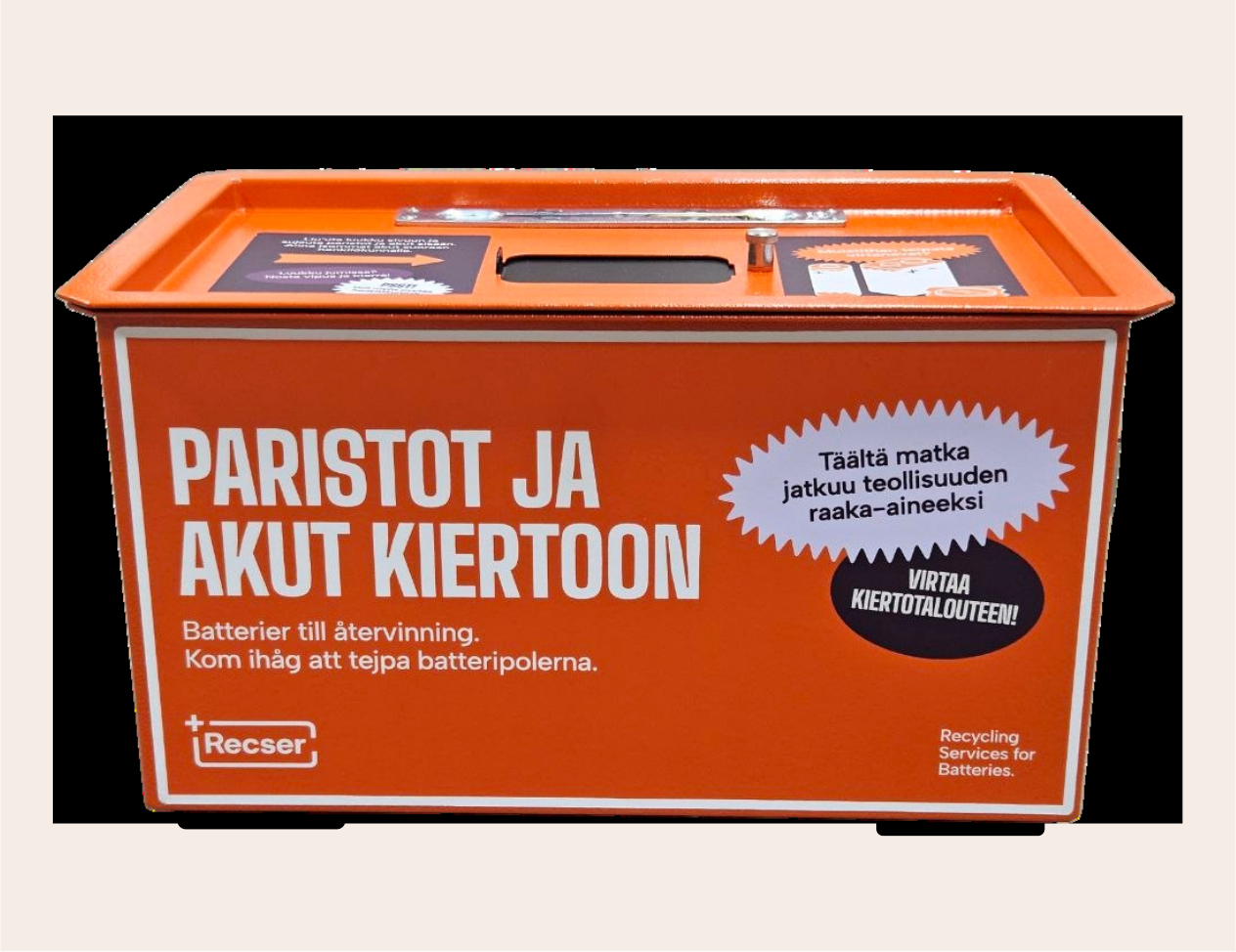
MiniBaxi is a safe container designed for the collection and transport of batteries at small collection points. The box prevents the spread of flames and sparks, thereby providing protection against fire. To allow smoke and pressure to escape, the container has vent holes fitted with flame arrestor screens.
Dimensions
base: 38 x 24 cm
height: 21.9 cm
Using the MiniBax
What types of batteries can be placed in the MiniBax?
You can put any used batteries that fit inside the MiniBax (excluding lead-acid (Pb) car starter batteries).
Opening and closing the lid’s collection slot
Unlocking
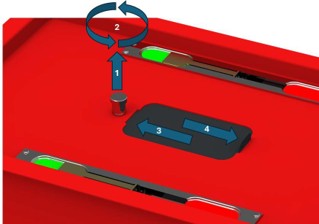
1. To fill the box, first pull the safety pin upwards.
2. When in the end position, turn the safety pin approximately 90° to the left; this locks it in the upper position and releases the sliding lid’s lock. The lid will now slide open and close automatically without any difficulty.
Keep the drawer’s sliding lid locked in this way whilst the drawer is in use.
Locking
To lock the sliding lid, turn the locking pin 90° to the right; the locking pin will then automatically return to the lower position and lock the sliding lid.
The sliding lid must be locked for transport.
If the lid does not lock, the box must not be used for transporting batteries.
Transfer any accumulated batteries to an undamaged box for transport and contact kuljetukset@recser.fi to report the faulty box.
Opening and closing the lid
The lid may be opened if a customer returns a battery larger than the hatch. Otherwise, always keep the box lid closed and locked.
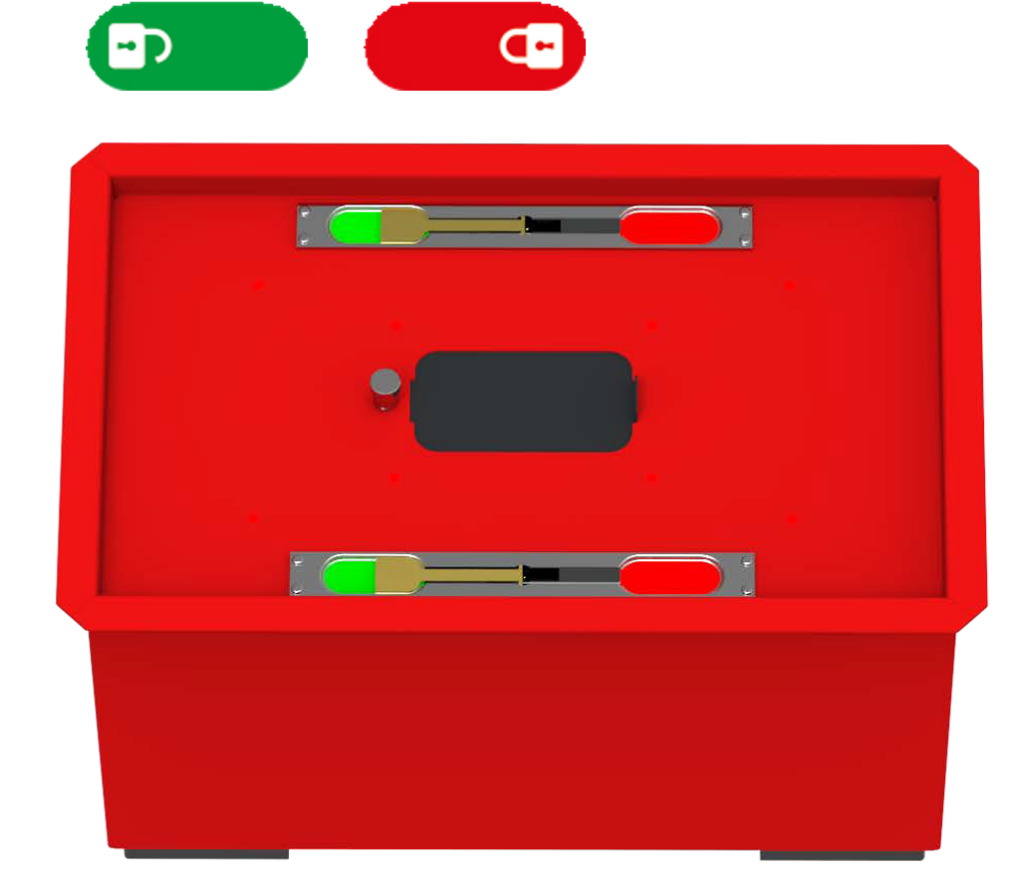
The box is fitted with a dual-lever locking system. The lid can be locked in two directions and is reversible. However, always position the lid so that the labels are easily readable by the customer. If the lock does not close properly, realign the lid or wiggle it gently.
Always ensure that both levers on the box are properly locked.
Order quantities
A maximum of three boxes can be ordered within a two-week period. If this quantity is insufficient for your collection point, please switch to a larger collection container.
Where should the MiniBaxi be placed?
Place the MiniBaxi in a supervised, dry location at room temperature, close to suitable fire-extinguishing equipment and a fire and/or smoke alarm system, so that it is easily accessible.
Place the battery compartment in a location where it cannot fall.
Place a roll of tape next to the battery box for taping the terminals of batteries.
Information materials for the collection point
Various guidance materials support the day-to-day running of the collection point and ensure a smooth returns process. You can print the materials yourself or order them from a printing company at your own expense.
Packaging of batteries
(VAK Special Provision 377, packaging method P909)
Preparing individual battery boxes for collection:
- Carry out a visual inspection of the contents of the battery box and remove any waste that does not belong there (light bulbs and other SER waste, ink cartridges, electronic cigarettes, etc.) as well as any excess rubbish. Plastic bags containing batteries may remain in the box.
- Close the lid of the box.
- Move the box to a place where the driver can easily find it.
- Note the box’s location and any other collection instructions on the order.
- Let your colleagues know that an order has been placed for the battery box. This way, others will also be able to direct the driver to the correct battery box for collection if necessary.
If the collection container is broken or otherwise unsuitable for transport, transfer the contents to an undamaged collection container or contact Recser for further instructions.
Large collection batches:
- On a pallet: If you are returning a large number of battery boxes, place them on a pallet for transport.
- Wrap the pallet in clear plastic film so that the markings on the collection containers remain visible. Do not use black or opaque film, as the markings on the boxes must be visible during transport.
Slightly swollen battery
If the battery is not warm, does not smell, make a noise, emit smoke or otherwise appear reactive:
→ pack the batteries individually in a plastic bag and place them in the Drum.
A slight bulge in a lithium-ion battery as it reaches the end of its service life is normal.
Damaged or defective lithium-ion battery weighing over 500 g
(VAK Special Provision 376, packing method P908)
A damaged battery may, for example, be dented, cracked, bent, broken, leaking or swollen. If the customer reports that the battery is dented, it shall be treated as a damaged battery.
Handle the battery as little as possible. Do not dismantle, puncture or charge it.
→ Pack each battery individually in a plastic bag and place it in a MiniBax. If damaged or defective batteries are returned infrequently, pack them on top of the load for transport. Fill any empty space in the package with vermiculite.
Reactive batteries
If a battery becomes hot, swells rapidly, hisses, crackles, emits an unusual odour or smokes, a chemical reaction may be taking place inside it.
- Do not handle the batteries unnecessarily.
- If the battery is already in the MiniBax, do not open the box.
- If the battery is not in the MiniBax, do not move it into the box if doing so poses a risk.
- Prevent others from entering the area.
Once the reaction has ceased and the battery is no longer hot or emitting smoke, allow it to cool for at least 2–3 days before packing it as normal.
If the batteries start to react again, follow the emergency procedures.
Instructions for action in an emergency
Emergencies are rare, but it is wise to be prepared for them in advance. Familiarise yourself with the instructions and ensure you know how to act in an emergency.