Instructions for use of drums
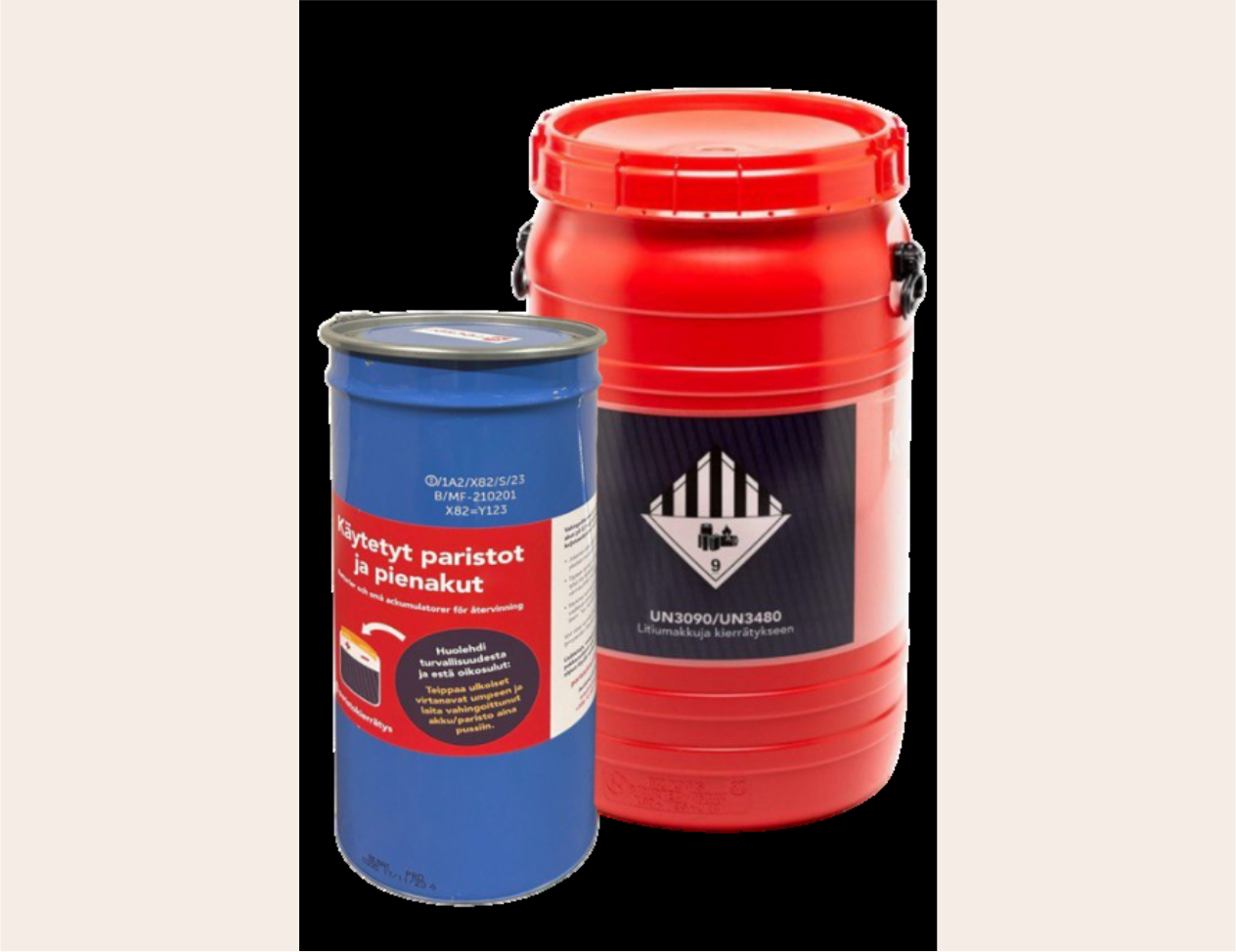
Battery drums are suitable for collection points that collect more than 150 kilograms of batteries per year or regularly collect lithium batteries weighing more than 500 grams. The suitability of battery drums for your collection point is assessed during the registration process.
Battery drums are UN-approved and bear the markings required by VAK legislation.
Dimensions
Metal Drum:
dimensions: 75 x 35 cm
opening diameter: 32.5 cm
capacity: 62 l
Plastic drum:
dimensions: 77.8 x 45.5 cm
opening diameter: 39 cm
capacity: 110 l
Plastic drums will be phased out by 2028.
Use of drums
Do you need a small or large number of drums at any one time?
When registering as a drum collection point, you can specify how many drums your site requires at any one time (1–2 drums or 2–6 drums). Metal drums are delivered individually, and they can also be collected individually, but only if the collection point has specified that it requires 1–2 drums per collection.
For collection points that have selected the option ‘2–6 drums’, the minimum collection batch is 2 drums on a pallet.
You can change your selection later by logging in to the collection order website and submitting a change request form under ‘change your details’. You log in using the ID number you received when you registered. If you have forgotten your ID number, you can request it from the Alli chatbot.
What types of batteries can be placed in the Drum?
You may pack almost all end-of-life batteries weighing less than 50 kg into the Drum, such as:
- standard portable batteries
- power tool batteries
- batteries for electric bikes and electric scooters
- lithium-ion-based starter batteries.
The following must not be placed in the Drum
Lead-based (Pb) batteries larger than portable batteries, such as vehicle starter batteries, lead-based industrial batteries and boat batteries.
→ Return to a lead-based battery collection point.
Power batteries from electric and hybrid cars, or parts removed from them.
→ Accepted at authorised car brand service centres and at Suomen Autokierrätys collection points.
Power batteries for electric motorbikes.
→ Contact the importer.
Batteries or accumulators designed for specific military purposes.
Industrial batteries weighing over 50 kg.
→ Contact Recser: info(a)recser.fi.
Collection lid for metal drums
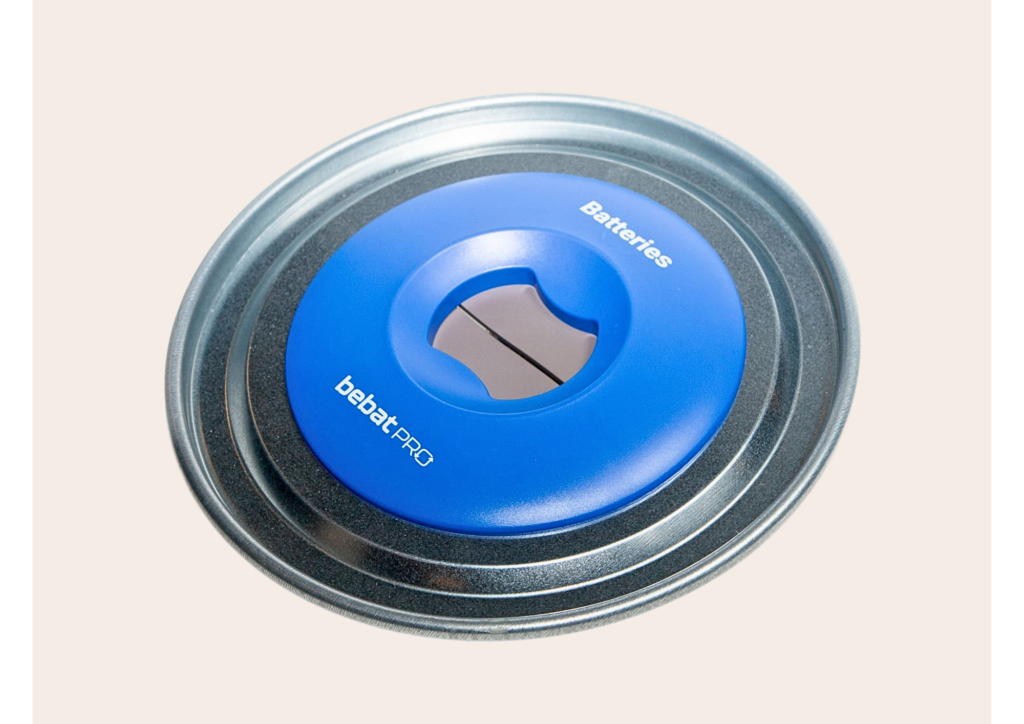
A separate collection lid is available for metal drums. The collection lid is well suited to situations where a single Drum is to be placed directly in the customer’s premises.
A collection point may order one collection lid for its use. The collection point must ensure that the lid is kept safe and that the Drum’s transport lid does not go missing whilst the collection lid is in use.
The drum’s transport lid is safer in terms of fire safety than the collection lid, which is why we recommend keeping the transport lid on the drum outside opening hours.
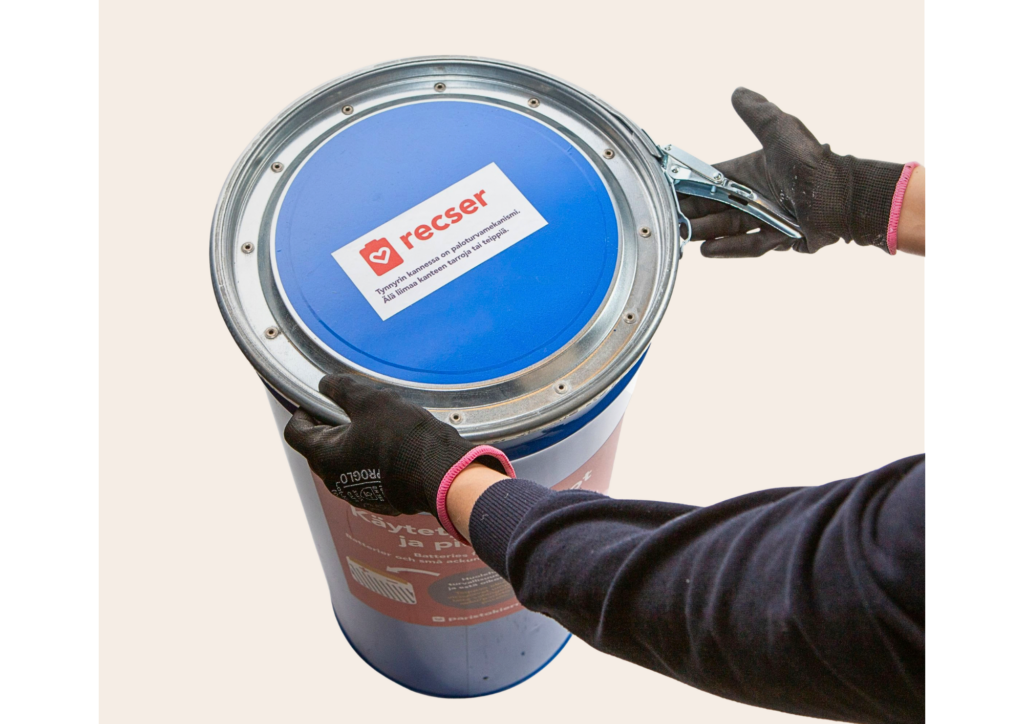
The lid of the metal drum is secured with a clamping strap.
Packaging of batteries
(VAK Special Provision 377, packing method P909)
Collection batches:
- 1 drum: blue metal drums can be collected individually. Collection is carried out using a hand truck without a pallet.
- Packing metal drums onto a pallet:
- Standard pallet = 2 Drums
- EUR pallet = 4–6 drums
- Packing plastic barrels onto a pallet:
- Standard pallet = 2 Drums
- EUR pallet = 4 drums
- FIN pallet = 5 drums
- The edges of the drums must not extend beyond the edges of the pallet.
Preparations:
- Lid: Replace the collection lid with a transport lid; drums must not be transported with the collection lid, and new collection lids cannot be ordered automatically via the system.
- Vermiculite: If there is a large number of batteries visible in the collection container, or if a large proportion of the batteries are without protective casings, you may use a suitable packing material, such as vermiculite (available to order via the ordering system). Vermiculite should be poured into the empty spaces between the batteries to prevent them from moving during transport.
- Wrapping: The drums must be wrapped together with clear cling film before collection.
- Place the consignment to be collected in a location where the driver can find it easily and it is straightforward to collect. Please specify on the order where the consignment can be found to ensure a smooth collection.
Please note:
- The driver will not accept consignments that are incorrectly or dangerously packaged.
- The driver may only accept batteries that are in a Recser Oy transport container. Additional containers, individual batteries or bags of batteries cannot be accepted as such.
- If a battery does not fit into the transport container, please contact kuljetukset@recser.fi
- If the collection container is broken or otherwise unsuitable for transport, transfer the contents to an undamaged collection container or contact Recser for instructions.
Damaged batteries
A slightly swollen battery
If the battery is not warm, does not smell, make a noise, emit smoke or otherwise appear reactive:
→ place the batteries individually in a plastic bag and place them in a Drum.
It is normal for a lithium-ion battery to swell slightly as it reaches the end of its service life.
Damaged or defective lithium-ion battery weighing over 500 g
(VAK Special Provision 376, packing method P908)
A damaged battery may, for example, be dented, cracked, bent, broken, leaking or swollen. If the customer reports that the battery is dented, it shall be treated as a damaged battery.
Handle the battery as little as possible. Do not dismantle, puncture or charge it.
→ Pack each battery individually in a plastic bag and place them in a Drum. If damaged or defective batteries are returned infrequently, pack them on top of the load for transport. Fill any empty space in the packaging with vermiculite.
Reactive batteries
If a battery becomes hot, swells rapidly, hisses, crackles, emits an unusual odour or smokes, a chemical reaction may be taking place inside it.
- Do not handle the batteries unnecessarily.
- If the battery is already in a drum, do not open the drum.
- If the battery is not in a drum, do not transfer it to a drum if doing so poses a hazard.
- Prevent others from entering the area.
Once the reaction has ceased and the battery is no longer hot or emitting smoke, allow it to cool for at least 2–3 days before packing it as normal.
If the batteries start to react again, follow the emergency procedures.
Instructions for action in emergency situations
Emergencies are rare, but it is wise to be prepared for them in advance. Familiarise yourself with the instructions and ensure you know how to act in an emergency.