Frequently Asked Questions
Here we have compiled questions and points of confusion that our customer service team regularly encounters in their work. We hope you find what you’re looking for!
Topics:
ID number
What is an ID number and what is it used for?
An ID number is a unique identification number for a collection point, which can be used to order collection bins for batteries, as well as to request the collection of full bins via our ordering system.
How do I get an ID number?
An ID number is generated when you register your collection point. If your premises are not yet registered, you can register as a collection point by following these instructions:
We already have an ID number, but I’ve forgotten it
Try our chatbot to find your ID number. Provide the name and address of your collection point and state that you are looking for your ID number, and our bot will check whether the number is in our system.
If the bot cannot find the number, you can register as a new collection point. We will process your registration manually. If we find your collection point’s ID number in our system, we will email it to you.
We already have a collection bin, but no ID number
ID numbers were introduced as part of our system upgrade. Since then, collection points have been registered in our system and assigned their own ID numbers.
You can therefore register the collection point as a new one, in which case you will receive your ID number and be able to place a collection order for your bin.
Collections and orders
Delayed collection
Your collection of batteries should arrive within 9 days of placing your order. If your collection has not arrived, please check the following:
- Did you receive an order confirmation? An order confirmation is sent to the email address provided once your collection order has been successfully placed.
- Check whether your order appears in the ‘Recent orders’ section of the ordering system.
If the order does not appear, it has not been processed by the system and you will need to place a new order.
If the order appears in the system and more than 9 days have passed since the collection date, please submit a complaint to us. You can do this on the ‘Orders’ page.
Why does collection take place within nine days of placing an order?
The reason for the nine-day response time is to minimise environmental impact. To reduce the environmental impact of transporting batteries, we optimise routes and make use of combined collections or return logistics. The smaller the carbon footprint of the collection, the greater the positive carbon footprint achieved through the recycling of battery and accumulator materials.
Is there a ‘time limit’ after which a partially filled collection box should be sent on?
Yes, there is. We recommend that the box should not be stored for longer than a year. Alkaline batteries, in particular, start to leak as they age, and storing them for too long is not good for other types of batteries either.
If you only have small quantities of batteries, you can also take the box to the nearest large collection point to have it emptied. You can find collection points at, for example: www.kierratys.info/.
I’ve accumulated a couple of plastic buckets full of batteries in my shop. How can I send them off for recycling?
Batteries are subject to legislation on the transport of dangerous goods, which means they may only be transported in packaging that complies with legal requirements and bears the necessary markings. You can order transport boxes and arrange for them to be collected free of charge from Recser Oy. See here for further information.
Collection point details
Changes to collection point details / closing a collection point
You can easily update collection point details in our ordering system. Log in using the collection point’s ID number and click on ‘update your details’.
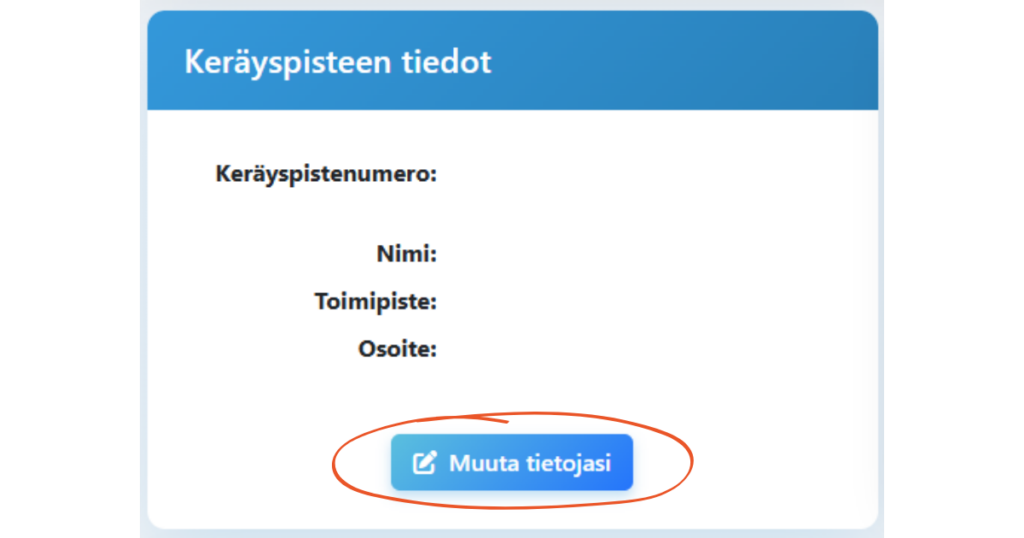
You will be presented with a form where you can notify us of the closure of the collection point, change the address details or the collection method, and specify what you accept.
Every notification submitted via the form is processed manually within a few working days. A notification will be sent to the email address provided on the form once the change request has been processed.
Storage of collection point contact details
Collection point details are displayed directly in our ordering system. We do not retain the contact details of those placing orders for any longer than is necessary to fulfil the order. However, the email address added to the order will be added to the mailing list for collection point updates, so please use the collection point’s general email address or work email address when placing orders.
Registration: When you register, we ask for your contact details so that we can send you your ID number, but this information is not stored for future use.
Orders: We store the contact details of the person who placed the most recent order in our transport information system until the details of the next customer replace those of the previous one.
Newsletters: We send our collection point newsletters to the email addresses used for orders. We recommend using the collection point’s general email address when placing an order. You can add the necessary email addresses to our mailing list under ‘News’. You can unsubscribe from the newsletter directly via the newsletter itself or by contacting us by email. However, the newsletter is essential if your premises operate as a collection point.
You can view our detailed privacy policy here:
Collection equipment
Is there a charge for the collection box or for its collection from the collection point?
Batteries fall under producer responsibility legislation, which means that the importer is responsible for collecting batteries collected by distributors and other outlets at their own expense. We also do not charge collection points for the transport boxes supplied for packaging purposes.
In practice, the producer passes on the costs of organising waste management via the price of the battery or rechargeable battery all the way to the end user. The end user has the right to return a used product easily and free of charge to an organised collection point.
Do the batteries to be returned need to be small enough to fit through the hatch of the collection box?
The size of the transport box’s opening has been designed so that batteries of approximately the correct size will fit through it. Slightly larger accumulators can also be placed in the transport box, but lithium accumulators weighing over 0.5 kg require more robust transport packaging.
Many power tool batteries are now lithium batteries, which, unlike other types of battery, can even ignite spontaneously as a result of the so-called thermal runaway effect. Factors that can trigger thermal runaway include physical damage and external short circuits.
The fire risk is linked to the high energy density of lithium-ion batteries and their highly flammable electrolyte. Furthermore, these batteries never discharge completely; some energy remains in the battery even when it appears to be empty or non-functional. Lithium batteries weighing over 0.5 kg should therefore be transported in Recser Oy’s red VAK-approved battery drums.
Is it possible to purchase a metal rack for the transport box?
Yes. A metal rack to go under the collection box is a good purchase for a collection point. One such option can be viewed on our website: www.paristokierratys.fi/kerayspisteille/taydentavia-keraysvalineita/
Is it possible to order more empty collection boxes than there are to be returned?
Yes. When booking a full collection, you can order more empty boxes than the number being collected from you. Please remember to mention to the customer service representative that you would like more boxes delivered if you are placing your order by telephone.
Safety and packing
Where should the collection point for batteries be located?
Place the battery collection container in a supervised, dry location at room temperature, close to suitable fire-extinguishing equipment and a fire and/or smoke alarm system.
What safety considerations should be taken into account at the collection point?
In addition to positioning the collection container correctly, please bear in mind the following instructions:
- Display the return instructions and ensure that they can be followed.
- Place a roll of tape next to the collection bin for taping over the terminals of batteries.
- Check regularly that there are no foreign objects or rubbish in the collection bin and that, in particular, the terminals of lithium batteries have been taped over to prevent short circuits.
I would like more information or materials to support battery recycling. What should I do?
You can find ready-made guidance materials for both collection point staff and those returning batteries here. We’d be happy to receive any suggestions for improvements or other enquiries: info(a)recser.fi.
Why must all batteries be correctly packaged and placed in the designated transport containers?
This is because batteries are classified as hazardous waste. During transport, hazardous waste must be marked with specific transport labels and packed correctly. Recser Oy’s transport boxes and drums meet the requirements of the VAK legislation in terms of their characteristics and labelling.
On our online training page, you will find the latest guidelines on the classification and packaging of batteries. Request a password to access the materials at info(a)recser.fi.
Do I need to check that all batteries being returned are taped up?
It would be advisable to check all batteries to be returned, but we do realise that this is practically impossible. We therefore urge you to inform customers of the importance of taping batteries and to provide a facility for taping them at the collection point.
However, even returning batteries in a simple plastic bag is better than returning them without any protection at all. A plastic bag also provides some protection when a large number of batteries are carried together, thereby reducing the risk of a short circuit.
We do not recommend returning batteries in a glass jar or any other container. A glass container can pose a hazard to staff at the sorting centre when the batteries are tipped out for sorting and the staff member is unaware that there is glass amongst the batteries. As an exception to this, small hearing aid batteries may be returned to the collection bin in their original sales packaging, as the design of the packaging itself prevents the batteries from coming into contact with one another.
Obligation to accept returns
I sell batteries; do I have to accept used batteries at my point of sale?
Yes, under the Waste Act, every point of sale for batteries must accept used batteries from end-users without requiring the purchase of a new product and free of charge.
Have you tried our chatbot?
If you can’t find the answer, our chatbot at the bottom of the page might be able to help you.
Couldn’t find what you were looking for?
If you couldn’t find the answer in the FAQs and our chatbot can’t help you either, please contact us directly!
Contact details