Baxi600 user manual
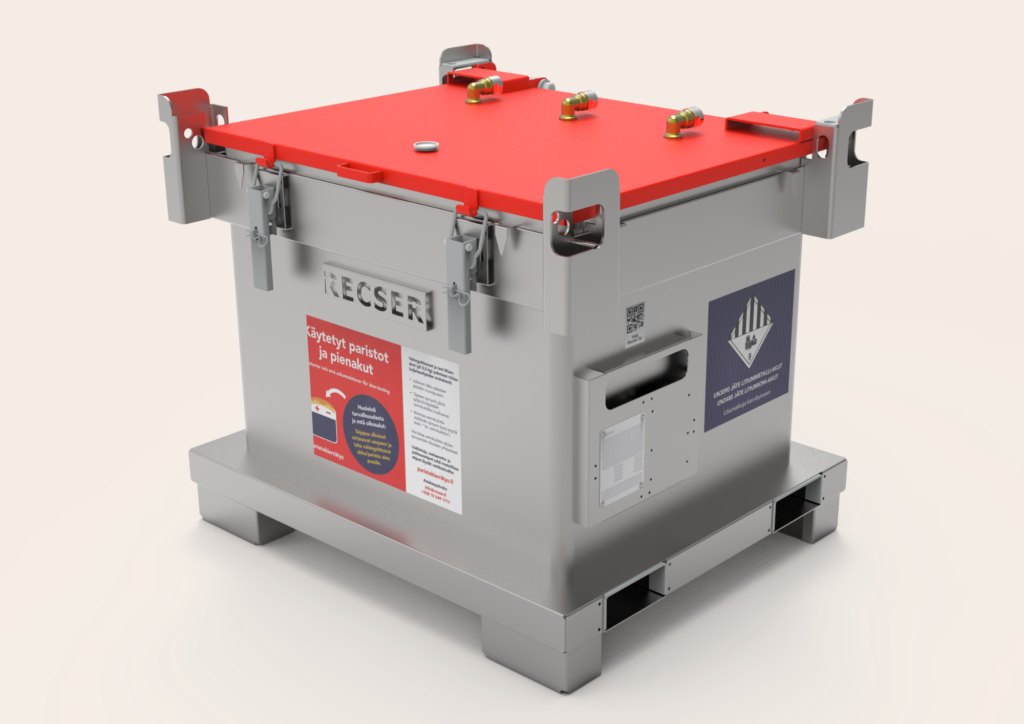
Baxi is a safe and efficient solution for the collection and transport of larger quantities of batteries. Baxi is particularly suitable for local collection points, large retail collection points and companies that handle large quantities of batteries for light mobility aids.
Dimensions
base: 100 x 120 cm
height: 102.5 cm
capacity: 600 litres
Using the Bax
What types of batteries can be packed in the Bax?
You can pack almost all end-of-life batteries weighing less than 50 kg into Bax, such as:
- standard portable batteries and batteries
- power tool batteries
- batteries for electric bikes and electric scooters
- lithium-ion-based starter batteries.
The following must not be placed in Baxi
Lead-based (Pb) batteries larger than portable batteries, such as vehicle starter batteries, lead-based industrial batteries and boat batteries.
→ Return to a lead-based battery collection point.
Power batteries from electric and hybrid cars, or parts dismantled from them.
→ Accepted at authorised car brand service centres and at Suomen Autokierrätys collection points.
Power batteries for electric motorbikes.
→ Contact the importer.
Batteries or accumulators designed for specific military purposes.
Industrial batteries weighing over 50 kg.
→ Contact Recser: info(a)recser.fi.
Do not overfill
The Baxi is suitably full when it is about two-thirds full. Do not overfill the Baxi!
Keep the lid closed whenever possible
The Baxi lid must be kept closed whenever possible. The lid is locked on both sides with locking latches.
The lid’s pressure-equalisation system keeps flames and sparks inside whilst allowing smoke and pressure to escape.
How should the Baxi be positioned?
Shops: The Baxi should be placed in the stockroom or at the back of the shop. The collection bin in the customer area is emptied into the Baxi. The lid is kept closed.
Waste management facilities: The Baxi can be placed in the customer area and the lid kept open during customer service hours. The lid is closed before the area is locked up.
The Baxi should preferably be placed in a covered area near fire alarms. Staff must provide guidance on and supervise its use.
How should the Baxi be moved?
By forklift: Only lift the Baxi from the openings on the sides designated for forklift tines! Do not lift the Baxi from the front or rear edges.
With a hand truck: The Baxi can be moved from any direction, provided it is securely positioned on the prongs of the hand truck.
Packing the batteries
The Baxi600 box is considered full and ready for dispatch when it is approximately two-thirds full. The box should not be packed to its absolute capacity.
- Check the contents of the box superficially and remove any foreign waste and excess rubbish.
- If the box contains large batteries that are not visible at first glance, write a note on a piece of paper, for example: “ATTENTION! Large batteries!” and place the paper on top of the box. Also, write in the ‘Additional order details’ field that the container contains large batteries (batteries weighing over 12 kg). At the processing plant, the boxes are tipped onto the sorting line and large batteries can cause hazardous situations.
- Vermiculite: If there is a large number of batteries in the collection container, or if a large proportion of the batteries are without protective casings, you can use a suitable packing material, vermiculite (available to order via the ordering system). Vermiculite is poured into the empty spaces between the batteries, preventing them from moving during transport.
Close the lid of the box before collection.
- Handling: The Baxi600 is moved using a forklift or a hand truck. The box can be lifted by a forklift from the points marked on its sides. The box must not be lifted by a forklift from the front edge, but it can be moved using a hand truck from either side.
- Place the consignment to be collected in a location where the driver can find it easily and it is straightforward to collect. Please specify on the order where the consignment can be found to ensure a smooth collection.
If the collection container is broken or otherwise unsuitable for transport, transfer the contents to an undamaged collection container or contact Recser for instructions.
Damaged batteries
A slightly bulging battery
If the battery is not warm, does not smell, make a noise, emit smoke or otherwise appear reactive:
→ pack the batteries individually in a plastic bag and place them in a Bax container.
It is normal for a lithium-ion battery to swell slightly as it reaches the end of its service life.
Damaged or defective lithium-ion battery weighing over 500 g
(ADR Special Provision 376, packaging method P908)
A damaged battery may, for example, be dented, cracked, bent, broken, leaking or swollen. If the customer reports that the battery is dented, it shall be treated as a damaged battery.
Handle the battery as little as possible. Do not dismantle, puncture or charge it.
→ Pack each battery individually in a plastic bag and place it in a Bax box. If damaged or defective batteries are returned infrequently, pack them on top of the load for transport. Fill any empty space in the package with vermiculite.
Reactive batteries
If a battery becomes hot, swells rapidly, hisses, crackles, emits an unusual odour or smokes, a chemical reaction may be taking place inside it.
- Do not handle the batteries unnecessarily.
- If the batteries are already in Bax, do not open the box.
- If the battery is not in the Bax, do not move it into the Bax if doing so poses a risk.
- Prevent others from entering the area.
Once the reaction has ceased and the battery is no longer hot or emitting smoke, allow it to cool for at least 2–3 days before packing it as normal.
If the batteries start to react again, follow the emergency procedures.
Instructions for action in emergency situations
Emergencies are rare, but it is wise to be prepared for them in advance. Familiarise yourself with the instructions and ensure you know how to act in an emergency.