The parliament adopted the new Battery Regulation on 14 June 2023—what next?
The European Parliament adopted the EU’s Battery Regulation, which was prepared for already a couple of years, with the overwhelming majority voting for it. After the final vote by the plenary meeting, the Council of the European Union must adopt the text officially, which is expected to take place in a meeting on July 10.
The adoption of the final results of the negotiations was supported by 587 representatives of the Parliament. Only 9 representatives voted against it, with 20 representatives abstaining. The regulation will enter into force 20 days after it has been published in the Official Journal of the EU. It is directly applicable in all Member States six months from its entry into force unless decreed otherwise by transitional provisions.
“All operators face new requirements that must be met quickly throughout the life cycles of batteries, so now is high time to roll up your sleeves and find out which requirements apply to your company. First and foremost, the regulation provides responsible operators with a variety of opportunities,” says Recser Oy’s Managing Director Liisa-Marie Stenbäck.
Key measures provided for in the regulation:
The regulation pertains to all batteries, which will be divided into five categories in the future:
1. Portable batteries
2. Batteries for light means of transport (LMT), including, for example, electric bikes and electric scooters
3. Electric vehicle (EV) batteries
4. Industrial batteries
5. Starting, lighting and ignition (SLI) batteries
New CE marking and QR code requirements as well as requirements concerning safety, durability and performance for all batteries released to the EU market
Clearer provisions regarding the reuse, remanufacturing and repurposing of batteries
Mandatory carbon footprint declaration and label for EV and LMT batteries as well as rechargeable industrial batteries with a capacity of more than 2 kWh
Requirement to design battery-powered devices so that the battery can be removed and replaced easily (portable and LMT batteries)
Digital Battery Passport for LMT batteries, industrial batteries with a capacity of more than 2 kWh and EV batteries
Due diligence policy for processing social and environmental risks
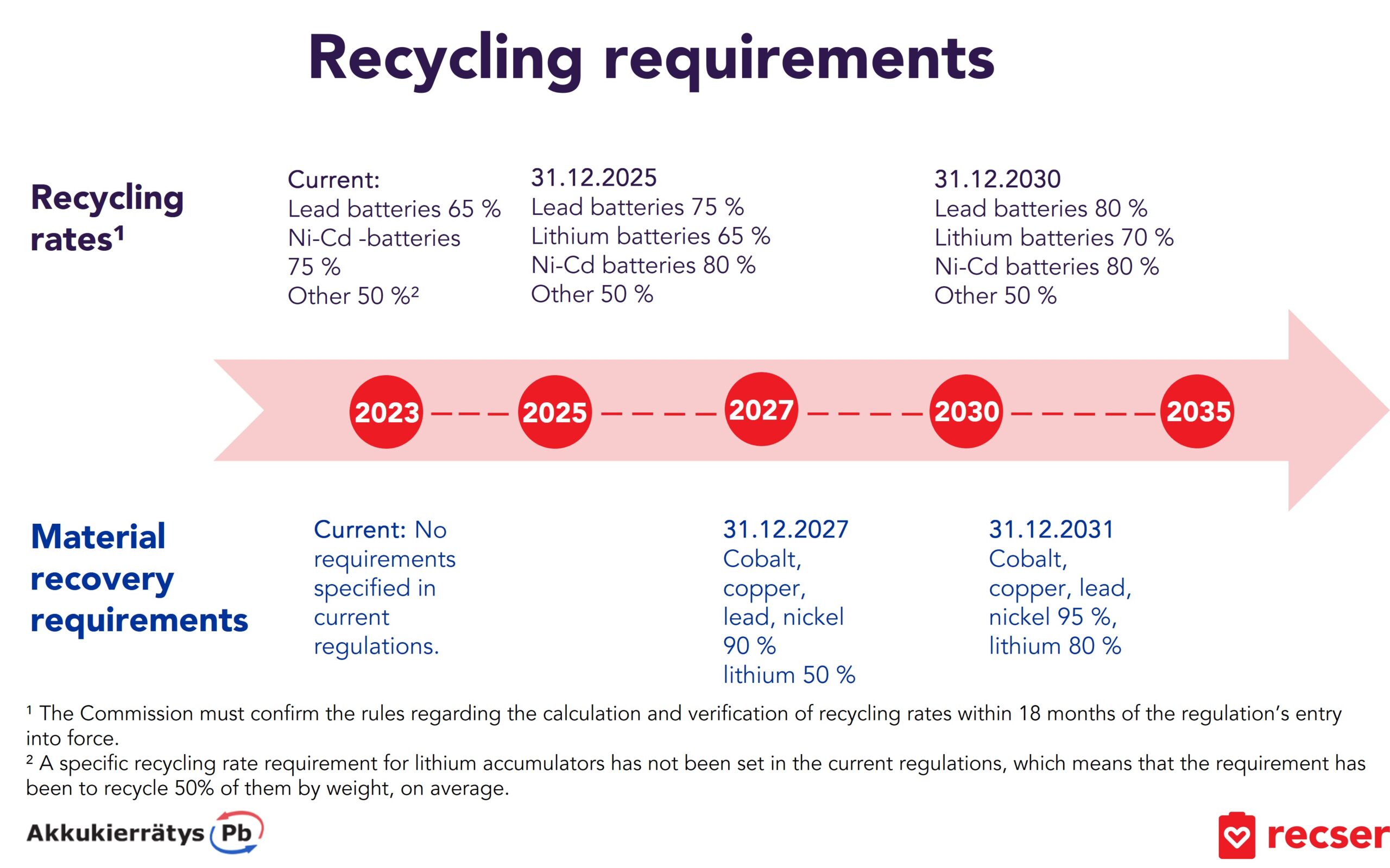
Stricter battery collection targets: collection rate of 45% by 2023, 63% by 2027 and 73% by 2030 regarding portable batteries. First collection targets specifically set for LMT batteries: 51% by 2028 and 61% by 2031
Specific recycling targets for the materials of the batteries: lithium 50% by 2027 and 80% by 2031, cobalt, copper, lead and nickel 90% by 2027 and 95% by 2031
Blending obligation, i.e. the requirement to use recycled raw materials in new batteries will enter into force eight years from the entry into force of the regulation. After this, new batteries must include the following amounts of recycled raw materials: 16% for cobalt, 85% for lead, 6% for lithium and 6% for nickel. 13 years after the entry into force of the regulation, the levels required increase as follows: 26% for cobalt, 85% for lead, 12% for lithium and 15% for nickel.
EU’s Green Deal provides impetus
The new Battery Regulation will cover the entire life cycle of batteries from the mining of raw materials to the end of their service life for the first time while taking into account the technological development of batteries and future challenges of the industry. As transport becomes increasingly powered by electricity and the portion of renewable energy rises, new solutions regarding batteries are needed and the aim of the new regulations is to ensure that the demand can be met with more environmentally friendly batteries made sustainably from recycled materials. Consequently, the regulation can improve Europe’s energy security, promote the green transition in line with EU’s Green Deal and develop the circular economy of batteries.
“As producer organisations, we want to actively support our members and other stakeholders in complying with the new requirements in practice. If you haven’t subscribed to our newsletter, now is the time to do so as we will provide information about future events and useful materials that will help understand the content of the regulation,” says Akkukierrätys Pb Oy’s Managing Director Johanna Alakerttula.
The text adopted by the Parliament is available here in Finnish and here in English.
Liisa-Marie Stenbäck is the Managing Director of the producer organisation Recser Oy, who coordinate the Paristokierrätys battery collection system.Johanna Alakerttula is the Managing Director of Akkukierrätys Pb Oy, a producer organisation in charge producer responsibility related to lead-acid batteries.
Report: Metals recovered from recycled batteries save up to 98% in emissions compared to virgin mining
According to a report we commissioned, the recycling of raw materials used in batteries provides significant climate benefits.
Based on a recent study commissioned by Recser, the production of these recycled raw materials generates 50–98 per cent fewer emissions compared to virgin metals, which require mining and consume a considerable amount of energy.
The study was carried out by Lassila & Tikanoja in February 2023.
Recycling is definitely an action for the climate
Recycled materials replace virgin materials. When comparing the emissions of virgin materials to the emissions of recycled materials, we can determine how much greenhouse gas emissions are reduced through the production of recycled materials.
Traditional alkaline batteries can be recycled to recover valuable materials, such as zinc and iron in particular. The climate impact of recycled zinc is 50 per cent lower and that of recycled iron 85 per cent lower than their respective virgin counterparts, obtained through mining.
Important battery metals include cobalt, nickel and copper, in particular, and they are subject to a so-called recovery obligation under the upcoming EU Battery Regulation. In practice, this means that the majority of these valuable battery metals must be recovered as recycled raw materials from the batteries that are returned for recycling.
Recycling is definitely an action for the climate since e.g. the production of recycled nickel only causes 2 per cent and the production of recycled cobalt 41 per cent of the carbon emissions compared to their virgin production counterparts.
‘Circular economy solutions are effective in combating climate change. The study conducted for Recser demonstrates that recycling is indeed an action for the climate. It has been great to assist Recser in its sustainability efforts and identify areas in its operations where it can further focus on positive environmental impacts,’ says Senior Environmental Responsibility Specialist Antti Pitkämäki from Lassila & Tikanoja.
The climate impacts of recycled and virgin battery metals
Background of the study
In a study conducted by Lassila & Tikanoja, climate benefit coefficients were determined for seven metals obtained through the recycling of batteries. These coefficients illustrate the reduction of emissions compared to primary production when one tonne of metal is recycled.
The coefficients were determined based on scientific literature, and they took into account the emissions from the entire value chain of metal production, starting from mining.
Based on the literature, the best source for the coefficients was an article from 2018 [1], which assessed the environmental impacts of the demand for seven metals until 2050 under different scenarios, with recycling in mind. The coefficients for Recser were formed based on the raw data of this article by using the average metal-specific emissions in the analysed scenarios for the year 2025 (separating primary and secondary production, with the difference representing the emission reduction achieved through recycling). The article did not contain information on cobalt. Instead, another reliable source was found for cobalt, which similarly considered the entire production chain [2].
[1] Van Der Voet, E., Van Oers, L., Verboon, M. ja Kuipers K. 2018. Environmental Implications of Future Demand Scenarios for Metals: Methodology and Application to the Case of Seven Major Metals. Journal of Industrial Ecology 23 (1), 141 155. [2] Rahimpour Golroudbary , S., Farfan , J., Lohrmann , A. ja Kraslawski , A. 2022. Environmental benefits of circular economy approach to use of cobalt. Global Environmental Change 76.
Akkukierrätys Pb and Recser are building a one-stop-shop reporting system with Elker
The aim is for all imported batteries and electrical and electronic equipment to be reported via the same system, regardless of the producer organisation. This will facilitate the work of producers.
Producer responsibility applies to all batteries placed on the Finnish market, regardless of whether they have been imported as separate batteries or as part of a device or machine. Therefore, it is important to examine the fulfilment of producer responsibility for batteries from a broader perspective than a single producer organisation.
Companies that have transferred their producer responsibility to Akkukierrätys Pb or Recser can now conveniently take care of their producer responsibility and the reporting of products they place on the market through a one-stop-shop system. Traditionally, each producer organisation has had a separate reporting system, but the new model allows companies to report almost all of the batteries they import, regardless of the producer organisation.
Producers who have joined a producer organisation for waste electrical and electronic equipment (WEEE) can also use the same reporting system to report the imported volumes of all electrical and electronic equipment. Companies can join a WEEE producer organisation via the service company Elker, which manages the reporting system.
One producer can belong to several producer organisations
Companies that import or manufacture products subject to producer responsibility must join one or more producer organisations to fulfil their producer responsibilities. Producer organisations are always only responsible for providing waste management for certain products; for example, a WEEE producer organisation is responsible for the collection and recycling of waste electrical and electronic equipment, while a battery producer organisation is responsible for the collection and recycling of certain types of batteries.
For instance, if a company imports electric modes of transport, such as electric bikes, it must take care of its producer responsibility both via a WEEE producer organisation and the battery producer organisation Recser. This also applies to other companies that import laptops, phones or other electrical and electronic equipment containing batteries.
A company that only imports starter batteries or industrial lead-acid batteries can take care of its producer responsibility by joining the lead-acid battery producer organisation Akkukierrätys Pb. In contrast, vehicle importers are subject to several producer responsibilities; in other words, they must take care of their producer responsibility for the vehicle, starter batteries, electric vehicle batteries, tyres and the electrical and electronic equipment and small batteries contained by the vehicle.
The one-stop-shop principle facilitates the reporting of battery volumes
Akkukierrätys Pb Oy and Recser Oy are producer organisations established by battery importers. They are tasked with taking care of the collection and recycling of the battery types under their responsibility. The service company Elker Oy is owned by the WEEE producer organisations SELT ry, ICT Producer Co-operative and FLIP ry.
Akkukierrätys Pb Oy and Recser Oy in collaboration with Elker Oy are developing a joint reporting system that will allow batteries and electrical and electronic equipment to be reported based on the one-stop-shop principle. The aim of this joint reporting system is to facilitate the reporting work of producers and help them take care of their producer responsibilities sustainably.
There are a total of four battery producer organisations and five WEEE producer organisations in Finland.
Celltech believes that the EU’s Batteries Regulation will boost the competitiveness of responsible suppliers – “By taking care of our responsibility obligations, we increase customer loyalty”
Commitment to responsibility obligations can improve the company’s reputation and increase the innovativeness of the battery market while simultaneously reducing the negative environmental impact – these are just some of the positive aspects of the EU’s Batteries Regulation that are mentioned by Managing Director of Celltech Anders Blomqvist.
“By taking care of our responsibility obligations, we increase customer loyalty. This also brings business profits,” says Blomqvist.
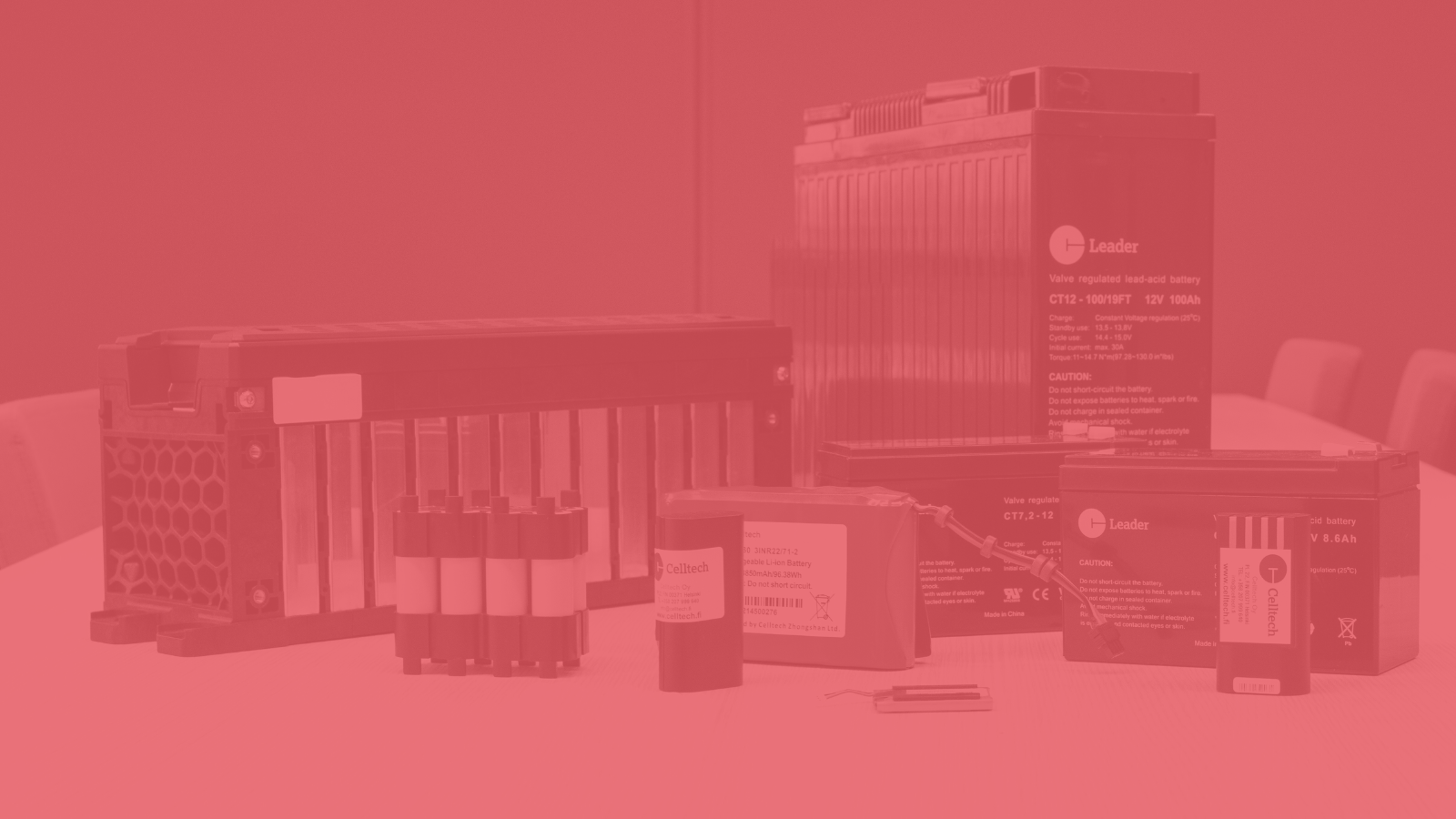
Celltech is a designer and manufacturer of battery systems and an importer of standard and special batteries. Celltech is a leading operator in this field in Finland. From its position at the forefront of the industry, the company has long followed the progress of the Batteries Regulation and taken on an active role in communicating the changes to others.
The EU’s Batteries Regulation, which is expected to be officially approved this summer, will introduce new requirements for all phases of the production and use of batteries as well as their recycling and entire lifecycle. The new requirements are based on the European Green Deal. Its aim is to conserve natural resources, prevent severe environmental and human rights issues and improve the service life, quality and safety of products.
For producers, the new legal provisions will introduce new obligations, such as CE markings, QR codes, transparent supply chains and stricter collection and recycling requirements. Compliance with these obligations will bring both challenges and opportunities.
Besides manufacturers and importers, the stricter requirements will also apply to companies that import batteries for their own use or as part of the products they offer. According to Celltech, this may lead to some companies discontinuing the import of batteries to Finland because then they are not required to carry out responsible supply chain monitoring, for example. Nevertheless, Blomqvist believes that the changes will be beneficial in many ways.
“In the future, the regulation will prevent poor-quality batteries from entering the EU, which will also benefit all consumers.”
The goal is to reduce negative environmental impacts
According to Blomqvist, one of the most important positive aspects of the EU’s Batteries Regulation is that it will reduce negative environmental impacts. The Batteries Regulation takes into account the importance of a closed recycling system.
“Through the new Batteries Regulation, the EU seeks to further increase the recycling rate. Both the collection targets and material recovery targets will be increased,” Blomqvist says.
“The aim is to process battery minerals, such as cobalt and lithium, for reuse instead of continuously mining and consuming more virgin raw materials.”
In addition to recycling materials, another purpose of the new rules laid down by the regulation is to promote the reuse and reconditioning of batteries. For example, a battery installed in a personal vehicle that no longer meets the power or performance requirements for its original purpose of use can be utilised in second-life energy storage for a solar panel system.
We will take into account the importance of the second life concept and pursue a higher recycling rate.
The changes will boost technological development
As the Eldorado of the battery industry, Finland boasts a high level of general expertise in minerals and their processing. Finland increasingly emphasises the need for efficient recycling, and several companies are actively researching methods to implement it. One superb example mentioned by Blomqvist is the Finnish company Tracegrow Oy, which manufactures fertilisers from old, crushed alkaline batteries.
Although research and development is continuously being carried out to develop more sustainable and recyclable batteries, a fully renewable battery material is not yet available – not in Finland or anywhere else in the world.
“It’s apparent that even though we are seeking new, alternative battery technologies, traditional lithium-ion batteries will continue to dominate as an energy storage solution for a long time to come,” Blomqvist predicts.
Preparations are also being made for social risks
The procurement of the materials required for lithium-ion batteries involves its own challenges, however. For example, human rights violations, such as the use of child labour, have been identified in cobalt mining in the Democratic Republic of the Congo.
“According to EU authorities, we must all identify the specific mine, enrichment plant and smelting plant from which the battery minerals used in our products originate. This poses a major challenge, as it takes time and resources, but it’s also necessary to promote the wellbeing of humanity,” says Blomqvist.
With the entry into force of the new regulation, distributors will also become obligated to conduct an ethical assessment of their entire raw material production chain. The purpose of this is to ensure that each of the parties involved in the market take due account of human rights.
In the future, the obligations concerning the responsible production chain will also apply to smaller batteries instead of being limited solely to large industrial batteries or energy storage for electric vehicles. However, the legal provisions will not be applied to importers with an annual turnover below EUR 40 million.
“We hope that all operators, regardless of their due diligence responsibility, recognise the importance of ethical conduct and make well-thought-out decisions when concluding international agreements,” says Blomqvist.
Due diligence takes time and resources, but it’s also necessary to promote the wellbeing of humanity.
“We believe that informed customers will buy batteries from responsible suppliers in the future.”
It is also important to note that the significance of the origin of minerals has been highlighted in public procurements. The winner is no longer solely the tenderer that offers the lowest price but the tenderer that takes its environmental and social obligations seriously.
Growing role of producer organisations
In light of the EU’s new regulation, Blomqvist emphasises the growing role of producer organisations, as it may be difficult for individual battery importers to meet the requirements imposed on them alone.
“To ensure the success of our business, I believe that it’s now more important than ever to have a functional producer organisation that builds the collection network and takes care of recycling on our behalf,” says Blomqvist.
We need a functional producer organisation that will build the collection network and take care of recycling on our behalf.
“Producer responsibility has covered industrial batteries for a long time. However, we’ve been able to conclude a separate agreement with the customer regarding the costs of their recycling when the matter has become relevant. In the future, we’ll be required to provide this price tag in advance.”
Blomqvist hopes that the EU’s upcoming Batteries Regulation will serve as an incentive for the development of the existing recycling methods for batteries. For the time being, there are no recycling services available in Europe for batteries such as low-cobalt lithium iron phosphate batteries, which are becoming more common in large modes of transport and energy storage.
Managing Director of Celltech Anders Blomqvist believes that the EU’s new Batteries Regulation will boost the competitiveness of responsible suppliers.
Photos: Celltech Oy
This article is a part of the joint communications of the battery and accumulator producer organisations Recser Oy and Akkukierrätys Pb Oy concerning the EU Batteries Regulation. You can also subscribe to our newsletter to receive the latest news on the subject.
Remanufacturing prolongs the service life of batteries
Reuse and remanufacturing of batteries improves the availability of battery materials. The Electrical Fingerprint method developed by CeLLife Technologies is able to quickly tell which battery cells and modules can be used for remanufacturing.
The purpose of the EU’s new Batteries Regulation is to promote the battery value chain, which would cover the entire life cycle of batteries from raw materials to the production of battery cells as well as the reuse and recycling of batteries. What plays a key role in the new regulation is the procurement of raw materials for batteries as sustainably as possible and the precise utilisation of these raw materials.
The life cycle of batteries can be prolonged in many ways. The new Batteries Regulation takes more account of the reuse and remanufacturing of electric vehicle batteries and industrial batteries as well as the change in the purpose of use of batteries.
The preparation of batteries for reuse refers to full or partial reuse of the battery for its original purpose of use. If the battery can no longer be used for the same purpose, it may be possible to change its purpose of use. For example, electric vehicle batteries at the end of their service life can still be used for energy storage.
Used batteries may also go through remanufacturing. In remanufacturing, the discarded battery is dismantled into battery cells or modules, from which suitable components are selected for further use. The saved battery cells and modules can then be used to build a new battery with at least 90 per cent of the original capacity. As a result, the producer responsibility for these batteries is transferred to the party that places the battery back on the market.
Tool for quick condition analysis
Before initiating remanufacturing, the remanufacturer must find out which components of the used battery are still usable. The Electrical Fingerprint method developed by CeLLife Technologies Oy allows poor and hazardous batteries to be identified from among useable battery cells and modules.
This is important, as even a single poor battery cell can make the entire battery unusable, explain the founders of CeLLife Technologies Tuomas Messo and Roni Luhtala.
“The method helps select only the working and mutually compatible batteries for reuse. Selecting battery cells that are similar in condition ensures that the battery package is as good as new in terms of the performance and service life.”
Under the Batteries Regulation, operators that remanufacture batteries are obligated to ensure the quality and safety of the batteries and take care of their safe testing, packaging and transport. They must also ensure that the remanufactured battery complies with legislation and technical requirements when placed on the market.
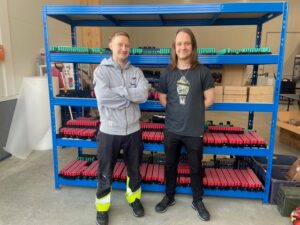
Founders of CeLLife Technologies Tuomas Messo and Roni Luhtala.
Reuse reduces the carbon footprint
The carbon footprint of a remanufactured battery is only a fraction of the carbon footprint of a battery made of virgin materials. In practice, the carbon footprint of a reused battery only comprises encapsulation, connectors, the thermal management system and electronics. Some of these components could also still be reused, further reducing the carbon footprint, remark Messo and Luhtala.
There are strong incentives for the reuse of batteries from both environmental and economic perspectives. More than half of the battery cells that currently end up being crushed could still be reused in the energy reserves of the electric grid or the charging stations of electric cars, for example, state Messo and Luhtala.
“There is no sense in crushing fully usable battery cells. The availability of materials and components has decreased in recent years, and their production is strongly concentrated outside of Europe.”
The sector hopes that the new Batteries Regulation will facilitate the reuse and remanufacturing of batteries as well as changing their purpose of use. At least the Battery Passport introduced by the regulation includes more precise labelling requirements, which increases the transparency of battery operators.
“The data contained in the Battery Passport on the raw materials used for the battery and the quantities describing the battery’s performance will facilitate the assessment of the potential for reuse,” explain Tuomas Messo and Roni Luhtala.
This article is a part of the joint communications of the battery and accumulator producer organisations Recser Oy and Akkukierrätys Pb Oy concerning the EU Batteries Regulation. You can also subscribe to our newsletter to receive the latest news on the subject.
Batteries Regulation promotes responsibility in car industry: ‘environmental debate on cars easy to start from batteries’
The electrification of transport and environmental friendliness of batteries is a hot topic amongst car manufacturers and consumers, but Toyota wants to tackle the carbon challenge more holistically. ‘The Batteries Regulation, entering into force in June, is one of the things that affect the car industry’s responsibility trends,’ says Pekka Karvinen from Toyota Auto Finland.
The European Union is adopting a new Batteries Regulation, which will harmonise the regulations on the entire lifecycle of batteries across the EU. The legislation will also finally include requirements on product design, the end users’ role and promotion of recycled raw material markets.
Toyota Auto Finland’s Communications Manager Pekka Karvinen believes that the new Batteries Regulation will help the car industry work towards circular economy and responsibility. The importer’s parent company that represents Toyota and Lexus, Toyota Motor Europe, has taken part in preparing the EU regulation through communities that look after the interests of the industry.
‘Toyota is a big player in Europe, and others tend to listen to it in these sort of matters. We have been paying a lot of attention to the new battery regulation and have looked into various options of adopting a battery passport, for example,’ Karvinen says.
‘When it comes to the work carried out by the Finnish importer and retail network, the new regulation will have the most concrete impact on the handling of faulty and damaged high-voltage batteries. The regulation will provide new guidelines for these instances for repair shops and scrapyards,’ Karvinen continues.
Carbon, not the internal combustion engine, is the enemy
According to the European Commission’s policies, all new cars entering the market must be zero-carbon ones from 2035 onwards. In other words, consumers are directed away from fossil fuels towards vehicles that run on electricity or hydrogen.
‘This is a challenge that the car industry will begin to tackle in the next few years. Toyota has been talking about the electrification of transport since the end of the 1990s, but the current debate seems to focus too heavily on just one part of the problem,’ Karvinen says.
‘None of us is hoping that the zero-carbon legislation will be cancelled, but we are happy to take part in discussing the timeframe and how realistic it is. Even if we manufacturers were able to produce zero-carbon cars, society’s preparedness must also be taken into account,’ Pekka Karvinen concludes.
‘As fully electric cars have become more common, the debate about the natural resources used for their batteries has also heated up. Batteries provide an easy argument on how responsible cars are, because they are so valuable but at the same time harmful to the environment,’ Karvinen says. He explains that different options are considered as a whole at Toyota, not by valuing one over another.
‘Our message is that the enemy is carbon, not the internal combustion engine. Reducing the amount of carbon, for example with biofuels or synthetic alternatives, might have some potential, but developing these alternatives is not viable unless legislation encourages it.’
Lead-acid and small batteries will remain necessary
‘In addition to the starter and traction batteries, cars contain several smaller batteries as well. The most familiar ones for the consumers are the button cell batteries in car keys. They will not disappear anywhere, at least in the near future, even though the technology already exists for getting rid of physical keys,’ Karvinen says.
‘Lead-acid batteries also remain victorious: regardless of the propulsion system, every Toyota and Lexus that leaves the factory has a 12-volt lead-acid battery,’ says Karvinen.
‘Lead-acid batteries offer a lot of benefits: they are inexpensive and reliable. Unless they are specifically banned, they will remain in use for a long time to come.’
Pekka Karvinen says that the current debate emphasises the recyclability of the larger components, but the smaller power supplies are not associated with any major problems either. The small batteries of control units have been designed to last until the end of a car’s lifespan, and the lithium-ion battery of a key is easy to replace at a car dealership.
The Batteries Regulation sets recycling targets for different battery categories, but also the main raw materials used in batteries. This means that the increasing number of batteries entering the market and stricter recycling requirements will lead to a rise in the collected volumes of batteries in the next few years.
‘The customers of Toyota’s Finnish network can trust that the batteries they return to shops will be recycled correctly – the audits required by the manufacturer guarantee this,’ says Karvinen.
‘What is particularly nice about lead-acid batteries is that their collection rate in Finland is in practice 100%. However, in Europe, it will take some effort to raise the recycling rate of low-voltage batteries, and the Batteries Regulation will play an important role in that,’ Karvinen continues.
New battery types expected to be light and recyclable
The development and research work on batteries is yielding battery types that are completely new. Finding increasingly good options is in the interests of all manufacturers that use batteries, but the car industry, in particular, is interested in this development. The car industry has a constant need for recyclable, sustainable and energy-dense batteries that are simultaneously compact in size.
Karvinen gives an example: instructions on a fuel-efficient driving style advise drivers to remove all unnecessary items from the car in order to lessen the load, thereby saving fuel. The batteries in fully electric cars are large, and it takes a significant amount of energy to get them moving. Reducing the battery size would also reduce the amount of power required.
‘New battery types have been designed for years, but some of them are not the most suitable for cars. A solid-state battery could be the next step in that area of development. We at Toyota have been studying this type and will continue to do so going forward,’ Karvinen explains.
In recent years, car manufacturers have begun to realise their environmental responsibilities increasingly well. For example, bumpers use recycled plastic and synthetic alternatives have been adopted for the upholstery. ‘However, for an average consumer, it is the zero local emissions that matter the most, as it usually means low fuel consumption,’ Karvinen says. ‘The debate on the propulsion system options does have merit, but sometimes it seems that people forget that a responsible approach involves multiple elements,’ he says.
‘In an ideal world, 100 per cent of car parts could be recycled, from boot to bonnet. However, we cannot reach this goal if we only focus on the problems of one component,’ Pekka Karvinen concludes.
Text: Riina Nygren / Noon Kollektiivi
This article is a part of the joint communications of the battery and accumulator producer organisations Recser Oy and Akkukierrätys Pb Oy concerning the EU Batteries Regulation. You can also subscribe to our newsletter to receive the latest news on the subject.
There is demand for recycling the rare metals used in lithium-ion batteries, but some batteries lack recycling solutions—what will happen to the increasingly demanding recycling targets of the EU?
The number of batteries on the European market has been predicted to multiply ten-fold by 2030. All batteries taken out of use should be recycled to ensure the sufficiency of raw materials, but smaller batteries seem to have been omitted in the development of recycling processes.
Lithium-ion batteries are taking over the battery market at a rapid pace. Battery solutions are needed to electrify cars and store renewable energy, but significant growth is also happening in the numbers of wireless tools and electric light means of transport, such as electric bicycles.
The EU is also paying attention, as the Batteries Regulation, due to enter into force soon, specifies demanding recycling requirements for lithium-ion batteries. In 2026 and 2031, at least 65% and 70% of the separately collected lithium-ion battery must be recycled as materials, respectively.
In addition, material-specific recycling requirements have been specified for the most common lithium-ion battery materials (cobalt, lithium and nickel), as well as the blending obligation, i.e. the obligation to use a specific amount of recycled raw materials in new batteries.
“The current recycling requirement is 50%, so major changes are coming. The aim of the demanding requirements is to accelerate the development of the circular economy of batteries and reduce Europe’s dependency on materials from third countries,” says Managing Director Liisa-Marie Stenbäck from Recser Oy, the organisation responsible for collecting and recycling batteries and small batteries in Finland.
It is particularly challenging to meet the recycling requirements of certain lithium-ion batteries, which sorting plants are full of at the moment. In between the lithium-ion batteries used in small smart devices and the large batteries used in electric cars, there is a growing group of medium-sized batteries, including, for example, the batteries of wireless tools andelectric means of transport [1], which no one seems to want to accept.
The common denominator between lithium-ion batteries suitable for different purposes is their operating principle
Despite its name, a lithium-ion battery contains only a few percent of lithium. “Lithium-ion battery ” is a generic term for batteries with an operating principle based on the movement of lithium ions between negatively charged anodes and positively charged cathodes.
The name “lithium battery” does not specify the raw material content of the battery. All lithium batteries typically contain copper, aluminium and graphite, but the content of cobalt, nickel, manganese, iron, phosphate and other materials in the composition of the cathode may vary remarkably.
So far, the most valuable raw material recovered in the recycling processes of lithium batteries has been cobalt. Because of this, lithium-ion batteries are divided into batteries with high or low cobalt content for recycling purposes.
High cobalt content allows for a large energy density, which is why it has been a popular solution for smart devices, which often require a small and light battery. The less the size of the battery matters, the more likely it is that the cobalt content is low due to the price and availability of cobalt. Examples of low-cobalt batteries include the medium-sized batteries for wireless tools and electric light means of transport, which the storages of recycling plants are currently full of.
The typical type of large lithium-ion batteries used, for example, in forklifts, is the lithium-ferro phosphate (LFP) battery. which uses iron and phosphate instead of cobalt, nickel and other common lithium-ion battery materials. [2]
Recycling medium-sized, low-cobalt lithium-ion batteries poses the greatest challenge. The chemistry used in these batteries varies a lot and the raw material content cannot be determined from the label.
“If the content of an battery is highly varied, it is difficult to separate, and the black mass resulting from recycling can contain almost anything. This mixed content is not popular among further processing units, as it is difficult to sort important metals from it,” says Managing Director Tommi Karjalainen from recycling plant AkkuSer Oy, who provide sorting services for the batteries and batteries collected by Recser and recycling services for batteries with nickel and high cobalt content in Finland.
Demand for recycling capacity all over Europe
“The recycling of lithium-ion batteries has been developed in Europe for a long time but, nevertheless, the storages of sorting plants are piled with medium-sized, low-cobalt lithium-ion batteries that are used in wireless tools and electric means of transport,” says Karjalainen.
Asians are interested in these batteries as well. The processing of batteries materials and the production of batteries is still largely centralised in Asia, where even indeterminate content can be sold. [3] Many critical materials are flowing from Europe to Asia.
According to Akkukierrätys Pb Oy Managing Director Johanna Alakerttula, who has paid close attention to the progress of the Batteries Regulation, the regulation assumes that Europe relies on European raw materials and manufacturing.
“In the end, these are critical materials that are in increasingly large demand in Europe. Processing them nearby also reduces the environmental impact caused by transportation.”
According to the goals of the Batteries Regulation, batteries should have a recycling solution within the EU, which means that recycling processes need to be developed in the EU as well.
Could the recycling plants designed for the batteries of electric cars also process smaller batteries?
Recycling of low-cobalt lithium-ion batteries in Europe is not entirely impossible. Fortum, in particular, is investing in developing the capacity for recycling the batteries of electric cars in Finland.
The recycling plants designed for the lithium-ion batteries of electric cars could, in principle, process other medium-sized, low-cobalt batteries. However, according to Mari Lundström from Aalto University, who has studied the recycling of lithium-ion batteries, the problem with small and medium-sized consumer batteries may lie with the impurities in the mass used to produce them.
Another factor that might make it difficult to recycle low-cobalt lithium-ion batteries is the residual charge that may cause the battery to short circuit and start a fire. [4] Residual charge does not prevent the processing of small batteries, and it is easier to discharge large batteries used in electric cars. The group of random medium-sized batteries poses a challenge, as they may need to be discharged manually one by one.
Discharging can also be made with chemical methods, in which the battery is immersed in a saline solution. According to Karjalainen, this method involves a risk that the battery stops the discharging process at some point before it is fully discharged. This means that the chemical discharging method is not very reliable. An additional challenge in recycling batteries is the relatively low volumes.
“There cannot be hundreds of large battery recycling centres in Europe as the majority of batteries are still in use. The greatest demand will be in about ten years,” says Lundström.
Although demand will grow in the next decade, the recycling capacity should be in place before. This requires investments from other parties as well.
Recyclability should be taken into account already in the design phase
Karjalainen says that it would be ideal to use the existing infrastructure in the recycling process without any major changes. In other words, the end of the life cycle should be considered already in the manufacturing phase.
Lundström also highlights the product design phase. Batteries should be designed in a way that makes it easy to recycle them.
The Batteries Regulation aims to improve recyclability in many ways, such as requiring removable batteries and labels and information that make it easier to recycle the batteries and emphasising producer responsibility.
Producer responsibility means that the producer, i.e. the manufacturer or importer, must arrange the recycling of the batteries they have placed on the market at the end of their service life at the producer’s expense. This ensures that recycling does not fully depend on the value of the raw materials recycled as recycling plants may profit from the provision of recycling services for low-cobalt batteries, which involve a difficult recycling process.
The Batteries Regulation specifies the producer responsibility contribution adaptation principle, according to which producers are rewarded for the investments made in product design.
“Recser already distributes the costs of recycling between producers so that batteries that are easy to recycle have a lower recycling charge than those that are more difficult to recycle,” says Liisa-Marie Stenbäck.
Research and funding required to develop the recycling technology of small batteries
The recycling volumes of lithium-ion batteries are still low, but they are growing. Lundström says that there are a lot of separate innovations and research topics aimed at improving recycling.
A transitional state is currently in process. However, the transition will not happen on its own. Tommi Karjalainen wishes for more legislative support and investments to increase the resources.
Stenbäck and Alakerttula also emphasise the fact that, in addition to active consumers, means to facilitate and accelerate the recycled raw material market are needed. The Batteries Regulation’s blending obligation, i.e. the obligation to use a specific amount of recycled raw materials in new batteries, is a major reform.
In addition, the development of regulations concerning classification as waste in order to facilitate the productisation of recycled raw materials. It would also be ideal if research and development funds were also directed to the development of the recycling processes of medium-sized lithium-ion batteries piled up in the storages of sorting plants in Finland.
“There are dozens of different batteries projects currently in progress, but they seem to mainly concern the batteries of electric cars. We would like to see a project that focuses on the challenges of recycling smaller lithium batteries, as there will be much more of these collected and recycled in Finland than the batteries of electric cars,” says Stenbäck.
[1] The number of portable, rechargeable batteries placed on the EU market between 2010 and 2040 is predicted to increase from 330 million units in 2010 to 680 million units in 2050 (+105%). The number of batteries used in electric means of transport on the EU market is expected to grow from fewer than one million units to 17 million units between 2010 and 2040. Waste streams will develop later on due to the reasonably long service life of lithium-ion batteries (4–10 years on average). See: Huisman, J., Bobba, S., “Available for Collection” study on alternative collection targets for waste portable and light means of transport batteries, EUR 30746 EN, Publications Office of the European Union, Luxembourg, 2021.
This article is a part of the joint communications of the battery and accumulator producer organisations Recser Oy and Akkukierrätys Pb Oy concerning the EU Batteries Regulation. You can also subscribe to our newsletter to receive the latest news on the subject.
The content of the upcoming Batteries Regulation has been published—specifications regarding producer responsibility incoming
The official Batteries Regulation draft negotiation text sheds light on the content of the upcoming regulation. There will be changes and specifications regarding producer responsibility. The regulation is expected to enter into force in late May–early June once the EU’s legislative bodies have officially verified it.
The Batteries Regulation will replace the directive of 2006, which is based on producer responsibility, i.e. the responsibility of the importers of batteries to arrange the waste management and recycling of their products. Producer responsibility has been an efficient method of promoting the collection and recycling of discarded products.
The requirements concerning the entire life cycles of batteries will now be uniform throughout the EU, and the links to product design, the role of the end user and the promotion of the recycled raw material market that were previously missing from the regulations will be introduced. These changes allow for producer responsibility to become a real accelerator and backbone of circular economy, around which the entire collection and recycling system will be built.
In the regulation, the producers’ responsibility is extended and more ambitious collection and recycling goals are set. In practice, producer responsibility is borne by producer organisations, such as Recser Oy and Akkukierrätys Pb in Finland. Producer organisations not only organise the collection and recycling of batteries and prepare statistics but make it possible to reuse collected batteries and arrange communications about collection and recycling as well.
New battery categories
The battery categories of the new regulation will correspond better to the batteries on the market. The existing categories of portable batteries (which will only include batteries weighing 5 kg or less) and automotive batteries (‘SLI battery’, which means according to Article 2 any battery designed to supply electric power for starter, lighting, or ignition) will also be in use in the future. New categories will be made for the product groups important for the green transition, i.e. the batteries of electric cars and electric light means of transport (electric bicycles, mopeds and scooters). Different categories need to comply with different labelling and collection requirements, for instance.
The regulation will directly apply to the batteries placed on the market of the Member State as well as the batteries inside of equipment, machines, vehicles and means of transport placed on the Member State’s market.
Producer responsibility to apply to an increasingly large group
The definition of a producer under producer responsibility has been specified to refer to the manufacturer, importer, distributor or distance seller of batteries. The most significant change is that distance sellers now bear producer responsibility. Detailed definition of a producer (Article 2):
is established in a Member State and manufactures batteries under its own name or trademark, or has batteries designed or manufactured and supplies them for the first time under its own name or trademark, including those incorporated in appliances, light means of transport or vehicles, within the territory of that Member State
is established in a Member State and resells within the territory of that Member State, under its own name or trademark, batteries, including those incorporated in appliances, light means of transport or vehicles, manufactured by others. A reseller is not regarded as the producer if the brand of the manufacturer appears on the batteries, as provided for in point (i)
is established in a Member State and supplies for the first time in this Member State on a professional basis, batteries, including those incorporated in appliances, light means of transport or vehicles, from a third country or from another Member State
sells batteries, including those incorporated in appliances, light means of transport or vehicles, by means of distance communication directly to end-users, that are either private households or other than private households, in a Member State, and is established in another Member State or in a third country
The new regulation takes the increasing reusability and remanufacturability of the batteries and the party under producer responsibility better into account. According to the regulation, an economic operator making available on the market for the first time within the territory of a Member State a battery that results from preparing for reuse, preparing for repurpose, repurposing or remanufacturing operations shall be considered as the producer of such battery (Article 47).
The main principle is that only batteries the related producer responsibility of which has been taken care of can be placed on the market in Member States. Producers shall not make available batteries on the market of a Member State, if they or, in case of authorisation, their authorised representatives for the EPR, are not registered in such Member State (Article 46).
No major changes in managing producer responsibility
There will be no major changes in carrying out producer responsibility, but the registration requirements to be made uniform throughout the EU will make the operations of multinational companies easier.
According to the regulation, producers under producer responsibility must register in (Article 46) or become a member of an approved producer responsibility organisation. Distance sellers must appoint an authorised representative for the EPR in each Member State it sells batteries. (Article 47) Member States may adopt measures to make the entrustment of a producer responsibility organisation mandatory (Article 47a). There are detailed requirements for registration and, in addition, producers and producer responsibility organisations are required to provide assurance.
Costs of municipal waste studies to be borne by producers
As is currently the case, producers are responsible for the costs of waste management, the provision of information and guidance and official reporting related to the batteries that they place on the market.
According to the specifications in Article 47, waste management will continue to include the separate collection, transportation and processing of discarded batteries. Specifications concerning the costs of processing mean that, in distributing the costs, the potential profits from the preparation for reuse and recycled materials must be taken into account.
The costs of carrying out a periodical compositional survey of collected mixed municipal waste are now borne by producers (Article 47(4)).
Responsibility and sustainability taken into consideration in the recycling fees of producer responsibility organisations
In the future, producer responsibility organisations must modulate the financial contributions paid to them by producers taking into account, in addition to the current requirements, the rechargeability, the level of recycled content in the manufacture of batteries and the fact that the batteries were subject to preparing for reuse, preparing for repurpose, repurposing or remanufacturing, and their carbon footprint (Article 47a(2)).
Producer responsibility organisation are given the chance to select the waste management service provider through a special selection process. Waste management service providers shall be subject to a non-discriminatory selection procedure, based on transparent award criteria, by producer responsibility organisations, without placing disproportionate burden on small and medium sized enterprises. Producer responsibility organisations shall make publicly available information on the selection procedure (Article 47a(6).
The collection targets that currently apply to Member States shall apply to producer responsibility organisations in the future. Producer responsibility organisations must also fulfil the collection targets or they may have their authorisation revoked by the competent authority (Article 47b(6).
Producers also responsible for collection
The producers of portable batteries are responsible for the maintenance of a nationwide, easily accessible collection network (Article 48). Distributors retain their reception obligation and, in the future, collection points organised by municipalities must accept batteries from consumers. Many municipalities in Finland have already organised a separate collection, but not all. In the future, the collection network organised by producers must include:
Distributors that must accept discarded batteries without charge and without the requirement to purchase a new product in their store or in its immediate vicinity in accordance with article 50. With regard to portable batteries, the distributors’ reception obligation is limited to the amount of products typically discarded by non-professional end users. The regulation introduces a new obligation for distributors to offer to accept discarded batteries without charge upon delivery or in a local pick-up point.
End-of-life vehicle treatment facilities
Public authorities (which probably refers to municipalities in Finland and their waste management plants), which, according to Article 53, must accept the batteries offered by private end users.
Voluntary collection points
Waste electrical and electronic equipment treatment and recycling facilities that must hand over the batteries resulting from the treatment of waste electrical and electronic equipment to the producers or to waste management operators selected by the producer (Article 52).
Producers may continue to be given the national priority to arrange collection as, as specified in Article 48(6), Member States may adopt measures to require that the collection points specified above must agree on the organisation of collection with producers. Alternatively or in addition to this, Member States may restrict the possibility of collection points to hand over collected batteries (Article 54a).
According to the regulation, producers must provide collection points with the required collection and transport equipment in addition to the pick-up service. In the current division of responsibilities, producers are responsible for the process beginning from the back doors of distributors. Collection must be free of charge to end users and it is prohibited to set an obligation for the end user to purchase a new battery or a requirement that the battery to be returned was originally purchased from the producer organising the collection.
The collection targets of portable batteries go up from the current 45% to 63% (by the end of 2027) and 73% (by the end of 2030). In order to better capture the actual volume available for collection, the Commission shall be empowered to adopt delegated acts to amend the methodology to calculate the collection rate of portable batteries and amend the target to adapt the rate to the new methodology while maintaining equivalent ambition and timelines prior to the introduction of new requirements (Article 48(8).
Member States responsible for organising municipal waste composition studies, carried out at the expense of producers in the future, at least every five years. Based on the results of the studies, competent authorities can order the producers to extend their collection network or arrange informative campaigns aimed at the end users.
Collection of light means of transport batteries expanded
The regulation will introduce a major change regarding the batteries of light means of transport (LMT) and the coverage of their collection network as the current regulations do not impose any reception obligations to the distributors regarding these.
In the future, the coverage of the LMT battery collection network and other requirements concerning collection are largely in line with the collection of portable batteries specified above. As a special requirement, Article 48a(4) specifies that producers must provide the collection points with suitable collection infrastructure for the separate collection of waste volumes handed over that meet the applicable safety requirements. In addition, producers are responsible for covering the necessary costs incurred by collection.
LMT batteries are also given their own, incrementally more demanding collection targets in the regulation: 51% (by the end of 2028) and 61% (by the end of 2031).
Automotive battery and industrial battery collection cooperation to be expanded
There will be some changes to the collection of automotive batteries and industrial batteries, especially with regard to the collection network. Previously, producers and producer responsibility organisations were exclusively responsible for establishing the collection network, but now, it will be carried out in more extensive cooperation. Producers and producer responsibility organisations will continue to be responsible for the collection of batteries, but the collection is organised in cooperation with the following parties (Article 49):
Distributors of automotive batteries and industrial batteries. The reception of batteries must take place without charge in a store or its immediate vicinity with regard to the battery categories sold by the distributor.
Operators carrying out re-use, remanufacturing or repurposing of batteries.
Waste electrical and electronic equipment and end-of-life vehicle treatment facilities for the waste batteries arising from their operations.
Public authorities (which probably refers to municipalities in Finland and their waste management plants), which, according to Article 53, must accept the batteries offered by private end users.
Member States may require operators specified in sections 1–3 to enter into a contract with the producer or producer responsibility organisation (Article 49). Producers are responsible for the organisation of collection infrastructure at collection points, covering the costs incurred by collection operations and, in particular, ensuring safety in the recycling of batteries (Article 49).
As is the case with the current requirements, the battery collection network must cover the whole territory of the Member State (Article 49). Batteries may be handed over by collection points to producers or producer responsibility organisations or delivered by waste management operators to recycling. Waste management operators responsible for collection are selected with regard to these batteries based on the criteria set by producers/producer responsibility organisations in a selection procedure (p. 51 (76) and Article 47a).
Separate material recovery collection targets
As is currently the case, producers must ensure that all batteries collected separately or removed from appliances are processed and recycled with the best available technique in accordance with the regulation’s requirements. Recycling plants must meet at least the following recycling rate targets, which are made incrementally more demanding (Article 57 and Parts B and C of Annex XII):
The regulation introduces new material-specific recovery targets for major raw materials. Recycling of batteries must be arranged so that the majority of cobalt, nickel and copper, for example, is recovered by 2031. The recycling targets are made incrementally more demanding, and, by 2027, the following targets are in place:
Lithium 50%
Cobalt 90%
Copper 90%
Lead 90%
Nickel 90%
End users are responsible for delivering discarded products for recycling
End users play an important role in recycling portable batteries, in particular. The regulation sets an obligation for end users to collect discarded batteries and batteries from other waste streams and to deliver them to the collection system maintained by producers (Article 51). Transparency is supported by the fact that costs covered by the producer must be shown separately to the end-user at the point of sale of a new battery (Article 60(5)).
As is currently the case, producers and producer responsibility organisations must inform end users about, for example, the battery collection systems, labels concerning recycling and the importance of recycling. Furthermore, distributors must continue to inform end users about the possibility of returning batteries for recycling (Articles 51 and 60).
In addition, producers must offer end users information and recommendations about the safe handling of discarded batteries (especially batteries that contain lithium), how to prolong their service life, their re-use and potential for repurposing. As a new requirement, producers are required to offer collection points and other waste management operators carrying out preparing for re-use, preparing for repurpose, and treatment, information regarding the safety and protective measures applicable to the storage and collection of waste batteries (Article 60).
Longer transition period for waste management and producer responsibility provisions
During the preparation of the regulation, there was discussion about the suitability of a deposit system for batteries. The topic was not directly included in the regulation, but the Commission was tasked with estimating whether such a system was feasible and useful, particularly with regard to portable batteries, by the end of 2027 (Article 50a).
The provisions regarding waste management and producer responsibility specified in Chapter VII must be complied with after a transition period of 24 months after the regulation’s entry into force.
This article is based on a negotiation text
This article is based on a negotiation text prepared in the regulation’s preparation process written in English, and Recser Oy or Akkukierrätys Pb are not responsible for any deviations between the article and the final official text of the regulation or its interpretation or Finnish translation. The official Finnish translation of the regulation will probably be available this spring.
Liisa-Marie Stenbäck is the Managing Director of Recser Oy, who organise the Paristokierrätys battery collection system.Johanna Alakerttula is the Managing Director of Akkukierrätys Pb Oy, a producer organisation in charge producer responsibility related to lead-acid batteries.
This article is a part of the joint communications of the battery producer organisations Recser Oy and Akkukierrätys Pb Oy concerning the EU Batteries Regulation. You can also subscribe to our newsletter to receive the latest news on the subject.
Agreement finally reached on the content of the EU Batteries Regulation – what compromises were made?
On 9 December 2022, the Member States of the European Union, the European Parliament and the European Commission reached an agreement on the content of the proposal for an EU Batteries Regulation, put forward by the Commission almost two years ago. The European Parliament and the Council of the European Union must officially approve the regulation before it can enter into force. The aim is for this process to proceed promptly.
The Batteries Regulation will bring significant changes to the regulation of batteries throughout their life cycle. The goal is to only bring durable and sustainably produced batteries to the EU market in the future. The regulation speeds up the circular battery economy by introducing more stringent producer responsibility obligations.
During the negotiations, which lasted almost two years, both the European Parliament and the Member States presented several significantly divergent views regarding the Commission’s original proposal. The exact content of the regulation and the agreement achieved on 9 December is still unknown at this point.
However, the press releases published by the Ministry of the Environment, the European Parliament and the Council (see below for links to the press releases) hint at compromises and changes having been made to the Commission’s original proposal during the negotiations.
These compromises and changes are listed below.
The Batteries Regulation applies to all batteries, and new labelling and other requirements will be introduced later
The regulation pertains to all batteries, which will be divided into five categories in the future:
1. Portable batteries
2. Batteries for light means of transport (LMT)
3. Electric vehicle (EV) batteries
4. Industrial batteries
5. Starting, lighting and ignition (SLI) batteries
Portable batteries incorporated into appliances should be removable and replaceable by the end user 3.5 years after the entry into force of the regulation at the latest. Batteries for light means of transport must be replaceable by independent professionals.
A carbon footprint declaration covering the entire life cycle of batteries and a digital Battery Passport will be obligatory not only for EV batteries and industrial batteries with a capacity of over 2 kWh but also for batteries for light means of transport, i.e. LMT batteries.
The new labelling requirements will enter into force three years from the entry into force of the regulation, with the exception of the QR code to be marked on batteries, which will become obligatory after four years.
By 2030, the Commission will assess whether to phase out the use of non-rechargeable portable batteries of general use.
Obligations concerning responsible battery production and the value chain
All economic operators placing batteries on the EU market, except for SMEs, will be required to develop and implement a ‘due diligence policy’, consistent with international standards, to address the social and environmental risks linked to sourcing, processing and trading raw materials for batteries.
The mandatory minimum levels of recycled content in new batteries will increase from the levels proposed by the Commission to the following:
1. 16% for cobalt
2. 85% for lead
3. 6% for lithium
4. 6% for nickel
Documentation on the recycled content must also be delivered with the battery. Recycled raw materials include secondary raw materials obtained from both discarded batteries and manufacturing and consumer waste.
Collection and recycling rate targets will increase significantly
The waste collection targets for portable batteries will increase in stages as follows:
1. The 63% collection target must be achieved by the end of 2027 (in 2021, the collection rate was 55%, read more about the current situation)
2. The 73% collection target must be achieved by the end of 2030
A new, dedicated collection rate requirement will be introduced for batteries for light means of transport (LMT), with the target increasing in stages:
1. The 51% collection target must be achieved by the end of 2028
2. The 61% collection target must be achieved by the end of 2031
The recycling efficiency target for nickel-cadmium batteries was set higher than in the Commission’s proposal: 80% of their raw materials must be recycled by 2025.
The lithium recovery targets were set higher than in the Commission’s proposal: the targets for recovering lithium from waste batteries through recycling processes are 50% by 2027 and 80% by 2031.
The regulation will be directly applicable in all Member States
The regulation will replace the current Battery Directive and constitute legislation directly applicable in all Member States once it enters into force. However, the agreement reached will leave some national leeway for the Member States with regard to actions concerning producer responsibility, among other things.
Recser Oy and Akkukierrätys Pb Oy have actively cooperated with the Ministry of the Environment and Members of the European Parliament throughout the consideration of the regulation and sought to ensure that the matters concerning producer responsibility will be taken into account properly in the consideration of the regulation. We will provide information on the progress of the approval process and the final content of the regulation as soon as such information is released.
Read more about the agreement and the views of different parties:
This article is a part of the joint communications of the battery and accumulator producer organisations Recser Oy and Akkukierrätys Pb Oy concerning the EU Batteries Regulation. You can also subscribe to our newsletter to receive the latest news on the subject.
Rulebook published on calculating the carbon footprint of batteries
The Global Battery Alliance (GBA) recently published the Greenhouse Gas Rulebook for calculating and monitoring the carbon footprint of lithium-ion batteries for electric vehicles.
The new EU Batteries Regulation will require the carbon footprint details to be provided on batteries for light means of transport, industrial batteries with a capacity of over 2 kWh and batteries for electric vehicles (EV). Until now, there has been no specific standard or guidelines for calculating the carbon footprint of batteries. The objective of the newly published Rulebook is to unify the collection of carbon footprint data and obtain comparable data. At this stage, the Rulebook only applies to lithium-ion EV batteries.
Batteries are at the centre of the green transition, and they play a significant role in renewable energy and the electrification of transport. However, the battery value chain is still relatively non-transparent, and information on life cycle CO2 emissions and other environmental impacts is not sufficiently available.
The GHG Rulebook serves as a basis for collecting data in the Battery Passport
The GHG Rulebook offers a method that allows data to be collected and generated across the battery value chain in a standardised way. This provides transparency and comparability for the carbon footprint of batteries throughout their life cycle. The GHG Rulebook focuses on the carbon footprint of the manufacturing stage of batteries. It does not yet include guidelines for calculating the carbon footprint of batteries during their use and end-of-life stage, but such guidelines may be incorporated into future versions of the Rulebook.
The GHG Rulebook may also serve as a basis for collecting the carbon footprint data to be included in the Battery Passport. The new Batteries Regulation will require EV batteries and certain industrial batteries to have a Battery Passport. The Battery Passport is the digital product passport for batteries. It functions as a digital twin of the physical battery and as a data set about the battery properties and information related to batteries, such as their carbon footprint. (Read about How Valmet Automotive is preparing for a digital battery passport.)
The GHG Rulebook was developed based on the input of 41 members of the Global Battery Alliance, which collectively cover the full EV battery value chain and include Tesla, Renault, Eurasian Resources Group, BASF, Saft, Umicore, Natural Resources Canada, Transport & Environment, and others. Many existing standards and guideline documents related to calculating the carbon footprint and life cycle assessment were used in developing the Rulebook. Examples of these standards and documents include ISO 14040, ISO 14067, the Greenhouse Gas Protocol and ISO 14025.
This article is a part of the joint communications of the battery and accumulator producer organisations Recser Oy and Akkukierrätys Pb Oy concerning the EU Batteries Regulation. You can also subscribe to our newsletter to receive the latest news on the subject.