Webinar Provides Answers: Durability, Safety, Labeling, and Information Requirements for Batteries
What does the EU Battery Regulation require regarding the durability and safety of batteries? And what labeling and information obligations does the regulation set? Answers to these questions were provided in the sixth Battery Regulation webinar.
The European Union’s Battery Regulation came into effect in February 2024. The regulation includes numerous transitional periods, and different requirements will apply after varying timeframes. In the webinar organized by Recser Oy and Akkukierrätys Pb, the focus was on battery safety as well as labeling and information obligations. At its peak, the webinar attracted 264 participants.
Labeling and Information Requirements under the Battery Regulation
Tiia Salamäki, Lead Expert on Chemical Products at Tukes, reviewed the requirements and scope of the Battery Regulation. She focused particularly on substance restrictions in batteries, labeling requirements, and removability and replaceability.
A new restriction for portable batteries, effective from August 18, 2024, is the lead content limit.
According to the Battery Regulation, as of August 18, 2024, batteries placed on the market must bear the CE marking, which is a new requirement for batteries. In addition, they must include, for example, a model identifier and information about the manufacturer and importer. Further labeling requirements are planned, including a QR code, place and date of manufacture, weight, and critical raw materials contained in the battery.
“The Commission’s implementing act, which will clarify battery labeling, is currently being prepared,” Salamäki said.
Portable batteries, as well as batteries for light means of transport, must generally be removable and replaceable by the user. The European Commission is currently preparing a list of products or product groups that are exempt from this requirement.
Salamäki emphasized that economic operators should clearly understand their roles (manufacturer, importer, distributor) and the responsibilities imposed by the Battery Regulation. Companies must also understand their responsibilities if batteries are reused or repurposed. Producer responsibility obligations must also be considered.
Battery Safety Regulations
Seppo Niemi, Lead Expert on Electrical Products at Tukes, presented the EU Declaration of Conformity that battery manufacturers must prepare. Preparing this document requires technical files to demonstrate compliance. An exemplary list can be found in Annex VIII of the Battery Regulation.
“The EU Declaration of Conformity is a standardized and easy-to-prepare document if the process is otherwise well organized,” Niemi noted.
Under the new regulation, specific requirements have been set for testing safety parameters as well as minimum requirements for battery performance and durability.
Article 12 of the Battery Regulation sets safety requirements for batteries used as energy storage. These include overcharge protection, overheat protection, and thermal runaway protection. Niemi noted that while other batteries are not subject to the same safety requirements, dangerous goods transport regulations practically require similar standards to be met for all batteries.
Overall, the greatest safety risk for batteries is fire, but the risk of electric shock and hazards from battery chemicals must also be considered.
Most Common Battery-Related Damages
Antti Määttänen, Claims Director at LähiTapiola Pirkanmaa, presented data on claims related to batteries and charging received between January 2019 and July 2021.
In total, there were approximately 450,000 claims, of which 241 were battery-related. Damages were categorized into five types: swelling, overheating, smoldering, ignition, and external heat sources. In 153 cases, the cause or failure was the battery itself.
The most commonly affected devices were mobile phones and computers. Määttänen presented examples of damage scenarios caused by device charging, battery swelling, self-replacement, and using defective devices.
“If a battery is swollen, the phone should be taken to recycling immediately. A swollen battery poses a fire safety risk,” Määttänen reminded.
Although the number of batteries is enormous, fires caused by them are relatively rare, although increasing. According to Määttänen, lithium battery fires correlate with how many devices Finns order from Chinese online stores.
We recommend taking damaged and swollen batteries primarily to regional collection points, which usually have expertise and the possibility to store batteries outdoors if needed. Hand the battery to staff and inform them of any defects.
Find your nearest collection point: kierrätys.info. More information on handling damaged batteries: zombiakku.fi
EUCOBAT Stands by Producers as the EU Decides on Battery Regulation Guidelines
Since Member States are at different stages of implementing the Regulation, Eucobat is advocating for transitional periods in the EU Battery Regulation. Eucobat is also concerned that the obligation to take back end-of-life batteries free of charge could bring back batteries placed on the market years ago, shifting costs to producers and distributors and putting pressure on the liquidity of European producer responsibility organisations.
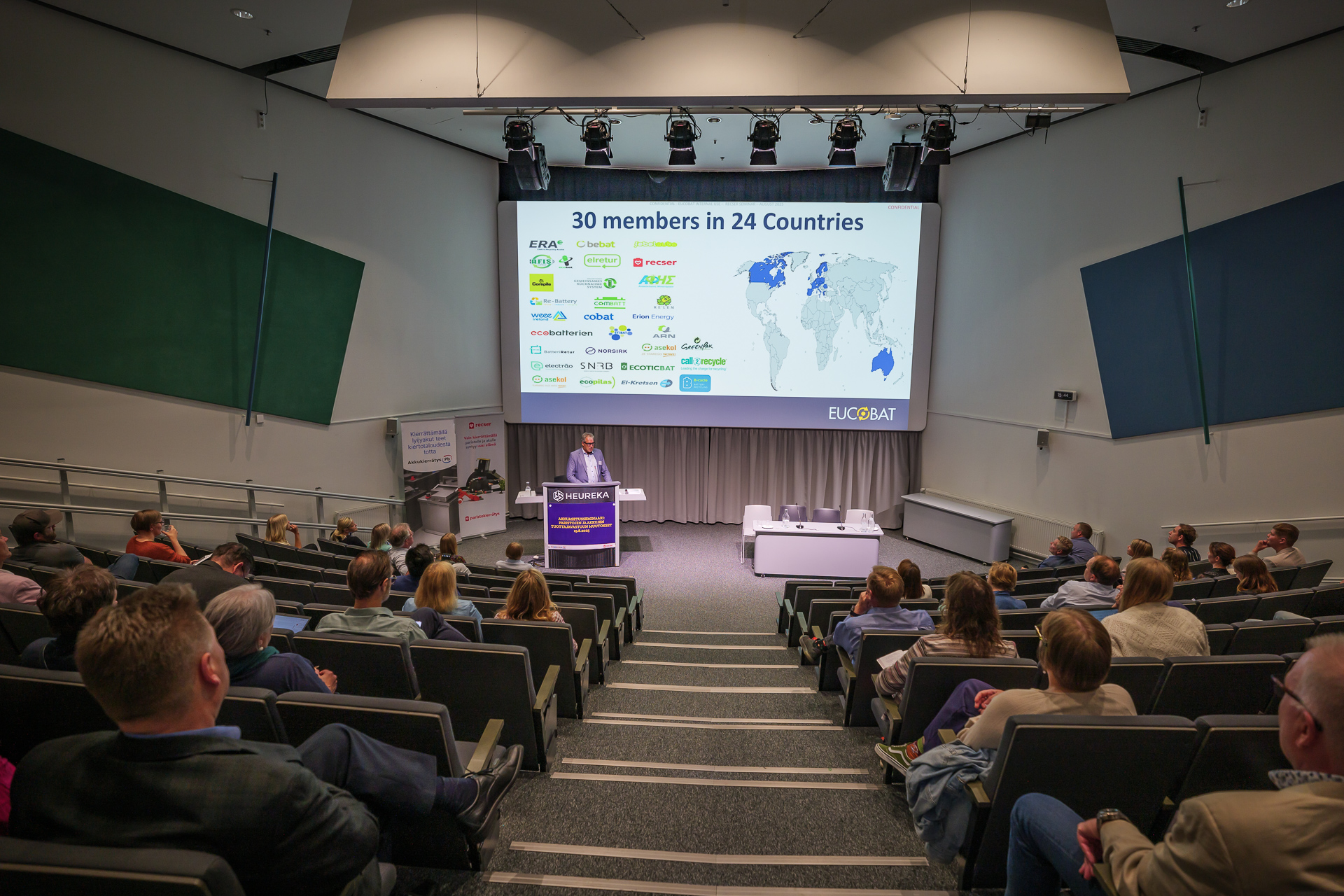
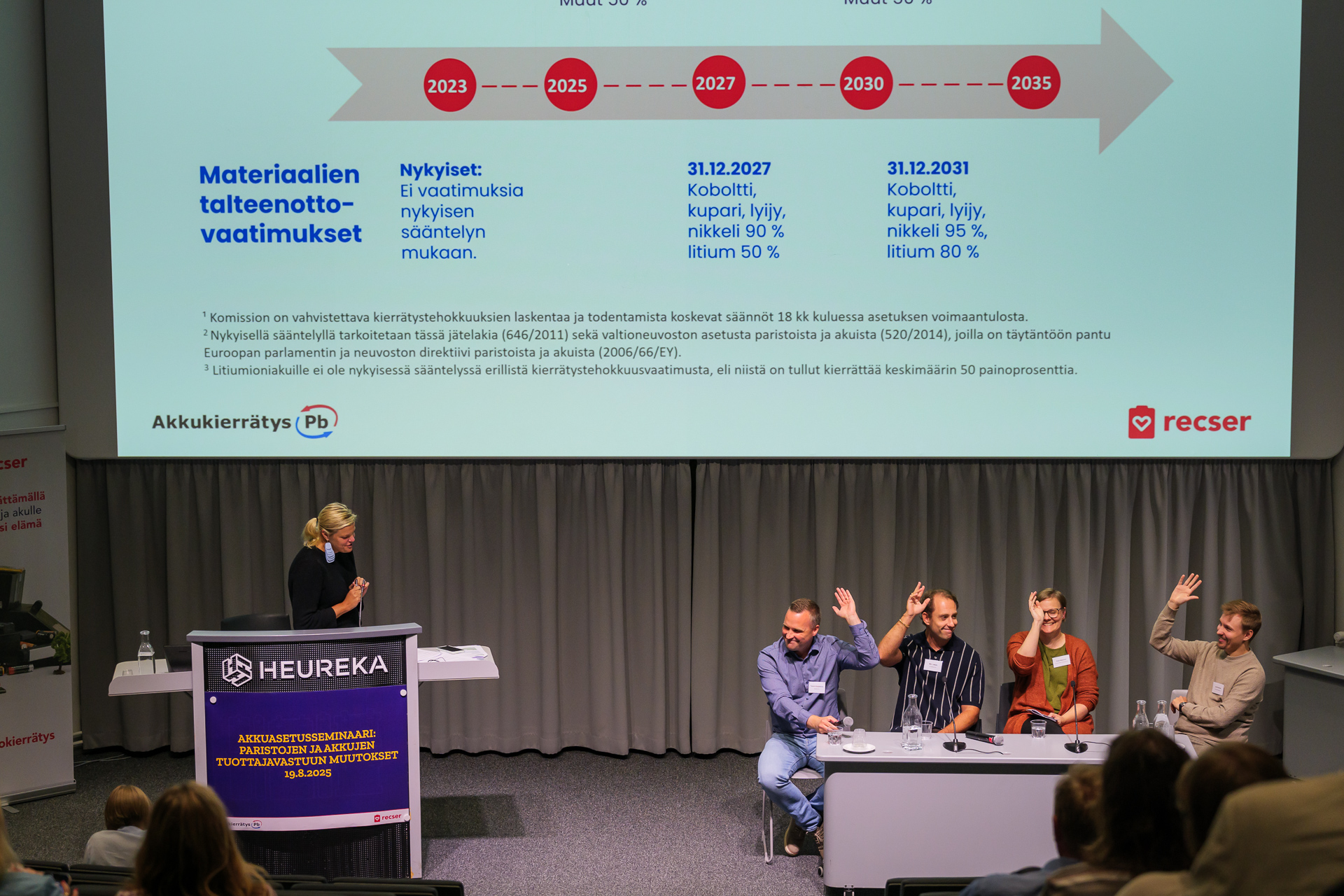
Eucobat, the European association representing national collection schemes for batteries, is based in Brussels and acts as an advocate for producers at EU level. Secretary General Eric Ruyters presented current advocacy priorities at the Battery Regulation Seminar held at Heureka Science Centre in Vantaa in August 2025.
The EU Battery Regulation applies directly in all Member States, and one of its goals is to create a level playing field in the new battery market established by the Regulation.
– We genuinely believe that equal conditions across Member States will benefit us all, says Eucobat Secretary General Eric Ruyters on expectations for EU-level implementation.
Eucobat’s members consist of national producer responsibility organisations running collection schemes in different EU countries. In Finland, Recser Oy is a member of Eucobat.
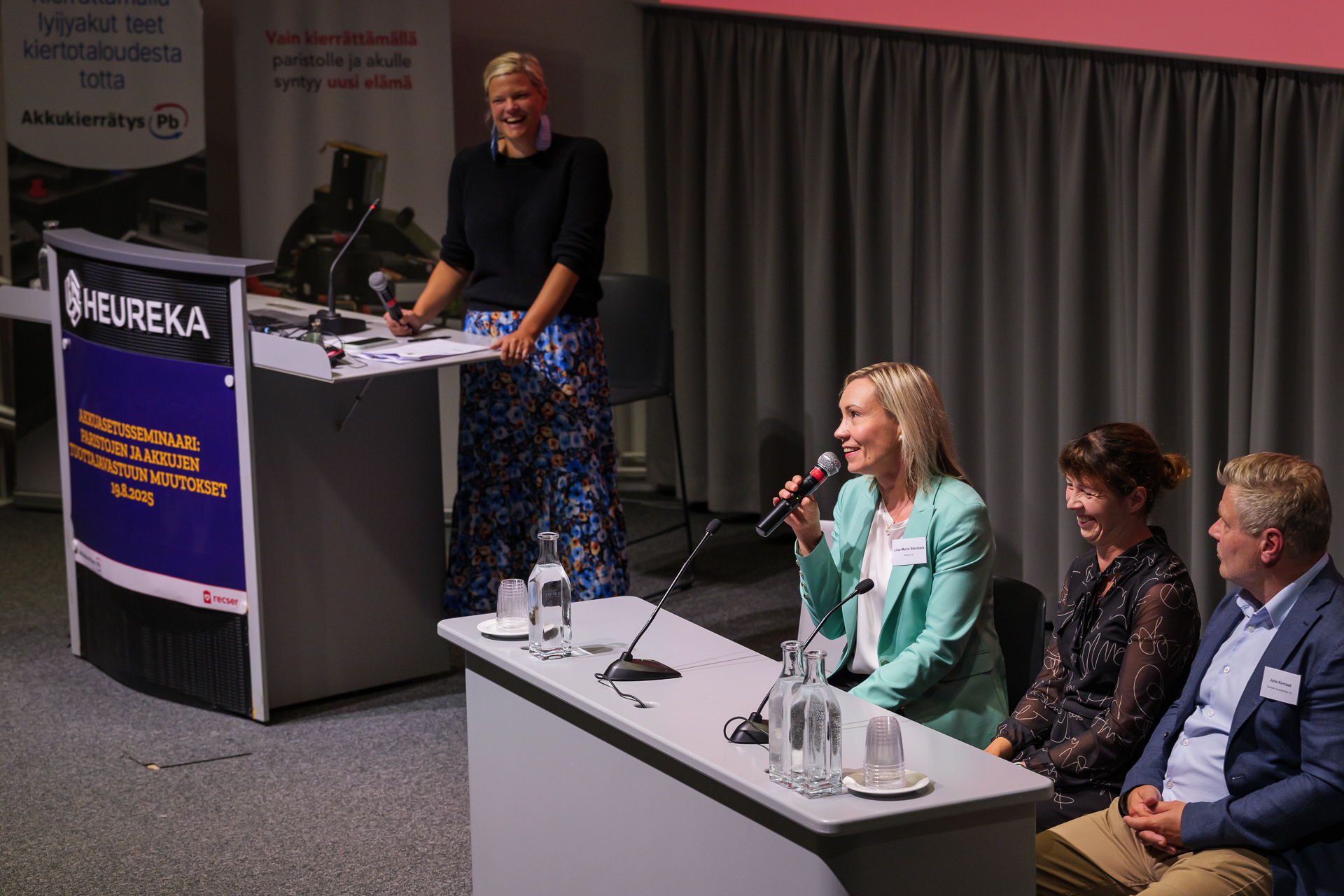
Organizers of the Battery Regulation Seminar (From the left: Terhi Ilonen, Johanna Alakerttula, Liisa-Marie Stenbäck) and Eric Ruyters. Photo: Sus+Com Agency/Antti Partanen
Transitional Period Needed for Implementation
Because the previous Directive mainly set targets, national collection systems have developed into quite different structures and often cover only part of the battery categories defined in the Regulation. For this reason, and because implementation is still ongoing in many Member States, Eucobat is in discussions with the Commission on the need for a clear transition period into early next year.
– Most of our members have had well-organised systems for portable batteries, since they were already subject to clear collection requirements and targets, Ruyters said.
– With the new Regulation, most of our members are expanding the number of battery categories they cover and developing their organisational structures to include all types of batteries – just like in Finland, where producer organisations are now strengthening their cooperation to ensure that all categories are efficiently covered, he continued.
Ruyters also noted that diverging national practices in implementing the Regulation are causing confusion: Member States have different interpretations of definitions and targets as well as varying registration procedures.
– We certainly do not want to stop the process underway in Europe – we simply want a uniform start for all, he said.
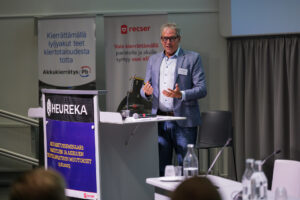
Eric Ruyters. Photo: Sus+Com Agency/Antti Partanen
Addressing the Challenge of Historical Waste
A key requirement of the Regulation for the circular economy is the obligation to take back end-of-life batteries. According to Ruyters, Eucobat sees it as problematic if this obligation also applies to industrial and electric vehicle batteries placed on the market before 18 August 2025, when the new producer responsibility rules entered into force.
– Since in many Member States no take back and recycling fees were collected for these so-called historical batteries placed on the market before that date, it would be unreasonable to require producer responsibility organisations to accept them free of charge, Ruyters explained.
Under the Regulation, however, producers must accept all batteries in their category, regardless of chemistry, brand, or origin. Take-back must be free of charge and cannot be tied to a purchase obligation. The same duty applies to distributors.
– This is part of the broader discussion we are having with the Commission. They were surprised to hear what the free take-back obligation could mean in terms of historical waste. Of course, the Regulation must be followed, but it is important that the responsibility applies only to industrial and electric vehicle batteries placed on the market after the Regulation entered into force.
– Producers themselves remain responsible for batteries placed on the market before that date. They can organise collection and recycling individually or agree on it with a producer organisation, provided that it does not distort the collective system, Ruyters said.
In Finland, a collective collection and recycling system has already been established for all small batteries under 25 kilograms as well as for lead batteries. In addition, there is a functioning collection system for EV traction batteries, operated by Suomen Autokierrätys. The change in Finland therefore mainly concerns large industrial batteries.
Producer Registers and Enforcement
The Regulation requires each Member State to have a mandatory producer register. Registration in the national register is a prerequisite for placing batteries on the market in that country.
– There is no single European producer register – instead, producers must register separately in every Member State where they place batteries on the market, Ruyters clarified.
In addition, distance sellers must appoint an authorised representative. Member States must designate a competent authority responsible for maintaining the register and supervising compliance with producer responsibility. From 18 August 2025 onwards, producer organisations can only fulfil the obligations of the Regulation on behalf of those producers with whom they have a contract.
– Free-riding must not be allowed. Authorities must ensure that free riders are obliged to register, join an approved organisation, and pay their share, Ruyters stressed.
When the EU and its Member States succeed in creating equal conditions and eliminating free-riding, we can together ensure that the objectives of the Battery Regulation are achieved – and that Europe takes a genuine leadership role in the circular economy of batteries.
EU battery regulation tightens requirements, but recycling service providers believe in collaboration: “This is a chain that we all influence”
Recycling service providers believe the battery regulation will accelerate raw material markets and the development of recycling technologies. Producer responsibility often forms the financial basis for battery recycling, as there has not yet been demand for all the chemical substances they contain. Business opportunities in reuse are also of interest.
At the Battery Regulation Seminar, recycling service providers shared their views on how the regulation will affect their operations. The seminar was held in Heureka, Vantaa, in August 2025.
Panel participants agreed on one of the biggest changes the regulation brings to their operations: the battery regulation will change the markets for recycled battery materials.
– “The increase in collection rates will bring more recyclables, which means more business for us, which is of course positive,” says Tommi Karjalainen, CEO of AkkuSer Oy.
Markets do not yet function fully competitively – for example, virgin materials are often cheaper – so producer responsibility often provides an important financial basis for recycling.
– “Producer responsibility ensures that all material goes to recycling regardless of chemistry; you can’t just pick the raisins out of the cake,” says Joni Korkola, Business Manager at Stena Recycling Oy.
Photo: Sus+Com Agency/Antti Partanen
Challenges for recyclers: efficiency and recovery requirements, new chemistries and fractions
The battery regulation gradually increases recycling efficiency and material recovery requirements until 2031, which also poses challenges for recyclers.
The reporting requirements demand more detailed tracking and identification of different battery and device categories. Calculating the required recovery rates requires recyclers to know the composition of incoming batteries more precisely than before.
This is a challenge that the upcoming battery passport, required by the regulation, is expected to partially solve. The battery-specific passport will be attached to the battery at the beginning of its lifecycle and will include information about the battery’s composition.
– “Without a battery passport, it is extremely challenging for us to identify the chemistry of certain batteries. As the first recycler, it is our duty to report recovery rates. We send the batteries forward for crushing and rely on the information provided by our partners,” says Ben László, Head of ITAD at Kuusakoski Oy. ITAD refers to the company’s reuse business and recycling and disposal of IT equipment.
Panelists also highlighted that not all batteries yet have recycling solutions.
– “Ambitious recycling targets must be met, but for LFP, lithium iron phosphate batteries, we need to find new solutions in Europe,” says Korkola of Stena Recycling Oy.
Lifecycle thinking in the battery regulation benefits recyclers
Panelists pointed out that the regulation’s lifecycle approach is a positive aspect, meaning finding recycling solutions is no longer only the recycler’s responsibility.
– “The battery regulation partly guides manufacturers to consider the raw and binding materials they use and the recyclability already in the design phase. Responsibility for recycling extends to manufacturers as well,” says Teija Käpynen, Environmental Manager at Fortum Battery Recycling Oy.
Considering recyclability also benefits the manufacturer, as the regulation sets minimum recycled material content requirements.
– “If we don’t recover them, they can’t use them in production either. This is an entire chain, and we all as actors influence it,” she continues.
Potential of reuse and remanufacturing sparks interest
The regulation has sparked interest in business opportunities for reuse and remanufacturing.
– “We are very interested in reuse and are actively working on finding various solutions,” says Korkola of Stena Recycling.
However, reuse must be weighed against producer obligations under the battery regulation.
– “There is a lot of potential, but it also comes with significant responsibilities and requirements – the same as for the producer,” says Käpynen of Fortum.
Producer organisations are central to recyclers’ business
Battery producer organisations use responsible recycling service providers for the collection, transport, and treatment of used batteries. For service providers, producer organisations are central to their business.
AkkuSer Oy, founded in 2005, offers recycling services to producer organisations. It owns Finland’s only battery sorting and recycling plant for batteries and small batteries, located in Nivala.
– “Legislation has been central to our story because not everything is market-driven. In 2006 came the Battery Directive, and in 2008 separate collection began. That provided the foundation for our business,” says CEO Tommi Karjalainen.
AkkuSer receives all separately collected batteries from Recser, sorts, crushes, and sends the fractions or sorted batteries to further processors.
Tommi Karjalainen. Photo: Sus+Com Agency/Antti Partanen
Fortum Battery Recycling Oy, founded in 2005, now has a significant commercial EV battery recycling value chain at the European level.
– “We are interested in expanding operations to industrial battery recycling as well,” says Environmental Manager Teija Käpynen.
Central to its operations is its own hydrometallurgical battery material recycling plant in Harjavalta. Additionally, the company has a battery crushing plant in Ikaalinen and a battery pre-processing plant in Kirchardt, Germany, and a crushing plant under development.
– “The black mass from the process is further treated in Harjavalta into nickel-cobalt sulfate solution, which is delivered to battery material manufacturers as raw material,” says Käpynen.
Kuusakoski Recycling Oy, founded in 1914, is a family company offering a wide range of recycling services, for example for batteries, electrical and electronic equipment, and recyclable plastics.
– “We work with almost all Finnish producer organisations, if not all,” says Head of ITAD Ben László.
In the battery value chain, Kuusakoski acts as the first recycler, sending materials and products forward.
Safety is central to Kuusakoski’s operations, as they handle, store, and export batteries. The company’s new product, a smart battery sensor, warns of battery fire before ignition.
– “Current market technologies detect fire after it has started. The smart sensor detects electrolyte gas leakage before the battery starts burning. It monitors local air and sends an alert to any client software, enabling preventive measures,” says László.
Ben László. Photo: Sus+Com Agency/Antti Partanen
Stena Recycling Oy, founded in 2005, operates recycling services in Finland, Sweden, Norway, Denmark, Germany, Poland, and Italy.
– “We work with practically all Finnish producer organisations in some capacity, from paper to tires,” says Key Account Manager Joni Korkola.
The company has its own battery crushing plant in Sweden, where the black mass is sold at the best market price.
– “Stena’s role sits between Kuusakoski and Fortum: Stena has the crushing plant that Kuusakoski doesn’t have, but no hydrometallurgy, which Fortum has,” Korkola says with a smile.
Producer organisations make producer responsibility manageable – even in times of change
The EU Battery Regulation significantly reforms producer responsibility systems for batteries. At the Battery Regulation Seminar held in August 2025 at Heureka Science Center in Vantaa, participants learned about the regulation’s impacts on the operations of producer organisations: distributors’ obligation to take back batteries as well as stricter efficiency and recovery requirements will change future collection and recycling. Recser Oy is building an entirely new collection system for large industrial batteries in cooperation with Akkukierrätys Pb Oy. Meanwhile, Suomen Autokierrätys Oy is preparing both for these changes and for the growing number of electric vehicles.
“The Battery Regulation changes the way we all work, our objectives, but at the same time, there are many elements that will remain much the same,” says Johanna Alakerttula, Managing Director of Akkukierrätys Pb Oy.
Producer organisations for batteries help their members understand the changes the regulation brings to producer responsibility and fulfill their new, up-to-date obligations.
“A single producer cannot realistically – and frankly should not – handle the obligations alone,” says Liisa-Marie Stenbäck, Managing Director of Recser Oy.
With the Battery Regulation, more and more companies are regarded as producers in the eyes of the law.
“The Battery Regulation has now broadened the definition of a producer to mean anyone who ‘places a product on the market in Finland for the first time.’ Therefore, distributors of products may also be regarded as producers and thus subject to producer responsibility,” Stenbäck explains.
Distributors’ take-back obligation and stricter requirements reform producer organisations
The take-back obligation for distributors is one of the changes introduced by the Battery Regulation, and it affects all three producer organisations.
“In the future, all distributors must take back the types of batteries they sell – which means the collection system will gain a large number of new points,” says Recser’s Stenbäck.
Producer organisations’ collection networks will therefore grow.
“If you sell electric cars, you are also obliged to take them back. Our collection network is already quite broad, and we are now considering what it will look like in a practical sense. We are planning a new system and digitalising it,” says Juha Kenraali, Managing Director of Suomen Autokierrätys Oy.
According to Akkukierrätys Pb’s Alakerttula, many lead battery distributors have in practice already been taking back batteries for a long time. However, the expanded take-back obligation will particularly change practices for smaller companies.
More detailed guidance on the take-back obligation will be provided later by the Ministry of the Environment.
Lithium-ion batteries as Europe’s challenge: stricter recycling efficiency and recovery requirements call for action
The Battery Regulation strengthens recycling through efficiency requirements and material recovery targets, which will gradually increase until 2031. These changes affect all three producer organisations, albeit in slightly different ways.
“Alkaline batteries and high-cobalt lithium-ion batteries in smart devices are already recycled quite efficiently,” says Stenbäck.
But not all battery types yet have established recycling processes in Europe.
“For light electric vehicle batteries and other low-cobalt lithium-ion batteries, efficient recycling channels have not yet emerged, as waste streams remain small due to long lifetimes. The biggest challenges relate to batteries with varying chemistries and raw material contents that are not evident from their markings,” she continues.
Stricter requirements also apply to lead batteries, though the situation is different in their case.
“A significant share of the lead recovered from batteries in recycling facilities is already used again in lead battery manufacturing,” says Alakerttula.
“Lead battery circular economy is already a reality,” she adds.
Recser Oy: “We make producer responsibility manageable”
Recser Oy, founded in 2008, has operated as a producer organisation for portable batteries and other small batteries under 25 kilograms, excluding lead batteries. It is a producer-founded and producer-owned organisation with more than 1,200 members.
“We expect the number of foreign distance sellers to grow significantly in the coming years, though the majority of registered members are currently domestic importers,” says Managing Director Liisa-Marie Stenbäck.
Recser’s collection network is extensive relative to population: there are about 7,000 collection points. Last year, around 2,000 tonnes of batteries were collected through the network, about half of which were recycled as secondary raw materials.
“That met the current collection target of 45%, but requirements will tighten significantly in the future,” says Stenbäck.
Battery Regulation changes are already expanding Recser
The most significant change for Recser under the Battery Regulation is the expansion of its operations to also cover large industrial batteries over 25 kilograms.
“The biggest change relates to large industrial batteries. They will be subject to collective responsibility, meaning we must take back all batteries in this category, regardless of who placed them on the market or their chemistry,” Stenbäck explains.
To address this change, Recser and Akkukierrätys Pb will jointly build a new collective system for large industrial batteries. This nationwide network will receive all types of industrial batteries and forward them to recycling.
Akkukierrätys Pb Oy: lead batteries responsibly recycled
Founded in 2008, Akkukierrätys Pb Oy is a producer organisation for automotive and industrial lead batteries. Like other producer organisations, it was established by producers and is owned by four companies that import batteries.
“Lead batteries have been mainstream for a very long time. We have over 400 members, ranging from importers of lead batteries to those importing vehicles and machines containing them,” says Managing Director Johanna Alakerttula.
Johanna Alakerttula. Photo: Sus+Com Agency/Antti Partanen
Akkukierrätys Pb’s nationwide lead battery collection network has more than 400 collection points, including waste facilities and auto service companies. For transport and recycling, Akkukierrätys cooperates with ten different operators.
“About 20,000 tonnes are collected annually. That’s a significant amount and has remained stable year after year,” Alakerttula says.
Suomen Autokierrätys Oy: “Our principle is to handle all producer responsibility obligations on behalf of producers and disturb them as little as possible”
Founded in 2001, Suomen Autokierrätys Oy was established by Autontuojat ry, the Finnish Car Importers’ Association, whose members are importers. Suomen Autokierrätys operates under one umbrella with separate producer organisations for end-of-life vehicles and for traction batteries in electric cars. Its nationwide collection network has about 700 collection points. The batteries recycled from electric cars are primarily lithium-ion batteries.
“There are not yet very many electric cars in traffic, so only a small number are currently reaching recycling. However, this will grow significantly in the future,” says Managing Director Juha Kenraali.
Juha Kenraali. Photo: Sus+Com Agency/Antti Partanen
The annual collection volume is about 500 tonnes.
“In tonnes, that’s already a significant amount, but compared to the potential, it’s still small. That 500 tonnes will increase ten- to twenty-fold in the next 5–10 years,” Kenraali says.
Suomen Autokierrätys is already preparing for the introduction of battery passports under the Battery Regulation. These passports will include information on each recyclable battery, which will facilitate reporting on behalf of producers.
“We have prepared for the battery passport by creating an interface in our new system, which will be able to provide information for possible future passports. The plan is to have the system ready at the beginning of next year,” Kenraali explains.
Producer responsibility for batteries
Producer responsibility refers to a company’s legal obligation to arrange waste management and recycling for its products at the end of their lifecycle. This obligation applies to companies acting as producers – that is, as manufacturers, importers, distributors, or distance sellers.
In Finland, companies meet their producer responsibility obligations by joining a producer organisation for their product group. The producer organisations for batteries in Finland are Akkukierrätys Pb Oy, Recser Oy, Suomen Autokierrätys Oy, and ERP Finland ry.
The producer organisation assumes responsibility for the practical arrangements of collection, transport, and recycling of the products placed on the Finnish market once they become waste.
View presentations from the webinar speakers (in Finnish):
Battery producer organisations’ seminar strengthened faith in the future and the power of collaboration
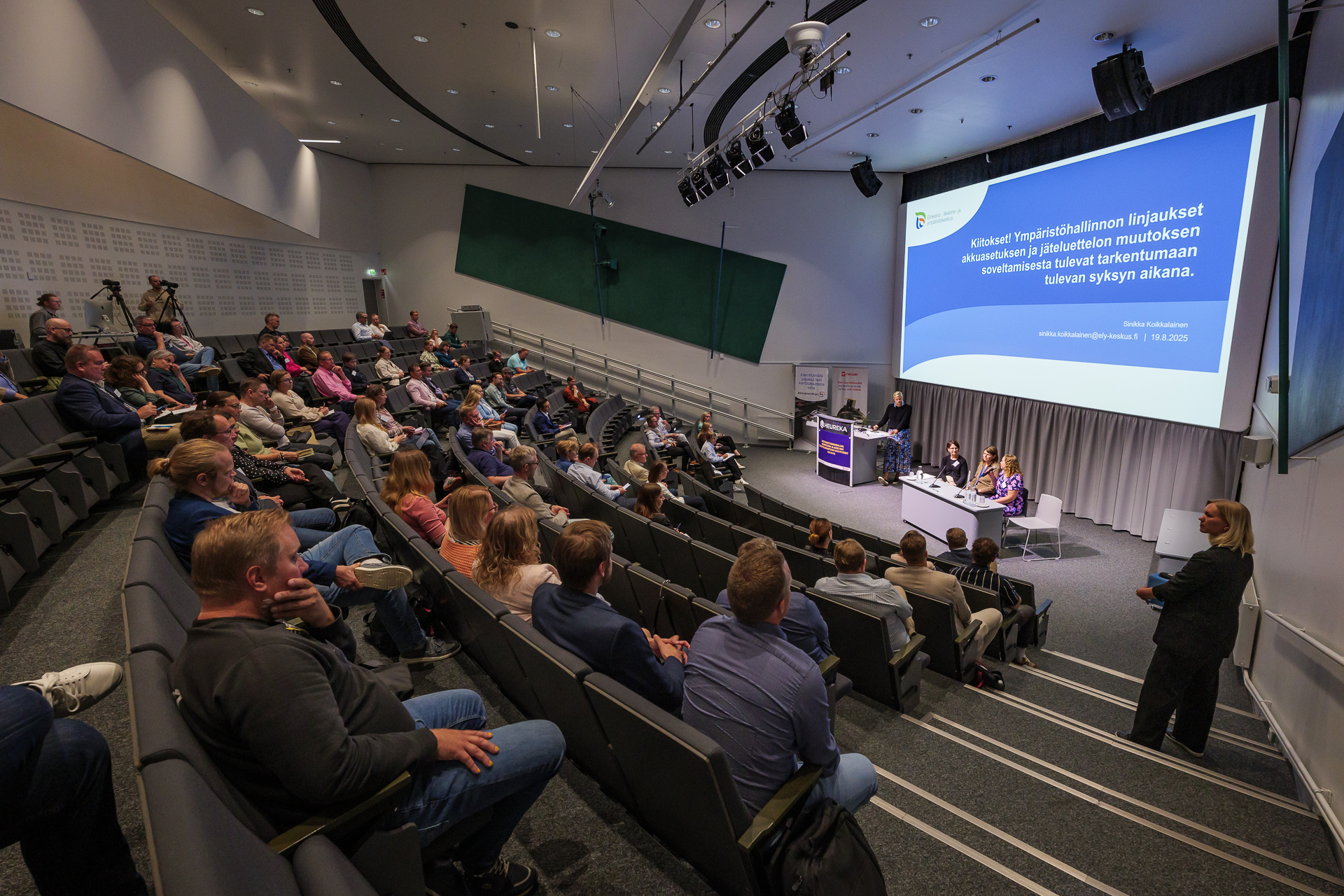
The battery regulation seminar, which addressed changes in battery producer responsibility, brought together the entire battery ecosystem. The topic was extremely timely, as the changes concerning waste management and producer responsibility under the EU Battery Regulation had just entered into force the previous day. The event at Heureka Science Centre in Vantaa gathered 240 participants from the battery sector, both on-site and online.
“Producer responsibility is not just an obligation – it is a strategic choice,” said Liisa-Marie Stenbäck, Managing Director of Recser Oy, in her opening speech.
“It is strategic above all because producer responsibility is corporate responsibility. It covers the entire life cycle of a product. In EU legislation, the producer responsibility obligations at the end of a product’s life cycle are referred to as extended producer responsibility, and the most effective way to fulfil them is usually by joining a producer responsibility organisation,” Stenbäck continued.
The seminar was organised by two battery producer responsibility organisations, Recser Oy and Akkukierrätys Pb Oy. Held on 19 August 2025 at Heureka in Vantaa, it brought together 240 stakeholders – producers, waste management operators, PRO representatives, authorities, and other representatives from both the public and private sectors.
“It was great to see that the seminar included representatives from the entire battery ecosystem. PROs are at the centre of this producer responsibility ecosystem, but the Battery Regulation requires all actors to take environmental impacts and circular economy conditions into account. Everyone is needed to make producer responsibility a reality,” said Johanna Alakerttula, Managing Director of Akkukierrätys Pb.
The seminar was part of a series of events jointly organised by Recser Oy and Akkukierrätys Pb Oy, exploring the changes the EU Battery Regulation brings for companies. Two years ago, the same stakeholders gathered at Heureka – then to address a new and emerging topic. Since then, more detailed aspects of the regulation have been covered through webinars.
The Battery Regulation seminar highlighted the legislative changes that had just come into force the previous day. Chapter VIII of the Regulation focuses on extended producer responsibility, which is central to achieving the overall objectives of the Regulation. Key changes include the new producer responsibility obligation for large industrial batteries and distributors’ take-back obligations.
The seminar addressed four themes: legislative requirements, renewal of producer responsibility systems, recyclers’ preparedness for change, and experiences from the EU level.
The Battery Regulation changes sparked discussion: “It will be a bit of a rumba, bigger for some, smaller for others”
The changes introduced by the Battery Regulation sparked much discussion at the seminar, both during Q&A sessions and over coffee breaks.
During a coffee break, Janne Peltola, Category Manager at MEKO Finland Oy, reflected on the Regulation from the perspective of corporate responsibility. He noted that the biggest change is in mindset.
“This strongly highlights corporate responsibility. Every company, regardless of size, must now and in the future operate responsibly and do their part. There is no room for free riders,” Peltola explained.
MEKO Finland Oy (formerly Koivunen Oy) is a Swedish listed company operating in Northern Europe. The company is an importer and wholesaler of automotive spare parts and also operates two of Finland’s largest repair shop chains, Fixus and Mekonomen.
Janne Peltola, MEKO Finland Oy. Photo: Sus+Com Agency/Antti Partanen
Corporate responsibility was also emphasised when seminar participants answered, via the Mentimeter tool, why producer responsibility is important. Some of the responses were more colourful, but all of them highlighted producer responsibility as essential for the circular economy, saving the planet, and sharing collective responsibility.
More than 60 responses were received from participants.
According to Marko Salminen, Sales Manager at Enersys Europe Oy, the biggest change brought by the Regulation for their company concerns producers’ take-back obligations. Enersys Europe, primarily a manufacturer of lead batteries, is one of the world’s largest producers of industrial batteries.
“It will be a bit of a rumba, bigger for some, smaller for others. We want to ensure that we move batteries forward as quickly as possible to operators working with PROs, so that they don’t end up in the wrong channels from our collection points,” Salminen said.
He found the seminar valuable, as he is not personally involved with the Battery Regulation on a daily basis.
Marko Salminen, Enersys Europe Oy. Photo: Sus+Com Agency/Antti Partanen
Helena Castrén, Chair of the Board at Recser Oy, has closely followed the changes introduced by the Regulation. During a coffee break, she reflected on the importance of hearing these topics explained by experts.
“When you hear these topics from the right people, it’s different from just reading about them yourself, as I too have done many times.”
She particularly appreciated the contributions of Johanna Routio (Ministry of the Environment), Jaana Mäenpää (Pirkanmaa ELY Centre), and Sinikka Koikkalainen (Häme ELY Centre).
Helena Castrén, Chair of the Board at Recser Oy. Photo: Sus+Com Agency/Antti Partanen
“From the presentations of the legislative and supervisory authorities, you could sense their expertise. They really know where we are heading, and we have excellent dialogue partners. These three were honestly pretty amazing!” Castrén said.
the EU Battery Regulation imposes obligations on all actors in the value chain
The changes in waste management and extended producer responsibility under the EU Battery Regulation entered into force on 18 August 2025. Batteries may no longer be placed on the market without fulfilling producer responsibility obligations and meeting the requirements of the Regulation. In Finland, these obligations are fulfilled by joining a producer responsibility organisation (PRO). The Battery Regulation applies directly in all EU countries, and its requirements must be followed even if national implementation is delayed.
Authorities responsible for legislative preparation and enforcement, the Ministry of the Environment and the ELY Centres, presented the changes at the Battery Regulation Seminar held at Heureka Science Centre in Vantaa in August 2025.
Johanna Routio, Government Secretary at the Ministry of the Environment, explained the nature of the Battery Regulation through a life-cycle approach covering batteries. Jaana Mäenpää, Senior Officer at the Pirkanmaa ELY Centre, emphasised that the Battery Regulation is built around producer responsibility.
In addition, Sinikka Koikkalainen, Head of Supervision at the Häme ELY Centre, outlined the impacts of changes in the European Waste Catalogue on waste reporting and the possible need to amend environmental permits.
The goal is a circular economy: Regulation covers the entire life cycle
According to Government Secretary Johanna Routio, the purpose of the Regulation is to promote the circular economy by covering the entire life cycle of batteries. A key objective is to increase the recovery and reuse of valuable materials contained in batteries.
The background to the Regulation is the rapidly growing demand for batteries, which is expected to increase fourteenfold by 2030.
“The term ‘life-cycle regulation’ may not fully describe it – it is really a ‘circular life regulation,’” Routio said.
Manufacturers, for example, must consider the reusability of products already at the design stage.
“There are obligations for all actors in the value chain, and everyone must do their part,” Routio emphasised.
The chapter of the Battery Regulation concerning producer responsibility entered into force on 18 August 2025. National implementation in Finland has been delayed (as of August 2025), with the goal of bringing the remaining regulatory changes into force by 1 January 2026.
“The current regulatory amendments mainly concern the chapter on producer responsibility and waste management. Preparation of the complementary national legislation is slightly behind schedule. Ideally, national legislation would have entered into force simultaneously with the Regulation’s chapter,” Routio noted.
Guidance is currently being prepared for reporting obligations and distributors’ take-back obligations by battery category. Instructions are also being drafted for producers’ collection network requirements, which will vary depending on the type of industrial battery.
Despite delays at national level, the Regulation must still be complied with. Most of its provisions are directly applicable in all Member States, and their content may not be repeated or interpreted in national legislation.
Johanna Routio, Ministry of the Environment. Photo: Sus+Com Agency/Antti Partanen
Producer responsibility is at the core of the Battery Regulation
With the entry into force of the changes regarding waste management and producer responsibility, batteries can no longer be placed on the market without fulfilling producer obligations. Producer responsibility refers to the obligation of producers to organise the sustainable and safe recycling and other waste management of their products at their own expense.
“In Finland, producer responsibility is primarily managed by joining a producer responsibility organisation,” explained Jaana Mäenpää of the Pirkanmaa ELY Centre.
The Regulation has expanded producer responsibility obligations, making it extremely challenging for individual companies to meet them alone. Producers must, for example, receive waste batteries of their own category free of charge through a nationwide collection network. This is a significant change, particularly for industrial battery producers, who will need to transition from individual contractual models to a common collective system.
Producer responsibility organisations are non-profit organisations founded by producers themselves, to which producers outsource the collection, transport, treatment, and recycling of their end-of-life products. PROs also handle tasks such as regulatory reporting and communications on behalf of producers.
Broader definition of “producer”
“In the case of batteries, the producer is the economic operator who places the product on the Finnish market for the first time. This includes importers, manufacturers, distributors established in Finland, and foreign distance sellers,” Mäenpää clarified.
Importers, in this context, are those bringing products into Finland from within the EU or from outside the EU.
“Producers also include those selling batteries under their own brand or embedded in other products,” Mäenpää continued.
According to the definitions in the Battery Regulation, more actors now fall under the scope of producer responsibility.
“Newly included are economic operators who, through treatment activities such as preparation for reuse or repurposing, place waste batteries back on the market as products,” Mäenpää said.
Distance sellers, in turn, must appoint an authorised representative in Finland to take responsibility for their producer obligations if they sell batteries directly to end-users.
Number of battery categories rises from three to five – PROs support producers in meeting the new requirements
The Regulation increased the number of battery categories from three to five. Portable batteries and automotive batteries remain as their own categories.
“In addition, propulsion batteries for electric and hybrid vehicles and batteries for light means of transport have been separated from industrial batteries into their own categories. Different categories and chemistries are subject to different obligations and targets,” Mäenpää explained.
The classification is important because, for example, new collection requirements under the Regulation are determined based on it. Furthermore, distributors’ take-back obligations specifically apply to the categories of batteries that they sell.
Battery Regulation and changes in the waste catalogue affect waste reporting and environmental permits
In addition to the Battery Regulation, waste operators must prepare for changes in the European Waste Catalogue, which will affect the classification of battery fractions in waste reporting and environmental permits. Batteries, their manufacturing waste, and intermediate fractions from treatment will generally be classified as hazardous waste in the future.
“The change to the Waste Catalogue will apply from 9 November 2026, according to the Commission’s decision. In Finland, the plan is that the current waste codes will still be used for 2026 reporting. Companies should prepare by ensuring that, in their bookkeeping for 2027, wastes are classified under the new codes, with reporting based on them the following year,” said Sinikka Koikkalainen, Head of Supervision at the Häme ELY Centre.
“Operators should already contact their supervisory authority to assess whether their permits will need to be amended before the Waste Catalogue changes take effect,” Koikkalainen added.
Sinikka Koikkalainen, ELY Centre for Häme. Photo: Sus+Com Agency/Antti Partanen
View presentations from the webinar speakers (in Finnish):
producer responsibility for industrial batteries changes in August 2025 – what does collective responsibility mean?
The EU’s new battery regulation introduces significant changes to the producer responsibility for industrial batteries starting from 18 August 2025. The key change is the expansion of responsibility: producers will be responsible not only for the waste management of their own batteries but also for similar batteries from other producers. This marks a shift from individual contract-based models to a shared, collective system.
From individual responsibility to a shared system
Currently, producers have legally been able to agree on recycling costs with the end user only when the battery reaches end-of-life. This has enabled an individual, retrospective responsibility without an obligation to participate in a shared collection network.
Under the new regulation, producers are required to accept end-of-life batteries free of charge – regardless of the battery’s origin, brand, or chemical composition. According to Article 61, the responsibility also includes so-called orphan batteries, whose origin cannot be traced. This necessitates the establishment of a nationwide collection system for industrial batteries as well.
The role of producer organisations becomes more important
Collective responsibility will in practice be implemented through producer organisations. In Finland, legislation has already steered towards a collective operating model, and the battery regulation reinforces this direction. In practice, joining a producer organisation will become essential.
The regulation requires that recycling fees within producer organisations must be based at least on battery type and chemistry. In addition, factors such as battery durability, recyclability, hazardous substances, carbon footprint, and potential for reuse or remanufacturing must be considered. Potential revenues from recovered raw materials or preparation for reuse can also be taken into account when adjusting fees.
Diverging interpretations on retroactive responsibility – EUCOBAT’s stance is clear
There has been debate about whether collective responsibility also applies to batteries placed on the market before 18 August 2025. EUCOBAT, the European association of battery and accumulator producer organisations, has requested clarification from the Commission regarding the application of Article 61.
EUCOBAT emphasises that the regulation must be applied uniformly across all Member States. National differences could cause market distortions and lead to a situation where compliant producers end up covering the costs of others.
EUCOBAT’s implementation recommendations
Time limitation of responsibility Batteries placed on the market before 18 August 2025 remain the responsibility of the original producer or must be addressed separately through an agreement with the producer organisation. For new batteries, recycling costs are typically covered in advance through fees paid to producer organisations.
Preventing free-riding Distance sellers must be required to appoint an authorised representative in the destination country. Authorities must have effective tools and the right to access information in order to monitor compliance with producer responsibility.
What does the change mean in practice for producers?
Responsibility for recycling costs is no longer limited to a producer’s own products – producers must contribute a fair share to the recycling of similar “orphan” batteries
Recycling fees are generally paid when the product is placed on the market
Belonging to a producer organisation is a prerequisite for market access
Waste management costs can no longer be transferred to the end user
Registration and producer organisations in Finland
Anyone who places batteries on the Finnish market or for their own use must register as a producer before beginning import or sales. Distributors must ensure that the producer belongs to an approved producer organisation.
the EU battery regulation demands more efficient recycling – Finland prepares for new targets
In Finland, the collection and recycling of batteries has been effectively implemented through producer responsibility systems, and the requirements of the current legislation are well met. Chapter 8 of the battery regulation, entering into force in August 2025, will gradually tighten collection and recycling requirements and introduce obligations for the use of recycled materials in the production of new batteries.
Producer organisations annually compile data on batteries placed on the market, collected, and recycled, and submit this information to the Pirkanmaa ELY Centre. The ELY Centre then compiles national statistics and reports them to the European Commission.
Separate collection targets
Current legislation requires that at least 45% of portable batteries be collected separately from other waste for recycling. The target is based on the average amount placed on the market during the previous three years.
In 2024, 3,480 tonnes of portable batteries were placed on the Finnish market, and nearly 2,000 tonnes were collected as waste. This corresponds to a collection rate of approximately 50%, which exceeds the minimum requirement. In 2022, only 13 EU member states met the target.
No specific collection target exists for industrial or automotive batteries, but producers must ensure that all batteries returned to collection points are recycled.
Recycling targets
Lead battery recycling has remained strong in Finland. In 2024, 23,000 tonnes were collected, with a recycling efficiency of 71%. The recycling rate for the lead content of these batteries was as high as 94.2%. The current requirement level (65%) has been met annually. Currently, lead batteries are delivered to four recycling facilities located within the EU.
Portable batteries are sorted in Finland and sent either after crushing or intact to specialised treatment facilities in Finland and elsewhere in Europe. For nickel-cadmium batteries, 80% is recycled, and for other batteries, such as lithium and alkaline batteries, at least 50%. These legislative requirements have been met annually.
Collection and recycling targets will tighten
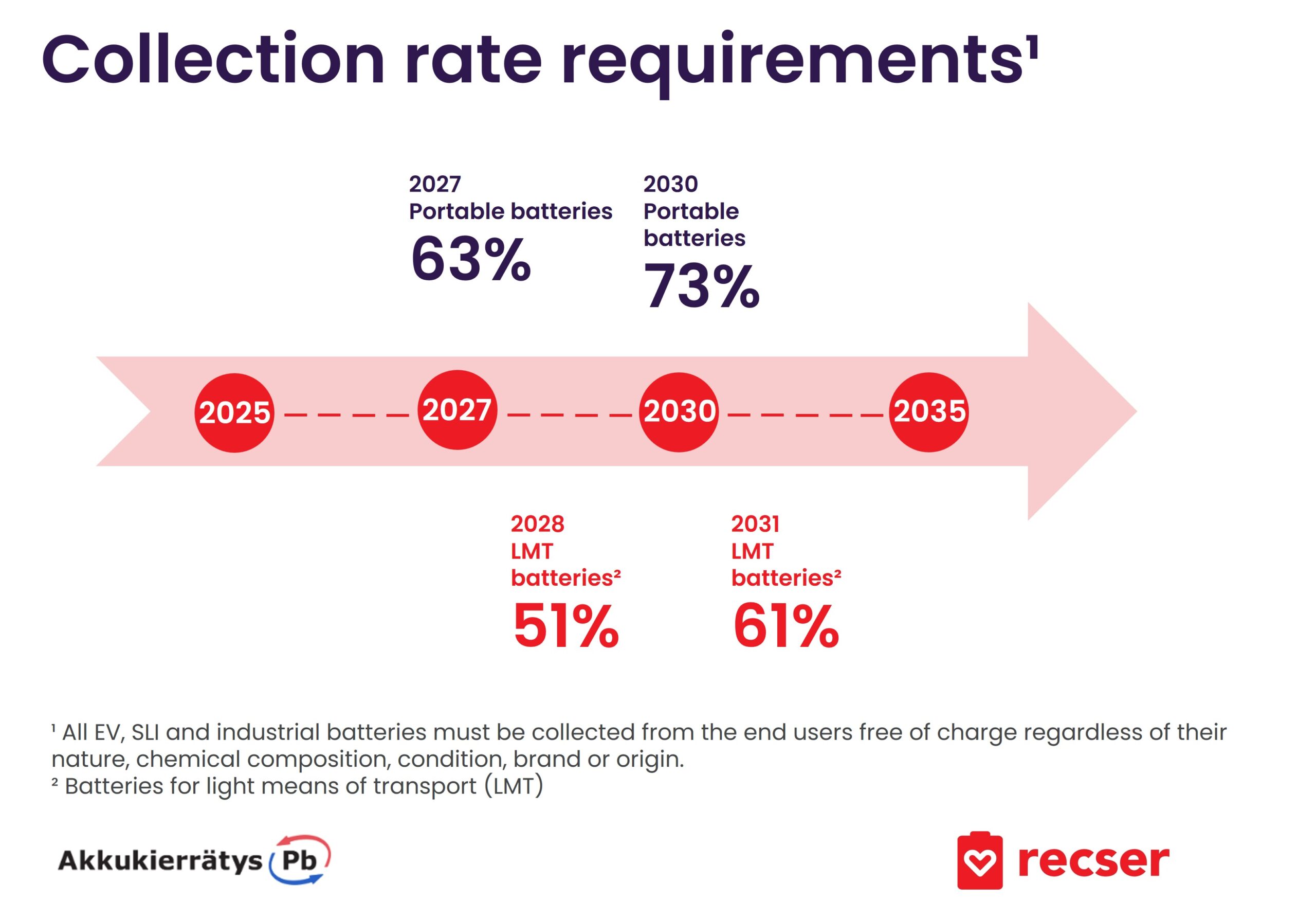
In the coming years, separate collection targets will become stricter. According to the battery regulation, the collection rate for portable batteries must rise to 65% by 2027 and to 73% by 2030. A collection target of 51% will apply to light means of transport, such as e-scooters and e-bikes, by the end of 2028, increasing to 61% by 2031. This reflects the growing need for more responsible material circulation.
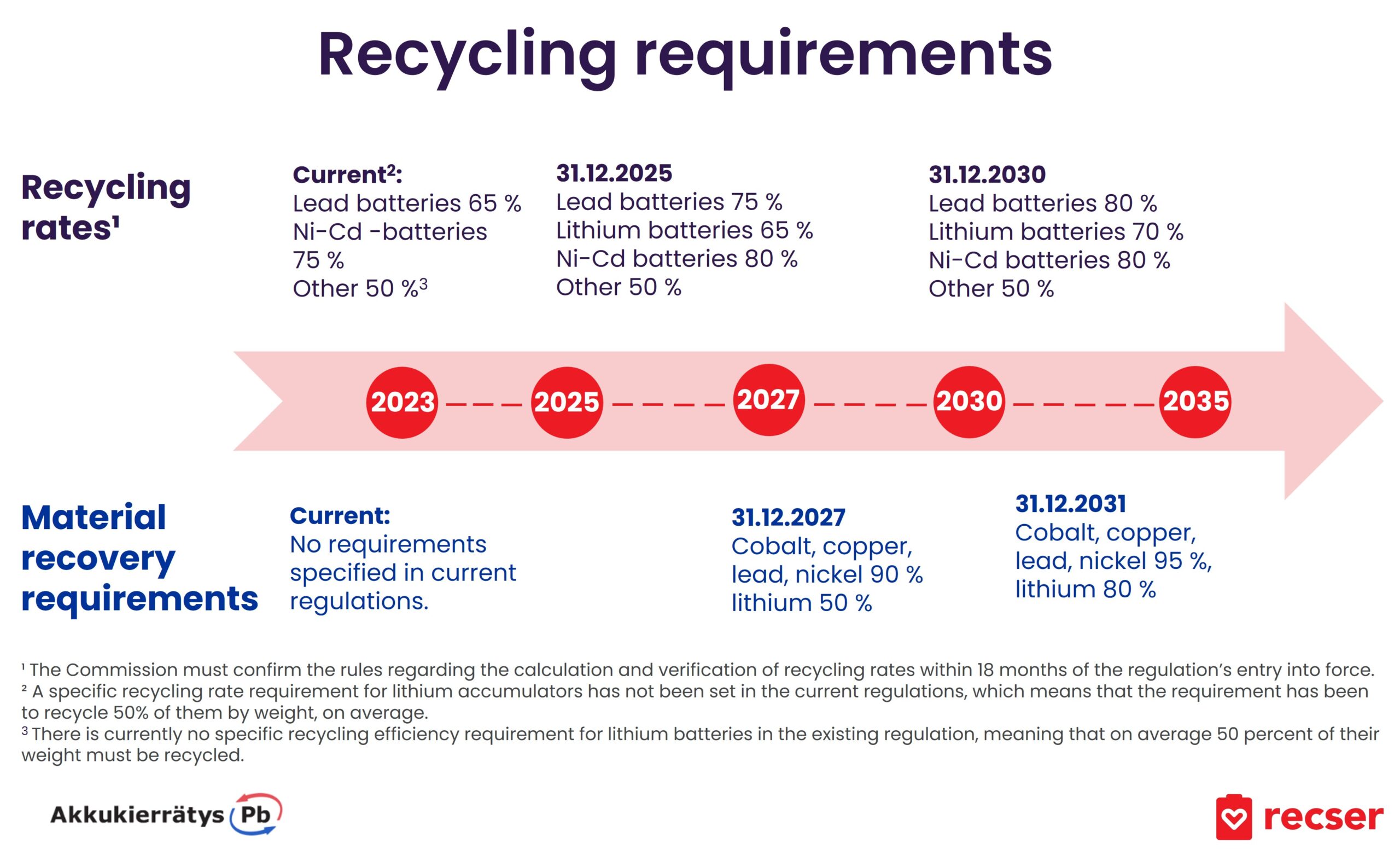
Efficiency requirements for recycling facilities will also tighten. By 2026, the recycling efficiency for lithium-ion batteries must reach 75%. By the end of 2027, 90% of cobalt, copper, lead, and nickel and 50% of lithium must be recovered from collected batteries. Both overall recycling rates and material-specific recovery requirements will continue to increase by 2030.
Markets for recycled raw materials will strengthen
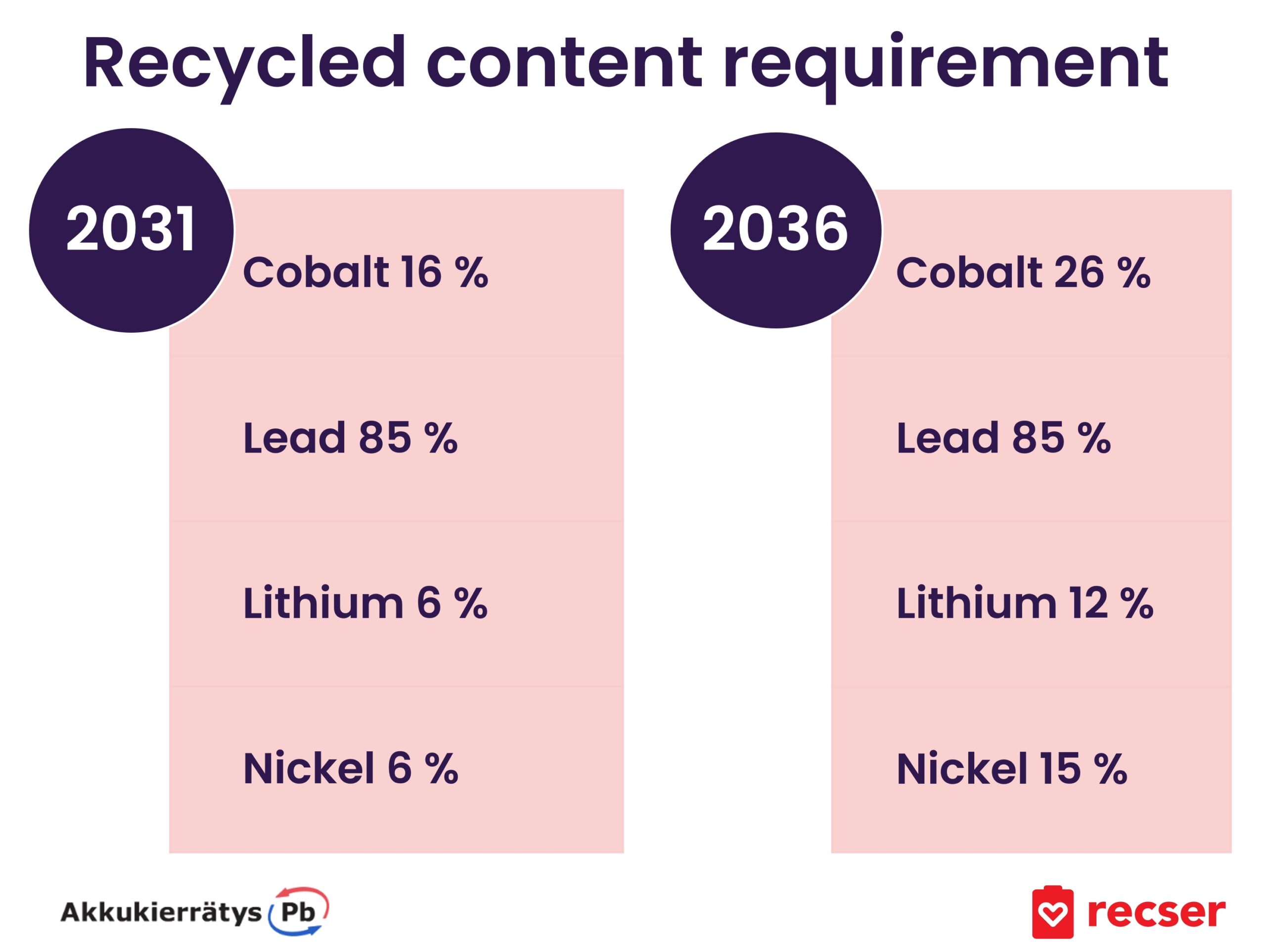
The new regulation focuses not only on collection volumes but also on the sustainable use of raw materials. From 2031 onward, new batteries must contain at least the following proportions of recycled materials: cobalt 16%, lead 85%, and lithium and nickel 6%. The requirements for cobalt, lithium, and nickel will increase further by 2036.
Circular economy becomes reality through collaboration
Finland’s long experience and established producer responsibility model provide a strong foundation for meeting the tightening requirements. However, the transition will require even closer cooperation between consumers, producers, waste management operators, and authorities to ensure a circular economy throughout the battery life cycle.
Consumer contribution is crucial in reaching the collection targets: the more batteries are returned properly, the easier it will be for Finland to meet the stricter requirements. Taking batteries to collection points is a small action with a big impact on sustainable development and material efficiency. From August 2025, the battery regulation requires end-users to separately sort and return used batteries to collection points.
Explore the recycling calculator
Member companies of Akkukierrätys Pb and Recser can use the recycling calculator to calculate their company-specific collection and recycling results. The calculator provides concrete data that can be used, for example, in communication with customers and stakeholders. Download the user guide (in Finnish) for the calculator.
Webinar Provides Answers: Proper due diligence in the battery supply chain
Due diligence in the battery supply chain – what do the Battery Regulation and the Corporate Sustainability Due Diligence Directive (CS3D) require from companies? These questions were addressed in the fifth Battery Regulation webinar.
The European Union’s Battery Regulation and Corporate Sustainability Due Diligence Directive (CS3D) impose new types of obligations on companies to ensure responsibility throughout their supply chains. These topics were explored during the Battery Regulation webinar held on 3 June 2025, where experts shed light on the content and impact of the new regulations on business operations. The event was organised by Recser Oy and Akkukierrätys Pb Oy, which operate as battery producer organisations. The webinar attracted around 230 participants interested in these timely topics.
CS3D requires companies to identify and respond to risks
Netta Skön, sustainability lawyer at Fondia Plc, presented the key requirements of the Corporate Sustainability Due Diligence Directive (CS3D). The directive currently applies to large companies – those with more than 1,000 employees and annual turnover exceeding €450 million – and requires the implementation of a comprehensive due diligence (DD) process to identify, assess, prevent, or mitigate adverse human rights and environmental impacts throughout the value chain.
Information gathering is at the heart of the directive. According to Skön, a company must understand the risks related to its own operations and supply chain: “In the global economy, value chains are complex, but this makes data management and understanding of impacts even more critical.”
Battery regulation vs. CS3D: similarities and differences
Both the Battery Regulation and CS3D emphasize responsible business conduct and supply chain transparency. They share the goal of preventing environmental and human rights risks. However, they differ in nature: the Battery Regulation is directly applicable EU legislation, while CS3D is a directive that requires national transposition. Additionally, the Battery Regulation specifically targets the battery value chain, whereas CS3D applies across multiple industries.
Skön sees the overlapping regulations not as a problem but as an opportunity: “If a company integrates its DD process effectively, it can meet the requirements of both regulations with one system.”
Regulatory landscape changing – impacts of the Omnibus packages
EU sustainability legislation is undergoing reform through so-called Omnibus packages, which introduce multiple changes or clarifications across regulations simultaneously. Notably, several changes have been proposed to CS3D, and its application timeline has been postponed by two years, now set to take effect in 2028.
The Omnibus IV package, published in late May, also proposes changes to the DD obligations under the Battery Regulation: the entry into force may be delayed by two years, and the threshold for applicability could be raised from companies with €40 million turnover to those with €150 million in turnover. The turnover threshold applies to the company’s entire revenue, not just the battery business.
Johanna Routio, ministerial adviser from the Ministry of the Environment, stressed that the delay should not be seen as a transition period: “Companies should use the additional time to prepare and develop their processes.”
The Omnibus IV proposals can be commented on through the EU’s Have Your Say portal. The points open for feedback concern, in particular, changes to the timeline and turnover thresholds.
What does the Battery Regulation require in practice?
Kati Suomalainen, senior specialist at the Ministry of the Environment, presented the content of Chapter VII of the Battery Regulation, particularly Articles 49–53, as well as Article 93 of Chapter XIV. The DD obligations focus on the sourcing, processing, and trade of raw materials and secondary raw materials – and on managing social and environmental risks throughout the supply chain.
Companies are required to:
Establish an operational policy and communicate it to suppliers and the public
Ensure traceability through upstream chains
Prepare a risk management plan and integrate it into business strategy
Set up a grievance mechanism
Undergo an audit conducted by a notified body
The proposed Omnibus changes are also expected to delay the publication of the Commission’s DD implementation guidelines until July 2026.
Sandvik’s experience: getting a head start through proactivity
The webinar concluded with a company case example from Sandvik Mining and Construction Oy. The company has proactively begun developing its due diligence process, focusing particularly on industrial batteries. Hinrich Kress described the project as requiring a group-level solution, close collaboration, and budgeting – with a single audit potentially costing up to €20,000.
Kress expressed concern about notified bodies becoming bottlenecks but remained optimistic about the future: “Legislators are behind schedule, but if we can demonstrate genuine efforts to comply, that will go a long way.”
Summary
It is time for companies to wake up to the responsibility requirements in their supply chains. Both the EU Battery Regulation and CS3D steer business toward more transparent and sustainable practices. Proactive preparation helps avoid last-minute rushes and potential sanctions – and can also provide a competitive advantage in a changing business environment.
Solution for producer responsibility of large industrial batteries – Four companies expanding Recser
A recycling system in line with producer responsibility is being established for large industrial batteries by expanding Recser’s operations. In February, four producers of large industrial batteries—Avant Power from Ylöjärvi, Cactos from Kempele, Enico from Tampere, and Merus Power from Ylöjärvi—joined Recser as shareholders.
The background for this expansion is the EU’s new Battery Regulation, which requires that producers of large industrial batteries must comprehensively and collectively manage the recycling of their products starting in August 2025. A company must be part of the collective responsibility system in order to place batteries on the market.
“Now that the ownership base is in place, we will start expanding the producer responsibility system by creating collection readiness as well as transport and recycling services for end-of-life large industrial batteries. To organize this, we have appointed Arttu Kautonen to a newly created position as Circular Economy Manager for Industrial Batteries,” says Recser’s Managing Director Liisa-Marie Stenbäck, expressing satisfaction with the solution.
Kautonen transitions into the role from the Mitsubishi Logisnext Europe Group.
“I have gained familiarity with industrial battery technologies and the producer interface while working for a global heavy machinery manufacturer. I hope this experience will help me quickly contribute to the development,” Kautonen says on his first day in the position.
The need for battery industry companies to organize is driven by the EU’s new Battery Regulation, which came into force in August 2023. The regulation mandates collective producer responsibility for the recycling of all battery categories starting in August 2025.
The newly joined companies enable the creation of a new producer responsibility system as part of Recser’s existing framework for industrial batteries over 25 kg that are not lead-based. Corresponding systems already exist in Finland for lead batteries and other battery categories.
Following the regulation’s implementation, Recser and other producer organisations in the battery industry began jointly investigating how producers of large industrial batteries wanted to organize themselves.
“In the process initiated by the seminar we held in spring 2024, producers decided to expand Recser instead of establishing a new producer organisation,” explains Stenbäck.
The new shareholder company Cactos sees collaboration as a reasonable way to handle producer responsibility.
“We handle many things ourselves, but this is something that makes sense to do together with other producers. Recser is a producer-founded and producer-owned organisation that will take care of this producer responsibility,” says Cactos’ COO Veli-Erkki Ruotsalainen.
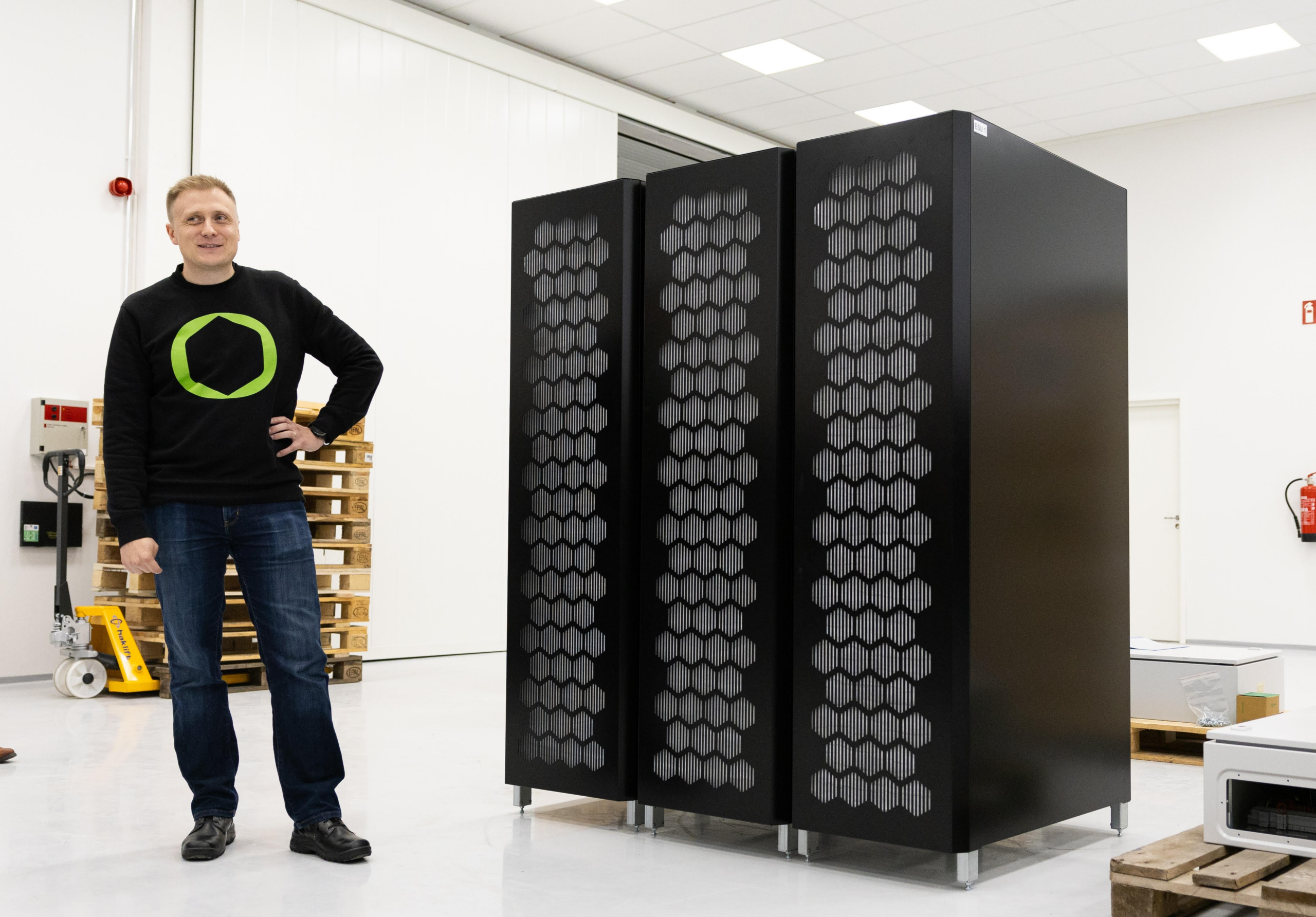
Veli-Erkki Ruotsalainen, Chief Operating Officer of Cactos. Photo: Cactos Oy
Industrial batteries include:
Traction batteries used in railway, water, and air transport vehicles
Traction batteries used in mobile work machines
Batteries used in communication networks, agricultural operations, or for energy production and distribution
EU Regulation: Recycling is a Requirement for Market Placement
Extended producer responsibility means that battery producers must comprehensively and collectively organize the recycling of their products. A company must be part of the collective responsibility system in order to place batteries on the market.
“Unlike directives, EU regulations generally do not allow for national discretion. This means that the Battery Regulation will take effect as it is in all member states. Each country must make the necessary amendments to its national legislation for implementation,” Stenbäck emphasizes.
Under producer responsibility, companies placing batteries on the market must ensure proper waste management and recycling at the end of their lifecycle while also considering recyclability in product design. The Battery Regulation requires that producer responsibility is addressed before products can be sold in the Finnish market, and its costs must be incorporated into product pricing at the time of sale.
Due to these requirements, the most significant amendment to Finland’s national Waste Act concerns industrial batteries, whose producer responsibility is shifting from individual to collective responsibility. Moving forward, a nationwide, collectively managed collection system must be established for all industrial batteries, regardless of when they were placed on the market.
The Battery Regulation aims to promote the circular economy, strengthen the internal market, and reduce the environmental and social impact of batteries.
However, according to Risto Laakso, representing the new shareholder company Merus Power, this is not just about complying with legal requirements—customers are highly interested in sustainability. Proper end-of-life recycling of products is essential.
“For large investors, EU taxonomy and the green transition are key factors. Taxonomy determines the types of investments eligible for support or favorable financing.”
Risto Laakso is the Environmental, Health, Safety, and Sustainability Manager at Merus Power. Photo: Merus Power.
Joining a Producer Organisation to Fulfill Producer Responsibility
In Finland, battery industry companies must fulfill their producer responsibility by joining a producer organisation. These organisations are non-profit entities founded by producers themselves, organizing the collection and recycling of end-of-life batteries on behalf of their members.
Suomen Autokierrätys Oy manages traction batteries from electric vehicles.
Akkukierrätys Pb Oy is responsible for lead-based vehicle and industrial batteries.
Recser Oy and ERP Finland ry have so far been responsible for batteries under 25 kg.
With Recser’s expansion, producer companies from all battery categories—including large industrial batteries—now have a suitable producer organisation to join.
The new shareholder company Enico sees joining a producer organisation as the most efficient way to manage a company’s responsibilities.
“The Battery Regulation mandates recycling responsibility, but it is also in the best interest of a responsible company. As a small, growing business, we didn’t see it as practical to handle this on our own,” says Enico’s COO Anna Prusi.
Anna Prusi, Chief Operating Officer of Enico. Photo: Enico
If your business involves batteries, it is essential to check the legal changes brought by the Battery Regulation. For example, the expanded definition of a “producer” has brought entirely new companies under producer responsibility.
You can transfer your producer responsibility to Recser by registering as a producer here: Registering as a producer – Paristokierrätys. We keep registered producers informed about upcoming changes and are happy to assist with any producer responsibility-related questions: info(a)recser.fi.
Cover image: Cactos Oy
Company introductions
Merus Power
Merus Power designs and manufactures energy storage systems and devices that improve power quality. Energy efficiency, a clean future, renewable energy, and power quality have been at the core of the company’s operations since its inception.
“From the very beginning, it has been clear to us that the recycling of devices must be taken care of,” emphasizes Risto Laakso, Merus Power’s Environmental, Occupational Safety, and Responsibility Manager.
“Industrial batteries in large energy storage systems can weigh up to 200 tons. When a battery system reaches the end of its lifecycle and needs to be replaced and recycled, it becomes quite a large-scale project,” he explains.
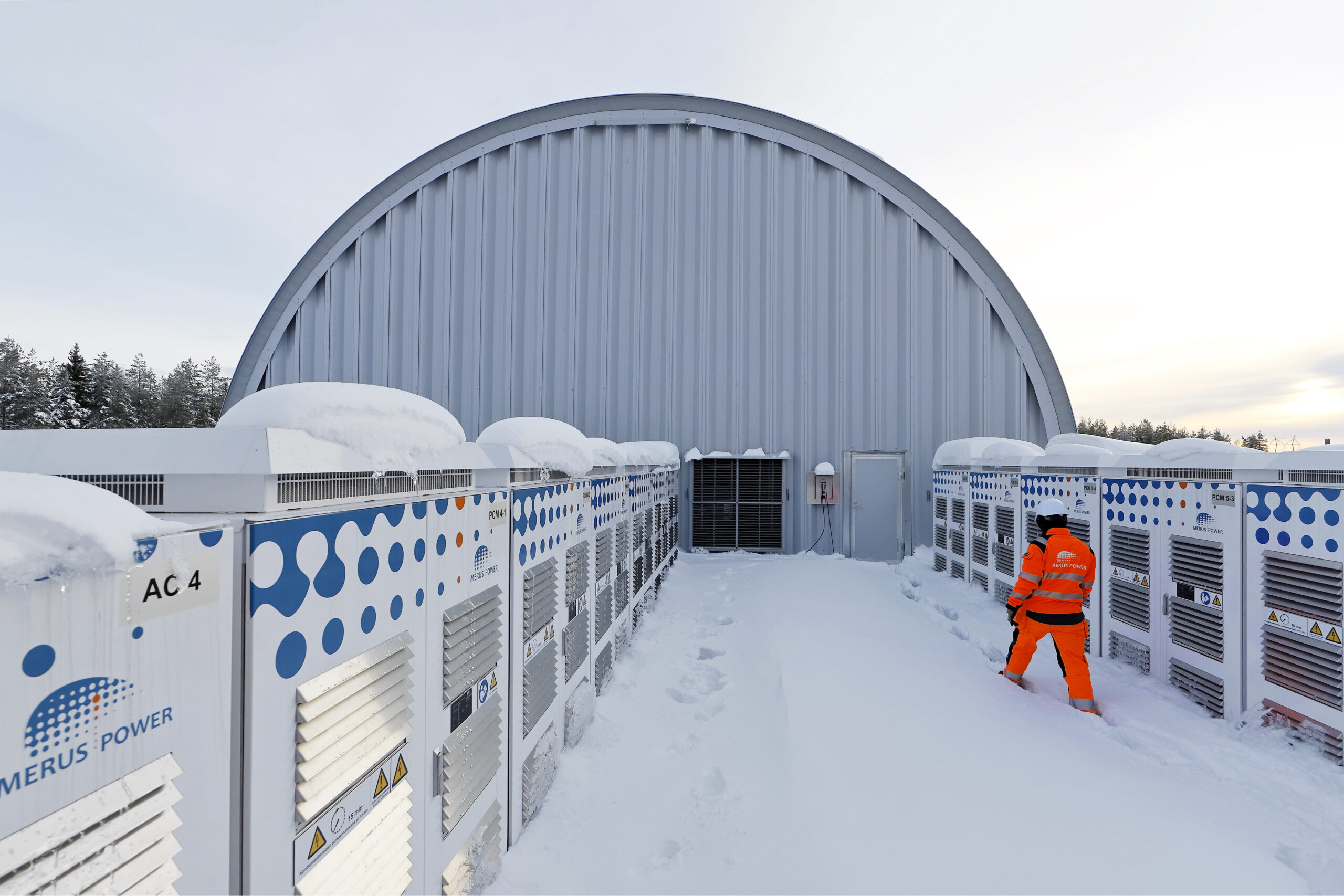
Photo: Merus Power
Merus Power was founded in 2008. The company’s revenue has steadily increased, reaching €35.6 million in the last fiscal year. The number of employees is also growing, with 117 at the end of last year. Merus Power’s headquarters are now in Ylöjärvi, and it also has offices in Helsinki, Germany, and the United Arab Emirates. The company went public four years ago.
“We are a company founded by engineers. The founders all have a shared background at Nokia Capacitors,” Laakso says about the company’s origins.
“Originally, we operated in Nokia, in the basement of a rubber boot factory. Two years ago, the company moved its production and headquarters to larger premises in Ylöjärvi,” he continues.
Merus Power operates globally, with its products sold in over 70 countries. In the early years, projects and devices were mainly delivered abroad.
“Our power quality improvement products include active filters, STATCOM, and SVC devices—speaking in engineering terms,” says Laakso.
“To put it simply, they act like a washing machine for electricity. In Finland, we generally have good power quality, but that’s not the case everywhere in the world,” he explains.
Merus Power delivered its first energy storage systems to Finland in 2018–2019. Energy storage allows for greater integration of renewable energy into the national grid. An energy storage system consists of batteries, inverters, control and protection systems, and various other components that enable grid connection.
“Energy storage systems have grown rapidly in number and their capacity has increased year by year,” Laakso states.
Beyond the company’s core values, Merus Power’s involvement in Recser’s ownership and the producer organisation is also driven by a desire to anticipate business developments through information access. Collaboration with other Finnish companies in the producer organisation is also important.
“Fairness and equity are key reasons we joined. All producers must take responsibility for battery recycling according to the polluter-pays principle. Producers are responsible for ensuring batteries are properly recycled,” says Laakso.
“Recser and the producer organisation organize recycling, enabling the reuse of materials,” he adds.
Enico
Enico provides comprehensive energy storage solutions designed for Nordic conditions. Founded in 2019 in Tampere, the company’s main markets are the Nordic and Baltic regions.
“There’s no alternative—devices must be recycled at the end of their lifecycle,” says Enico’s Chief Operating Officer, Anna Prusi, firmly.
Enico’s revenue has tripled annually over the past three years. Last year, it was around €9 million, with a target of €25 million this year. This growth is also reflected in its workforce, which tripled in 2024.
Enico is part of the Finnish family-owned group, West Invest Group. Within the same group, the sister company Ubitec is responsible for installation and maintenance services. The company sources components from Finnish or European suppliers.
“We operate with a partnership mindset, meaning we don’t rely on single suppliers but instead develop products collaboratively with our partners,” says Prusi.
“Energy storage systems participate in Fingrid’s frequency reserve market, making them part of critical infrastructure. We want to ensure that all activities—ours and those of our subcontractor network—are responsible and safe,” she continues.
With Enico’s energy storage solutions, customers can participate in Fingrid’s frequency reserve market, creating a new revenue model. There are various applications for energy storage, such as backup power, peak shaving, and maximizing the benefits of solar or wind power.
“Our customers include shopping centers, fish processing plants, sawmills, and electric vehicle charging operators.”
Enico sees producer responsibility as self-evident. The company joined Recser’s ownership to have a say in decisions affecting its operations.
“We don’t want to just sit in the passenger seat listening to decisions made by others,” Prusi says.
“Recser has been handling the recycling of smaller batteries for a long time, so they have expertise in battery recycling and network management. It makes sense to collaborate with an experienced player to develop large-scale battery recycling,” she adds.
Cactos
Cactos Oy, founded in 2021, offers automated energy storage services—providing both storage units and related software and operational solutions for businesses. The company has its own factory in Kempele, with additional offices in Helsinki and Amsterdam.
“Our company exists to enable the global energy transition,” says Cactos’ Chief Operating Officer, Veli-Erkki Ruotsalainen.
Despite being just a few years old, Cactos has installed approximately 160 energy storage units in Finland and Ukraine. Deliveries to the Netherlands and Sweden are in preparation. The company’s revenue has grown rapidly, reaching €3.2 million last fiscal year, with expectations exceeding €10 million this year.
“We sell energy storage as a service, meaning businesses can store electricity and optimize trading. In industry terms, this includes behind-the-meter operations that help reduce electricity costs or enable higher power outputs. Additionally, we operate Finland’s first five-megawatt grid-scale energy storage facility in Kuhmoinen,” Ruotsalainen explains.
Cactos’ workforce has also expanded quickly, now employing 75 people. A significant portion of the staff focuses on developing cloud-based and smart systems. The company is vertically integrated, handling its own manufacturing except for battery cells, which it purchases.
“The founders of Cactos all worked in different industries for over a decade—ranging from oil and arms manufacturing to social media marketing. What united us was the desire to create something tangible that drives the world forward,” Ruotsalainen says about the company’s founding.
Cactos also joined Recser’s ownership and the development of an industrial battery producer responsibility system based on its values.
“We are enabling the world’s shift to renewables, and it’s important to us that the end-of-life process is also handled properly in Finland,” Ruotsalainen states.
Recser’s ownership is also key to Cactos because it helps the company leverage its expertise in a new sector during expansion.
“We are one of the largest players and pioneers in many areas,” he specifies.
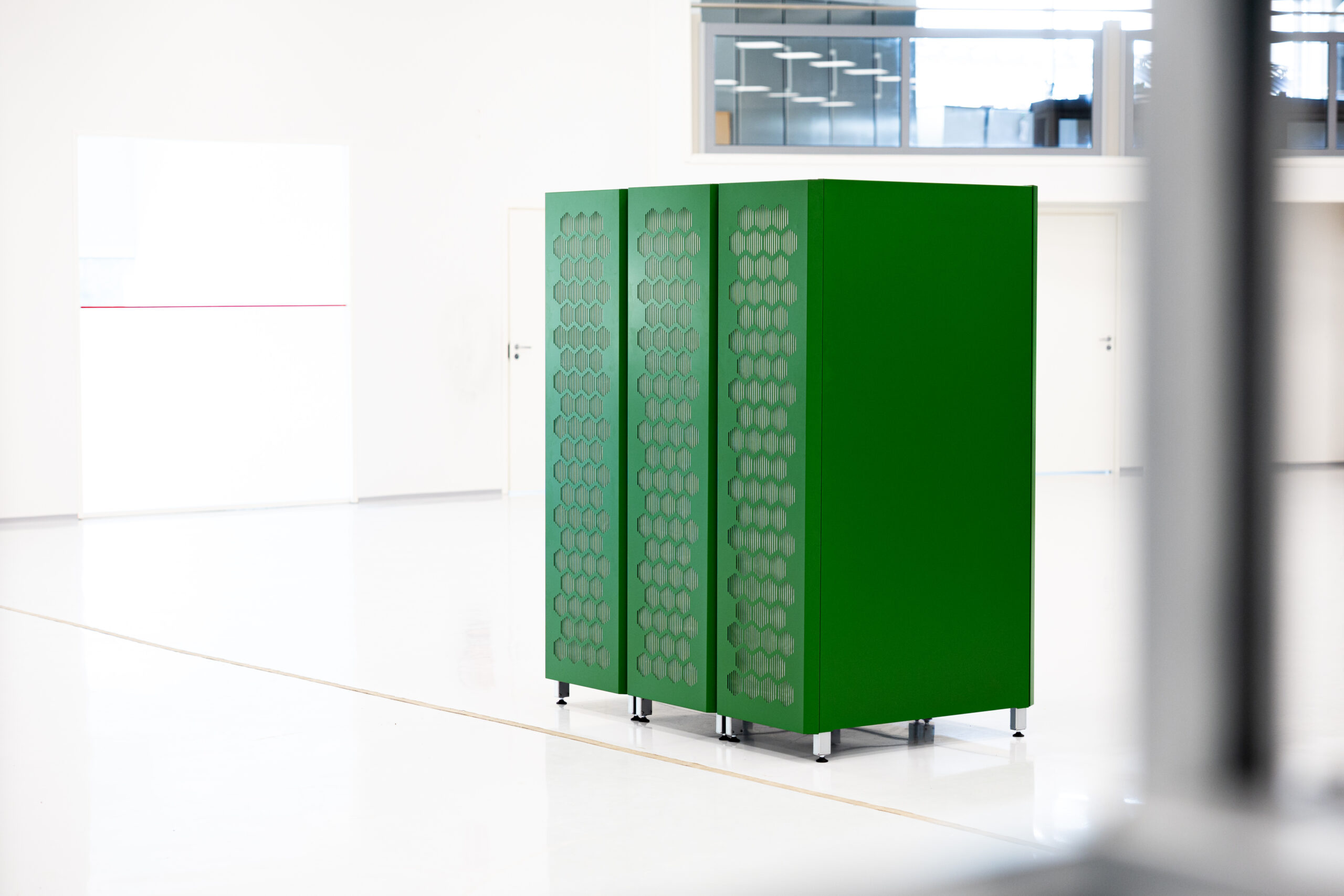
Photo: Cactos Oy
Definition changes: is your company now an industrial battery producer?
The new law provides a more precise definition of industrial batteries. These include batteries specifically designed for industrial use, as well as those repurposed for industrial applications.
Examples include traction batteries used in railway, marine, and aviation vehicles, batteries for mobile work machinery, and those used in communication networks, agriculture, or electricity production and distribution.
Additionally, all batteries over 5 kg are classified as industrial batteries unless they are specifically for electric vehicles, light mobility devices, or automotive applications. This means consumer products, such as home energy storage batteries, also fall under the industrial battery category.
The regulation also expands the definition of a battery producer to include not only importers, manufacturers, and online sellers but also distributors. Any entity that places industrial batteries on the Finnish market for the first time is considered a producer.
Online sellers must now appoint an authorized representative in each EU country where they sell batteries directly to end-users.
Responsibilities have changed: producer, this now falls under your duty
The producers are responsible for the collection and recycling of used batteries. According to the EU Battery Regulation, this extended producer responsibility becomes joint liability for industrial batteries, meaning that batteries cannot be placed on the market unless the responsibility is fulfilled. In Finland, this means joining the producer organisation established by producers.
The producer organisation ensures that users have the opportunity to return all waste batteries, classified as industrial batteries, easily, free of charge, and without the obligation to purchase a new product.
All industrial batteries simply refer to the fact that the battery must be accepted regardless of its origin, brand, condition, nature, or chemical composition. The challenge is further increased as collection points might also receive industrial batteries that were placed on the market before the law change.
To receive these, a nationwide collection network, collection infrastructure meeting safety requirements, and transport to licensed treatment facilities must be in place.
In addition to tightening recycling efficiency requirements, the recycling processes must capture an increasing amount of key battery raw materials, such as cobalt, lithium, copper, and nickel. After transition periods, new batteries must contain at least the minimum required amount of recycled raw materials.