Dark colours use less energy on the screen than light colours. The theme colour does not affect the colours of videos or other media content. Keeping dark mode enabled helps save energy and may also be more comfortable on the eyes.

Display website images in lighter versions. Smaller image files make the website lighter to load.

Turn off animations and motion effects on the website. This gives you a simpler and calmer browsing experience.

Webinar Provides Answers: Battery producer responsibility is changing. What does the EU Batteries Regulation mean in practice?Webinar Provides Answers: Battery producer responsibility is changing. What does the EU Batteries Regulation mean in practice?
Webinar Provides Answers: Battery producer responsibility is changing. What does the EU Batteries Regulation mean in practice?Webinar Provides Answers: Battery producer responsibility is changing. What does the EU Batteries Regulation mean in practice?

How does the EU Batteries Regulation change extended producer responsibility for batteries? What do producers, distance sellers and distributors need to know about the new obligations? These questions were explored in the ninth webinar on the EU Batteries Regulation, where the changes were discussed from the perspectives of both the authorities and producer responsibility organisations.

The EU Batteries Regulation covers the entire life cycle of batteries, from manufacturing and use to reuse and, ultimately, recycling. The requirements concerning extended producer responsibility and waste battery management began to apply on 18 August 2025. These changes are now affecting practical arrangements, including producer registration, collection systems, distributor obligations and reporting.

The EU Batteries Regulation introduces new producer responsibility obligations

In her presentation, Jaana Mäenpää, Senior Officer at the Finnish Supervisory Agency, explained what extended producer responsibility means and how the EU Batteries Regulation has changed the obligations.

The basic principle of extended producer responsibility is that the company first placing batteries on the Finnish market is responsible for organising their waste management. In practice, this responsibility covers the collection, transport, treatment and recycling of waste batteries. In Finland, producers can fulfil their obligations by joining an approved producer responsibility organisation.

Under the EU Batteries Regulation, the previous three battery categories have been replaced by five: portable batteries, light means of transport (LMT) batteries, starting, lighting and ignition (SLI) batteries, electric vehicle (EV) batteries and industrial batteries. The battery category determines, among other things, the applicable collection and take-back requirements.

The responsibilities of distributors have also expanded. Distributors are now required to take back waste batteries from all battery categories they sell. In addition, distributors must verify that the producer of the batteries has fulfilled its producer responsibility obligations and is registered in the producer register. This information can be checked through the Finnish Waste Management Compass (Jätehuoltokompassi).

Another significant change concerns distance selling. Companies selling batteries directly to end-users in another EU Member State through distance sales must appoint an authorised representative in that country to fulfil their extended producer responsibility obligations.

Producer responsibility organisations put the new requirements into practice

The CEOs Liisa-Marie Stenbäck of Recser Oy, Johanna Alakerttula of Akkukierrätys Pb Oy and Juha Kenraali of Suomen Autokierrätys Oy explained how the new requirements are being implemented in producer responsibility systems for different battery categories.

The key message for producers is that they do not have to manage the changing obligations alone. Producer responsibility organisations take care of various obligations on behalf of their members, including organising collection and recycling, reporting to the authorities and providing guidance. Following the introduction of the EU Batteries Regulation, these systems are being updated to meet the new requirements concerning battery categories, collection and recycling targets.

Recser Oy’s producer responsibility system covers portable batteries, light means of transport (LMT) batteries and non-lead-acid starting, lighting and ignition (SLI) batteries. The new Recser Industrial Oy is responsible for extended producer responsibility for non-lead-acid industrial batteries. The companies share an operational framework, but their responsibilities remain separate. Akkukierrätys Pb Oy continues to manage extended producer responsibility for lead-acid SLI and industrial batteries, while Suomen Autokierrätys Oy is responsible for electric vehicle (EV) batteries.

Collection networks are also being updated to meet the requirements of the new regulation. The regional collection network for batteries weighing less than 50 kilograms must cover every municipality in Finland. For industrial batteries weighing 50 kilograms or more, there must be at least one regional collection point in each region of Finland. At the same time, collection equipment, safety instructions and services are being developed to ensure that waste batteries are collected and treated safely.

For electric vehicle batteries, one of the key issues for the future is reuse. Juha Kenraali pointed out that the aim of the EU Batteries Regulation is not to direct all end-of-life batteries straight to material recycling, but also to enable their repair and reuse whenever this can be done safely. In the future, battery passports and information on the life cycle of batteries will become increasingly important.

The role of producer responsibility organisations is to make changing obligations as clear and manageable as possible for producers. The EU Batteries Regulation further specifies how extended producer responsibility is implemented in practice. Under the polluter-pays principle, producers are responsible for organising and financing the waste management of batteries they place on the market. They also have the primary right to organise the waste management of products covered by their producer responsibility obligations.

This ensures that waste batteries are safely directed into the producer responsibility system and that their valuable materials are returned to circulation.

Watch the full webinar recording in Finnish with English subtitles here.

Battery Producer Responsibility Organisations:

Further Information

The Finnish Licensing and Supervision Authority provides additional guidance and official interpretations related to producer responsibility legislation on its website: Legislation and Guidelines on Extended Producer Responsibility – Finnish Supervisory Agency

Renewables Finland

Cactos Oy

Read our previous articles:

Webinar Provides Answers: Industrial Battery Producer Responsibility in Practice: What BESS Project Stakeholders Need to Know – Recser

Webinar Provides Answers: what does the EU Battery Regulation require in practice from collection and distributors? – Recser

Webinar Provides Answers: Durability, Safety, Labeling, and Information Requirements for Batteries – Recser

Webinar Provides Answers: Proper due diligence in the battery supply chain – Recser
Webinar Provides Answers: How does the battery regulation change the obligations of manufacturers and importers? – Recser

Recser and Recser Industrial approved as producer responsibility organisations

Recser and Recser Industrial approved as producer responsibility organisations

Recser Oy and Recser Industrial Oy have received approvals as producer responsibility organisations in accordance with the EU Battery Regulation. With these decisions, the reform of the producer responsibility schemes is moving from preparation to practical implementation. The producer responsibility organisations will be entered in the producer register once the decisions become legally valid.

Existing producers’ agreements will be renewed

Existing producers’ agreements will be renewed to reflect the new producer responsibility organisation approvals, the battery categories under the EU Battery Regulation, and the corresponding division of responsibilities.

The agreement renewal process will begin in the Elrepo system on 1 December 2026 and continue until 28 February 2027. During this three-month transition period, no registration fees will be charged for the renewal of the required agreements, even if a producer needs agreements with more than one producer responsibility organisation in the future.

More detailed company-specific instructions for renewing agreements will be provided at the end of November. No action is required from producers at this stage.

New producers can join from 1 December 2026

New producer agreements with Recser Oy and Recser Industrial Oy can be concluded from 1 December 2026. The appropriate agreement will depend on the battery categories, as defined in the EU Battery Regulation, to which the batteries placed on the Finnish market by the company belong.

Recser Industrial Oy is responsible for industrial batteries, excluding lead-based industrial batteries. Depending on the types of batteries it places on the market, a producer may need agreements with more than one producer responsibility organisation.

Authorised representative for distance sellers

Under the EU Battery Regulation, appointing an authorised representative is mandatory for cross-border distance sales. A foreign company that sells batteries by distance selling directly to end users in Finland and is not established in Finland must appoint an authorised representative established in Finland to fulfil its producer responsibility obligations.

Recser Oy and Recser Industrial Oy can act as authorised representatives for batteries falling within their respective product categories.

Similarly, a Finnish company that sells batteries by distance selling directly to end users in another EU Member State in which it is not established must appoint an authorised representative in that Member State.

What happens next?

At the end of November, we will publish more detailed instructions on renewing existing agreements and concluding new agreements. The renewal of existing agreements and the conclusion of new agreements with Recser Oy and Recser Industrial Oy will begin on 1 December 2026.

Webinar Provides Answers: Industrial Battery Producer Responsibility in Practice: What BESS Project Stakeholders Need to Know

Webinar Provides Answers: Industrial Battery Producer Responsibility in Practice: What BESS Project Stakeholders Need to Know

The EU Batteries Regulation has significantly changed producer responsibility obligations for industrial batteries. A Batteries Regulation webinar organised by Recser Oy, Recser Industrial Oy, Akkukierrätys Pb Oy and Renewables Finland (Suomen uusiutuvat ry) focused on identifying who is considered a producer under the new legislation and how these obligations are fulfilled in practice in Finland.

The webinar brought together industrial battery producers, BESS project developers and owners, energy sector stakeholders, and public authorities to discuss the changes introduced by the Batteries Regulation. Particular attention was given to the definition of an industrial battery producer, collective producer responsibility, and practical solutions for battery collection and recycling.

Who Is an Industrial Battery Producer?

Jaana Mäenpää, Senior Officer at the Finnish Supervisory Agency, explained the legal definition of battery producers. Producers are economic operators that first place batteries on the Finnish market. A producer may be, for example, a manufacturer, importer, distance seller or distributor.

Producer responsibility may also arise when batteries are sold together with other products, resold under a private label, or placed on the market following reuse, repurposing or remanufacturing. In addition, the obligation may apply to batteries imported into Finland for a company’s own use.

“Batteries may not be made available on the market in an EU Member State unless the producer responsibility obligations have been fulfilled.”

Mäenpää also reviewed the definitions of industrial batteries and discussed how the Batteries Regulation is interpreted in battery energy storage system projects. As supply chains often involve multiple parties, determining producer responsibility may require case-by-case assessment.

Collective Producer Responsibility Changes the Operating Model

One of the most significant changes introduced by the Batteries Regulation is the transition of producer responsibility for large industrial batteries to a collective model. This means that producers jointly finance and organise the collection and waste management of end-of-life batteries within a battery category, regardless of which producer originally placed the batteries on the market.

Established in spring 2026, Recser Industrial Oy is a wholly owned subsidiary of Recser Oy and has been created to manage the collective producer responsibility obligations for industrial batteries other than lead-based batteries. The aim is to separate the responsibilities, costs and operations related to industrial batteries into their own dedicated system.

In the future, producer responsibility for industrial batteries will be managed through Recser Industrial Oy, while portable batteries, batteries for light means of transport, and vehicle batteries (SLI batteries excluding lead-based batteries) will remain within the scope of Recser Oy. Akkukierrätys Pb Oy, in turn, is responsible for fulfilling producer responsibility obligations for lead-based vehicle and industrial batteries.

Producer obligations include registration, reporting batteries placed on the market, and payment of recycling fees. The producer responsibility organisation is responsible for organising the collection network, logistics, recycling operations and regulatory reporting.

The service model has been designed to be fully digital. Producers register through an online portal, report batteries placed on the market electronically, and pay recycling fees based on their reported volumes. In addition, the producer responsibility organisation provides ongoing guidance, regulatory updates and an annual certificate confirming compliance with producer responsibility obligations.

Recycling Solutions for Growing Battery Volumes

Joni Korkola, Recycling Services Manager at Recser Oy, presented the collection, logistics and recycling chain for industrial batteries. The objective is to establish a nationwide collection network across Finland, complemented by direct collection services from large-scale energy storage sites when needed.

The webinar also examined how battery chemistry affects recycling costs. Particular interest was shown in lithium iron phosphate (LFP) batteries, as their recycling is currently more challenging than that of nickel manganese cobalt (NMC) batteries under existing recycling technologies.

“Recycling solutions for LFP batteries already exist, but the costs remain high because current recycling processes have primarily been
built around NMC and NCA battery chemistries.”

Nevertheless, recycling technologies are expected to develop rapidly as the growing market share of LFP batteries creates strong incentives for new investments and innovation.

A Clear and Cost-Effective System for Producers

The producer perspective was presented by Veli-Erkki Ruotsalainen, Founder and COO of Cactos Oy, who explained how the company is preparing for the new obligations. According to Ruotsalainen, collective producer responsibility simplifies compliance for companies. Once registration, reporting and fee payments have been completed, the producer responsibility organisation manages the remaining obligations.

A key message from the webinar was that every company involved in the industrial battery supply chain should assess its own role and obligations well in advance. Proper compliance with producer responsibility requirements is a prerequisite for placing batteries on the market. Furthermore, responsibility extends throughout the battery life cycle, from market placement to end-of-life management and recycling.

The producer responsibility system will continue to be developed in cooperation with industry stakeholders and other battery producer responsibility organisations. Future development work will focus on enhancing services for industrial battery producers, supporting closed-loop battery material cycles, and exploring alternative financing and fee models that take into account the long service life of industrial batteries.

Watch the full webinar recording in Finnish with English subtitles here.

Battery Producer Responsibility Organisations

Further Information

The Finnish Licensing and Supervision Authority provides additional guidance and official interpretations related to producer responsibility legislation on its website: Legislation and Guidelines on Extended Producer Responsibility – Finnish Supervisory Agency

Renewables Finland

Cactos Oy

Read our previous articles:

Answers from the webinar: what does the EU Battery Regulation require in practice from collection and distributors? – Paristokierrätys

Webinar Provides Answers: Durability, Safety, Labeling, and Information Requirements for Batteries

#BatteryRegulationSeminar: EUCOBAT Stands by Producers as the EU Decides on Battery Regulation Guidelines – Paristokierrätys

#BatteryRegulationSeminar: EU battery regulation tightens requirements, but recycling service providers believe in collaboration: “This is a chain that we all influence” – Paristokierrätys

#BatteryRegulationSeminar: Producer organisations make producer responsibility manageable – even in times of change

#BatteryRegulationSeminar: Battery producer organisations’ seminar strengthened faith in the future and the power of collaboration

#BatteryRegulationSeminar: the EU Battery Regulation imposes obligations on all actors in the value chain – Paristokierrätys

#BatteryRegulation: producer responsibility for industrial batteries changes in August 2025 – what does collective responsibility mean? – Paristokierrätys

#BatteryRegulation: the EU battery regulation demands more efficient recycling – Finland prepares for new targets – Paristokierrätys

#BatteryRegulation: answers from the webinar – proper due diligence in the battery supply chain – Paristokierrätys

#BatteryRegulation: Commission guidelines on the removability and replaceability of portable batteries and light means of transport (LMT) batteries – Paristokierrätys

#BatteryRegulation: An Intense Year of Battery Regulation Behind – and a New One Ahead – Paristokierrätys

#BatteryRegulation: The battery passport is real and full of potential – Test the battery passport using the QR code in the article! – Paristokierrätys

This article is a part of the joint communications of the battery producer organisations Recser Oy and Akkukierrätys Pb Oy concerning the EU Batteries Regulation. You can also subscribe to our newsletter to receive the latest news on the subject.

producer responsibility for industrial batteries changes in August 2025 – what does collective responsibility mean?

producer responsibility for industrial batteries changes in August 2025 – what does collective responsibility mean?

The EU’s new battery regulation introduces significant changes to the producer responsibility for industrial batteries starting from 18 August 2025. The key change is the expansion of responsibility: producers will be responsible not only for the waste management of their own batteries but also for similar batteries from other producers. This marks a shift from individual contract-based models to a shared, collective system.

From individual responsibility to a shared system

Currently, producers have legally been able to agree on recycling costs with the end user only when the battery reaches end-of-life. This has enabled an individual, retrospective responsibility without an obligation to participate in a shared collection network.

Under the new regulation, producers are required to accept end-of-life batteries free of charge – regardless of the battery’s origin, brand, or chemical composition. According to Article 61, the responsibility also includes so-called orphan batteries, whose origin cannot be traced. This necessitates the establishment of a nationwide collection system for industrial batteries as well.

The role of producer organisations becomes more important

Collective responsibility will in practice be implemented through producer organisations. In Finland, legislation has already steered towards a collective operating model, and the battery regulation reinforces this direction. In practice, joining a producer organisation will become essential.

The regulation requires that recycling fees within producer organisations must be based at least on battery type and chemistry. In addition, factors such as battery durability, recyclability, hazardous substances, carbon footprint, and potential for reuse or remanufacturing must be considered. Potential revenues from recovered raw materials or preparation for reuse can also be taken into account when adjusting fees.

Diverging interpretations on retroactive responsibility – EUCOBAT’s stance is clear

There has been debate about whether collective responsibility also applies to batteries placed on the market before 18 August 2025. EUCOBAT, the European association of battery and accumulator producer organisations, has requested clarification from the Commission regarding the application of Article 61.

EUCOBAT emphasises that the regulation must be applied uniformly across all Member States. National differences could cause market distortions and lead to a situation where compliant producers end up covering the costs of others.

EUCOBAT’s implementation recommendations

  1. Time limitation of responsibility
    Batteries placed on the market before 18 August 2025 remain the responsibility of the original producer or must be addressed separately through an agreement with the producer organisation. For new batteries, recycling costs are typically covered in advance through fees paid to producer organisations.
  2. Preventing free-riding
    Distance sellers must be required to appoint an authorised representative in the destination country. Authorities must have effective tools and the right to access information in order to monitor compliance with producer responsibility.

What does the change mean in practice for producers?

  • Responsibility for recycling costs is no longer limited to a producer’s own products – producers must contribute a fair share to the recycling of similar “orphan” batteries
  • Recycling fees are generally paid when the product is placed on the market
  • Belonging to a producer organisation is a prerequisite for market access
  • Waste management costs can no longer be transferred to the end user

Registration and producer organisations in Finland

Anyone who places batteries on the Finnish market or for their own use must register as a producer before beginning import or sales. Distributors must ensure that the producer belongs to an approved producer organisation.

Lead batteries: Akkukierrätys Pb Oy
Other industrial batteries: Recser Oy

Read more:

Solution for producer responsibility of large industrial batteries – Four companies expanding Recser – Paristokierrätys

Information on Extended Producer Responsibility – Tuottajavastuu – ELY keskus

Home | Eucobat

Read our previous articles:

#BatteryRegulation: the EU battery regulation demands more efficient recycling – Finland prepares for new targets – Paristokierrätys

#BatteryRegulation: answers from the webinar – proper due diligence in the battery supply chain – Paristokierrätys

#BatteryRegulation: Commission guidelines on the removability and replaceability of portable batteries and light means of transport (LMT) batteries – Paristokierrätys

#BatteryRegulation: An Intense Year of Battery Regulation Behind – and a New One Ahead – Paristokierrätys

#BatteryRegulation: The battery passport is real and full of potential – Test the battery passport using the QR code in the article! – Paristokierrätys

This article is a part of the joint communications of the battery producer organisations Recser Oy and Akkukierrätys Pb Oy concerning the EU Batteries Regulation. You can also subscribe to our newsletter to receive the latest news on the subject.

the EU battery regulation demands more efficient recycling – Finland prepares for new targets

the EU battery regulation demands more efficient recycling – Finland prepares for new targets

In Finland, the collection and recycling of batteries has been effectively implemented through producer responsibility systems, and the requirements of the current legislation are well met. Chapter 8 of the battery regulation, entering into force in August 2025, will gradually tighten collection and recycling requirements and introduce obligations for the use of recycled materials in the production of new batteries.

Producer organisations annually compile data on batteries placed on the market, collected, and recycled, and submit this information to the Pirkanmaa ELY Centre. The ELY Centre then compiles national statistics and reports them to the European Commission.

Separate collection targets

Current legislation requires that at least 45% of portable batteries be collected separately from other waste for recycling. The target is based on the average amount placed on the market during the previous three years.

In 2024, 3,480 tonnes of portable batteries were placed on the Finnish market, and nearly 2,000 tonnes were collected as waste. This corresponds to a collection rate of approximately 50%, which exceeds the minimum requirement. In 2022, only 13 EU member states met the target.

No specific collection target exists for industrial or automotive batteries, but producers must ensure that all batteries returned to collection points are recycled.

Recycling targets

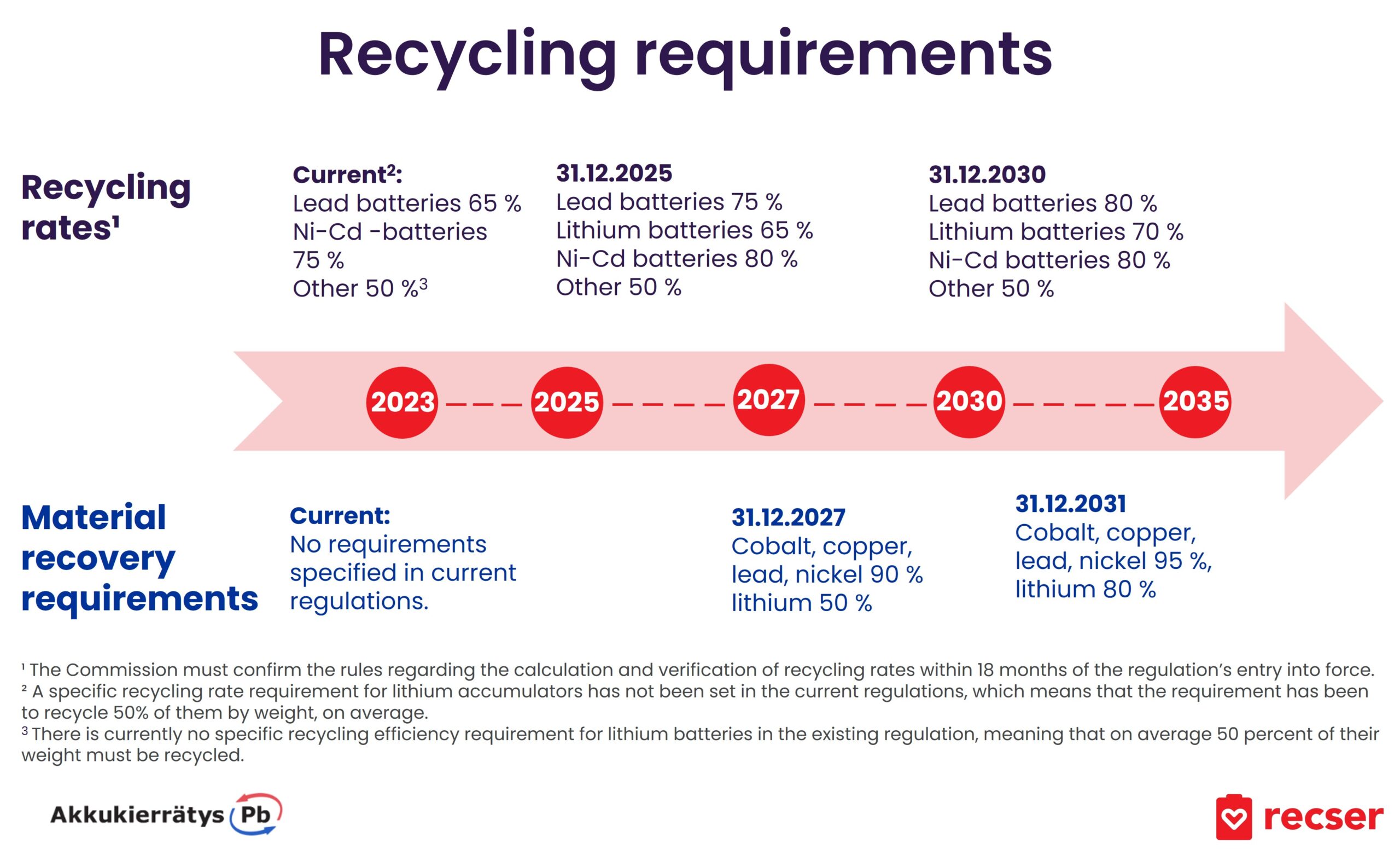
Lead battery recycling has remained strong in Finland. In 2024, 23,000 tonnes were collected, with a recycling efficiency of 71%. The recycling rate for the lead content of these batteries was as high as 94.2%. The current requirement level (65%) has been met annually. Currently, lead batteries are delivered to four recycling facilities located within the EU.

Portable batteries are sorted in Finland and sent either after crushing or intact to specialised treatment facilities in Finland and elsewhere in Europe. For nickel-cadmium batteries, 80% is recycled, and for other batteries, such as lithium and alkaline batteries, at least 50%. These legislative requirements have been met annually.

Collection and recycling targets will tighten

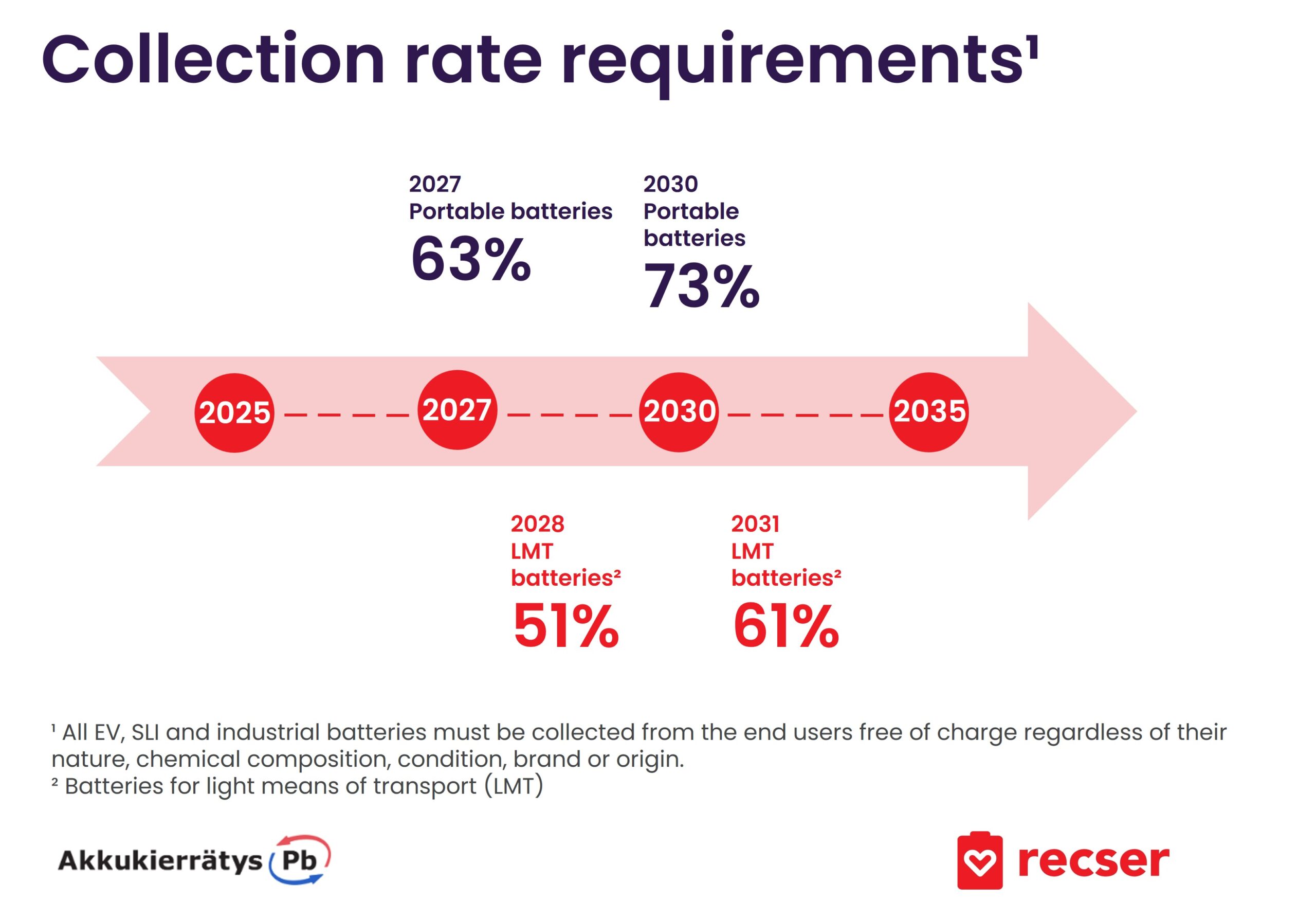
In the coming years, separate collection targets will become stricter. According to the battery regulation, the collection rate for portable batteries must rise to 65% by 2027 and to 73% by 2030. A collection target of 51% will apply to light means of transport, such as e-scooters and e-bikes, by the end of 2028, increasing to 61% by 2031. This reflects the growing need for more responsible material circulation.

Efficiency requirements for recycling facilities will also tighten. By 2026, the recycling efficiency for lithium-ion batteries must reach 75%. By the end of 2027, 90% of cobalt, copper, lead, and nickel and 50% of lithium must be recovered from collected batteries. Both overall recycling rates and material-specific recovery requirements will continue to increase by 2030.

Markets for recycled raw materials will strengthen

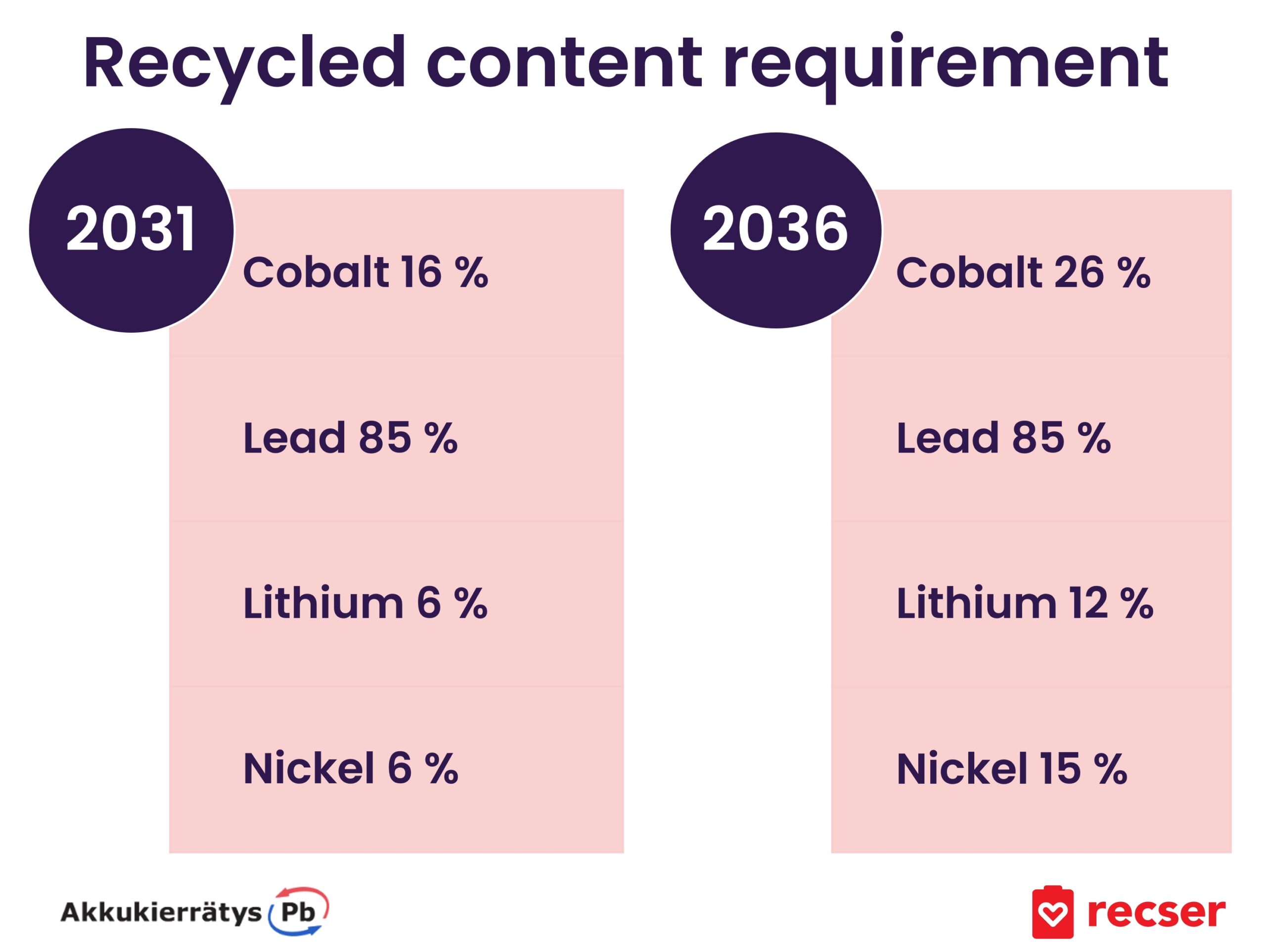
The new regulation focuses not only on collection volumes but also on the sustainable use of raw materials. From 2031 onward, new batteries must contain at least the following proportions of recycled materials: cobalt 16%, lead 85%, and lithium and nickel 6%. The requirements for cobalt, lithium, and nickel will increase further by 2036.

Circular economy becomes reality through collaboration

Finland’s long experience and established producer responsibility model provide a strong foundation for meeting the tightening requirements. However, the transition will require even closer cooperation between consumers, producers, waste management operators, and authorities to ensure a circular economy throughout the battery life cycle.

Consumer contribution is crucial in reaching the collection targets: the more batteries are returned properly, the easier it will be for Finland to meet the stricter requirements. Taking batteries to collection points is a small action with a big impact on sustainable development and material efficiency. From August 2025, the battery regulation requires end-users to separately sort and return used batteries to collection points.

Explore the recycling calculator

Member companies of Akkukierrätys Pb and Recser can use the recycling calculator to calculate their company-specific collection and recycling results. The calculator provides concrete data that can be used, for example, in communication with customers and stakeholders. Download the user guide (in Finnish) for the calculator.

Read more

Statistics: Statistics – Paristokierrätys and Tilastot – Akkukierrätys Pb Oy

Recycling process: Recycling process – Paristokierrätys and Recycling process – Paristokierrätys

Read our previous articles:

#BatteryRegulation: answers from the webinar – proper due diligence in the battery supply chain – Paristokierrätys

#BatteryRegulation: Commission guidelines on the removability and replaceability of portable batteries and light means of transport (LMT) batteries – Paristokierrätys

#BatteryRegulation: An Intense Year of Battery Regulation Behind – and a New One Ahead – Paristokierrätys

#BatteryRegulation: The battery passport is real and full of potential – Test the battery passport using the QR code in the article! – Paristokierrätys

This article is a part of the joint communications of the battery producer organisations Recser Oy and Akkukierrätys Pb Oy concerning the EU Batteries Regulation. You can also subscribe to our newsletter to receive the latest news on the subject.

Webinar Provides Answers: Proper due diligence in the battery supply chain

Webinar Provides Answers: Proper due diligence in the battery supply chain

Due diligence in the battery supply chain – what do the Battery Regulation and the Corporate Sustainability Due Diligence Directive (CS3D) require from companies? These questions were addressed in the fifth Battery Regulation webinar.

The European Union’s Battery Regulation and Corporate Sustainability Due Diligence Directive (CS3D) impose new types of obligations on companies to ensure responsibility throughout their supply chains. These topics were explored during the Battery Regulation webinar held on 3 June 2025, where experts shed light on the content and impact of the new regulations on business operations. The event was organised by Recser Oy and Akkukierrätys Pb Oy, which operate as battery producer organisations. The webinar attracted around 230 participants interested in these timely topics.

CS3D requires companies to identify and respond to risks

Netta Skön, sustainability lawyer at Fondia Plc, presented the key requirements of the Corporate Sustainability Due Diligence Directive (CS3D). The directive currently applies to large companies – those with more than 1,000 employees and annual turnover exceeding €450 million – and requires the implementation of a comprehensive due diligence (DD) process to identify, assess, prevent, or mitigate adverse human rights and environmental impacts throughout the value chain.

Information gathering is at the heart of the directive. According to Skön, a company must understand the risks related to its own operations and supply chain: “In the global economy, value chains are complex, but this makes data management and understanding of impacts even more critical.”

Battery regulation vs. CS3D: similarities and differences

Both the Battery Regulation and CS3D emphasize responsible business conduct and supply chain transparency. They share the goal of preventing environmental and human rights risks. However, they differ in nature: the Battery Regulation is directly applicable EU legislation, while CS3D is a directive that requires national transposition. Additionally, the Battery Regulation specifically targets the battery value chain, whereas CS3D applies across multiple industries.

Skön sees the overlapping regulations not as a problem but as an opportunity: “If a company integrates its DD process effectively, it can meet the requirements of both regulations with one system.”

Regulatory landscape changing – impacts of the Omnibus packages

EU sustainability legislation is undergoing reform through so-called Omnibus packages, which introduce multiple changes or clarifications across regulations simultaneously. Notably, several changes have been proposed to CS3D, and its application timeline has been postponed by two years, now set to take effect in 2028.

The Omnibus IV package, published in late May, also proposes changes to the DD obligations under the Battery Regulation: the entry into force may be delayed by two years, and the threshold for applicability could be raised from companies with €40 million turnover to those with €150 million in turnover. The turnover threshold applies to the company’s entire revenue, not just the battery business.

Johanna Routio, ministerial adviser from the Ministry of the Environment, stressed that the delay should not be seen as a transition period: “Companies should use the additional time to prepare and develop their processes.”

The Omnibus IV proposals can be commented on through the EU’s Have Your Say portal. The points open for feedback concern, in particular, changes to the timeline and turnover thresholds.

What does the Battery Regulation require in practice?

Kati Suomalainen, senior specialist at the Ministry of the Environment, presented the content of Chapter VII of the Battery Regulation, particularly Articles 49–53, as well as Article 93 of Chapter XIV. The DD obligations focus on the sourcing, processing, and trade of raw materials and secondary raw materials – and on managing social and environmental risks throughout the supply chain.

Companies are required to:

  • Establish an operational policy and communicate it to suppliers and the public
  • Ensure traceability through upstream chains
  • Prepare a risk management plan and integrate it into business strategy
  • Set up a grievance mechanism
  • Undergo an audit conducted by a notified body

The proposed Omnibus changes are also expected to delay the publication of the Commission’s DD implementation guidelines until July 2026.

Sandvik’s experience: getting a head start through proactivity

The webinar concluded with a company case example from Sandvik Mining and Construction Oy. The company has proactively begun developing its due diligence process, focusing particularly on industrial batteries. Hinrich Kress described the project as requiring a group-level solution, close collaboration, and budgeting – with a single audit potentially costing up to €20,000.

Kress expressed concern about notified bodies becoming bottlenecks but remained optimistic about the future: “Legislators are behind schedule, but if we can demonstrate genuine efforts to comply, that will go a long way.”

Summary

It is time for companies to wake up to the responsibility requirements in their supply chains. Both the EU Battery Regulation and CS3D steer business toward more transparent and sustainable practices. Proactive preparation helps avoid last-minute rushes and potential sanctions – and can also provide a competitive advantage in a changing business environment.

See the questions and answers presented in the webinar.

Read our previous articles:

#BatteryRegulation: Commission guidelines on the removability and replaceability of portable batteries and light means of transport (LMT) batteries – Paristokierrätys

#BatteryRegulation: An Intense Year of Battery Regulation Behind – and a New One Ahead – Paristokierrätys

#BatteryRegulation: The battery passport is real and full of potential – Test the battery passport using the QR code in the article! – Paristokierrätys

#BatteryRegulation: Review Product and Labeling Requirements Effective August 18, 2024 – Paristokierrätys

#BatteryRegulation: The Battery Passport is Coming – Are You Ready? – Paristokierrätys

New EU Battery Regulation Changes the Market – Eucobat Makes Finnish Producers’ Voice Heard in Brussels – Paristokierrätys

#BatteryRegulation: Distributors of batteries, are you aware of your new responsibilities? – Paristokierrätys

#BatteryRegulation: Webinar answers – How does the battery regulation change the obligations of manufacturers and importers?

This article is a part of the joint communications of the battery producer organisations Recser Oy and Akkukierrätys Pb Oy concerning the EU Batteries Regulation. You can also subscribe to our newsletter to receive the latest news on the subject.

Commission guidelines on the removability and replaceability of portable batteries and light means of transport (LMT) batteries

Commission guidelines on the removability and replaceability of portable batteries and light means of transport (LMT) batteries

The European Commission has published guidelines aimed at clarifying the uniform application of regulations concerning the removability and replaceability of portable batteries and light electric vehicle batteries (LMT batteries) under the EU Battery Regulation (EU) 2023/1542. The guidelines provide technical recommendations and illustrative examples that are not legally binding. Article 11 of the regulation will apply from February 18, 2027. The purpose of the guidelines is to ensure sustainable and safe practices for handling and replacing batteries throughout the product’s lifecycle.

Key principles of battery removability and replaceability

Under Article 11, anyone placing products equipped with portable batteries or batteries on the market must ensure that the batteries can be easily removed and replaced by the end user throughout the product’s entire lifespan. However, this requirement does not apply to individual cells or other components of battery units.

The requirements for LMT batteries differ from the above. Those placing products with LMT batteries on the market must ensure that both the batteries and individual battery cells within the battery unit can be easily removed and replaced by independent professionals throughout the product’s entire lifespan.

  • Removability means that the end user or an independent professional can safely remove the battery without damaging the device or the battery itself.
  • Replaceability requires that the battery can be replaced without causing damage, maintaining the device’s performance and safety.

Exceptions to the removability requirements

In certain cases, the end user does not need to be able to remove and replace the battery themselves. These exceptions include:

  • Devices operating in wet environments, such as those exposed to washing water.
  • Professional medical imaging and radiation therapy devices, as well as in vitro diagnostic devices.
  • Devices requiring continuous power supply for user safety or data integrity, such as certain medical devices and equipment that continuously collect and transmit data.

Exceptions apply only if redesigning the device does not allow for safe battery replacement by the end user.

Additional considerations

Compatible batteries

A compatible battery or battery unit must:

  • Not pose a safety risk to the user or device.
  • Allow the device to function as intended.
  • Match the original battery in technical parameters, such as capacity and chemical composition.

If the device falls under the type-approval requirements of Regulation (EU) No 168/2013, battery replacement is permitted only if it does not affect type-approval definitions. For LMT vehicles that do not require type approval, battery replacement must comply with the manufacturer’s safety protocols.

Software restrictions

Software must not prevent the replacement of compatible batteries. For example, “parts-pairing” practices, where a battery is software-locked to a specific device, are not allowed. However, software may ensure secure communication between the device and the battery to guarantee safety and functionality.

Under Regulation (EU) 2023/1670, which sets ecodesign requirements for smartphones and tablets, manufacturers must provide professional repairers with non-discriminatory access to software and tools ensuring the full functionality of spare parts. If both regulations (EU) 2023/1542 and (EU) 2023/1670 apply to the same product, the requirements of both must be followed.

Availability of spare parts

Under Article 11(7), portable batteries and LMT batteries must be available as spare parts for at least five years after the last model of the device is placed on the market. These must be offered at a reasonable and non-discriminatory price to independent professionals and end users. Spare parts, such as fasteners, must be delivered within five working days of ordering. If fasteners are not reusable, they must be provided separately. This requirement does not apply to products placed on the market before February 18, 2027.

Under Regulation (EU) 2023/1670, from June 20, 2025, phone manufacturers, importers, or authorized representatives must ensure that portable batteries and necessary fasteners remain available for professional repairers and end users for at least seven years after the last model of the device is placed on the market. If both regulations (EU) 2023/1542 and (EU) 2023/1670 apply to the same product, both must be complied with simultaneously to ensure the availability and compatibility of spare parts.

Recommendations

  • User manuals: Instructions should provide clear guidance on removing and replacing batteries, as well as technical specifications for compatible alternatives. If necessary, manuals should reference EU or international standards to ensure safety.
  • Recycling: Users should receive clear instructions on the proper recycling of batteries, especially small lithium batteries and lithium-ion batteries used in products such as greeting cards and e-cigarettes, as these pose a fire hazard in waste treatment facilities.

Link to the Commission’s guidelines

Commission Notice – Commission guidelines to facilitate the harmonised application of provisions on the removability and replaceability of portable batteries and LMT batteries in Regulation (EU) 2023/1542

Read our previous articles:

#BatteryRegulation: An Intense Year of Battery Regulation Behind – and a New One Ahead – Paristokierrätys

#BatteryRegulation: The battery passport is real and full of potential – Test the battery passport using the QR code in the article! – Paristokierrätys

#BatteryRegulation: Review Product and Labeling Requirements Effective August 18, 2024 – Paristokierrätys

#BatteryRegulation: The Battery Passport is Coming – Are You Ready? – Paristokierrätys

New EU Battery Regulation Changes the Market – Eucobat Makes Finnish Producers’ Voice Heard in Brussels – Paristokierrätys

#BatteryRegulation: Distributors of batteries, are you aware of your new responsibilities? – Paristokierrätys

#BatteryRegulation: Webinar answers – How does the battery regulation change the obligations of manufacturers and importers?

This article is a part of the joint communications of the battery producer organisations Recser Oy and Akkukierrätys Pb Oy concerning the EU Batteries Regulation. You can also subscribe to our newsletter to receive the latest news on the subject.

An intense year of battery regulation behind – and a new One ahead

An intense year of battery regulation behind – and a new One ahead

Akkukierrätys Pb and Recser Oy support battery producers in the implementation of the new EU Battery Regulation. In 2025, we will continue our popular webinar series on the new battery regulation.

The battery producer organizations Recser Oy and Akkukierrätys Pb began their communication collaboration in 2023 to inform stakeholders about the obligations introduced by the new EU battery regulation and to provide support in complying with them. In 2024, we intensified our communication efforts regarding the battery regulation.

Various events and online articles have played a central role in our producer organizations’ battery regulation communication. A key communication channel in 2024 was our webinar series, which attracted nearly a thousand participants across four webinars.

Topics covered in the webinars included new sustainability, safety, labeling, and information requirements, as well as the obligations of importers, manufacturers, and distributors, and the battery passport. Expert speakers represented the Ministry of the Environment, TUKES, the Pirkanmaa ELY Center, VTT, the Finnish Tax Administration, the Finnish Commerce Federation, and members of battery producer organizations.

During the webinars, we collected audience questions about the battery regulation, and authorities provided answers to nearly 100 questions afterward. These answers are available in the webinar summary articles.

Participants gave excellent feedback on the webinars, with an average rating of 8.75. This reflects strong engagement and interest in the topic. One participant praised the organizers with the following open feedback: “An excellently organized webinar series. I have listened to all sessions and will continue to do so in the future!”

Battery Regulation newsletter – subscribe for updates

In 2024, producer organizations published nine online articles providing in-depth information about the battery regulation. These articles were compiled into battery regulation newsletters, which reached 1,700 different stakeholders. A total of three newsletters were sent in 2024.

Many subscribers are members of the battery producer organizations, but the topic also clearly interests authorities, waste management professionals, and other stakeholders. The newsletters serve as a key information-sharing channel for companies wanting to stay updated on regulatory requirements.

Recser Oy and Akkukierrätys Pb have also released a battery regulation tool (in Finnish) to help various stakeholders assess the new regulation’s requirements. This tool is available exclusively for producer organization members.

In September, Recser also launched a battery regulation chatbot, which has sparked discussions and inquiries. The chatbot has hosted 124 conversations, generating a total of 366 question-answer pairs.

Stay updated on the Battery Regulation

Recser Oy and Akkukierrätys Pb’s efforts to address the obligations of the battery regulation and support companies have proven to be highly valuable. Through this work, we aim to ensure that all stakeholders are prepared to meet the regulation’s requirements and potential challenges.

The EU battery regulation came into effect in August 2023, with its application starting in February 2024. However, the new producer responsibility provisions will not take effect until August 17, 2025.

Our communication on the battery regulation will continue in 2025, as we organize new webinars and actively share information through our channels. If your organization needs more details or wishes to participate in upcoming events, follow our producer organizations on LinkedIn (Akkukierrätys Pb, Recser), visit our websites, and subscribe to the battery regulation newsletter.

Read our previous articles:

#BatteryRegulation: The battery passport is real and full of potential – Test the battery passport using the QR code in the article! – Paristokierrätys

#BatteryRegulation: Review Product and Labeling Requirements Effective August 18, 2024 – Paristokierrätys

#BatteryRegulation: The Battery Passport is Coming – Are You Ready? – Paristokierrätys

New EU Battery Regulation Changes the Market – Eucobat Makes Finnish Producers’ Voice Heard in Brussels – Paristokierrätys

#BatteryRegulation: Distributors of batteries, are you aware of your new responsibilities? – Paristokierrätys

#BatteryRegulation: Webinar answers – How does the battery regulation change the obligations of manufacturers and importers?

#Aalto University: BATCircle2.0 continued Finland-based battery metals and recycling research – Paristokierrätys

#BatteryRegulation: The webinar gave additional information about the requirements of the Battery Regulation (paristokierratys.fi)

#BatteryRegulation: The updated guide regarding battery passports has been released – Paristokierrätys (paristokierratys.fi)

#BatteryRegulation: The application of the EU Battery Regulation begins on 18 February 2024 – preparations in Finland (paristokierratys.fi)

This article is a part of the joint communications of the battery producer organisations Recser Oy and Akkukierrätys Pb Oy concerning the EU Batteries Regulation. You can also subscribe to our newsletter to receive the latest news on the subject.

The battery passport is real and full of potential – Test the battery passport using the QR code in the article!

The battery passport is real and full of potential – Test the battery passport using the QR code in the article!

The EU Battery Regulation introduces new obligations across the entire battery value chain. Battery producer organizations Recser Oy and Akkukierrätys Pb Oy, in collaboration with VTT, organized a webinar addressing the battery passport, a new digital record required for certain batteries. We have compiled the key takeaways from the webinar into this concise article.

The Battery Passport Webinar was held on December 4, 2024. It marked the fourth part of the producer organizations’ webinar series on the Battery Regulation and attracted nearly 150 participants from various organizations. Based on a poll conducted during the webinar, the majority of attendees represented importers of standalone batteries, portable batteries, and electrical and electronic devices. Other participants included manufacturers and waste management operators.

The producer organizations aim to support companies in meeting the new Battery Regulation requirements through webinars. Links to previous summary articles are available at the end of this article.

The battery passport: A digital record for battery data

The battery passport refers to an electronic record that provides key information about a battery. It will be made available through a QR code. The battery passport will become mandatory starting February 18, 2027, for batteries in light means of transport (e.g., electric scooters), traction batteries for electric vehicles, industrial batteries with a capacity exceeding 2 kWh.

The economic operator placing the battery on the market is responsible for the battery passport. This could include the manufacturer, importer, or a company preparing a battery for reuse. However, the market operator can delegate responsibility for maintaining the data and ensuring its accuracy to another party.

“All operators within the EU market must actively ensure their products comply with the requirements. If the manufacturer has not taken care of this, the responsibility falls to the importer,” explained Kati Suomalainen, Senior Specialist at the Ministry of the Environment, during the webinar.

When a battery’s purpose changes, the responsibility for the battery passport data transfers to the entity reintroducing it to the market. At that point, a new battery passport linked to the original will be created. Once a battery is classified as waste, the responsibility shifts to the producer organization or its chosen waste management operator. The battery passport ceases to exist only after the battery has been recycled.

Extensive data requirements for the battery passport

Suomalainen outlined the EU Battery Regulation’s content requirements for battery passports during the webinar.

“The battery passport will include a significant amount of information. Some data will be publicly available, while other data will be restricted to specific stakeholders,” Suomalainen said.

Information on battery models

Basic information about battery models, such as the manufacturer, battery category, place and date of manufacture, weight, capacity, and chemical composition, will be publicly available. Public information will also include data on carbon footprint, responsible sourcing, recycled and renewable content, expected lifespan, original performance capacity, and commercial warranty details.

More detailed information, such as test reports and precise compositions, will be accessible only to market surveillance authorities, notified bodies, and the European Commission. Additionally, stakeholders involved in battery waste processing or reuse will have access to disassembly instructions and component details. Information on the exact composition, component part numbers, and disassembly instructions will also be available to parties that require this data, such as those involved in battery waste processing or reuse. The Commission will issue an implementing regulation specifying the entities that will have access to this information.

Information on individual batteries

In addition to battery model data, the passport will include information specific to individual batteries. This data will be restricted to stakeholders with justified needs, such as waste handlers and reuse operators, as defined by the European Commission’s implementing regulations.

Individual battery data will include operational status, accident history, and whether the battery is original, repurposed, reused, or classified as waste.

Participate in policy development on Have Your Say

The European Commission regularly seeks input on regulatory proposals. Suomalainen encouraged stakeholders to visit the Have Your Say platform to contribute to the development of regulations related to the battery passport and digital product passports under the Ecodesign Regulation.

Sandvik leads the way with a battery passport pilot
“The battery passport is feasible and full of opportunities!“

Sandvik Oy, a manufacturer of mining equipment, has already piloted a battery passport prototype for one of its drilling equipment models in collaboration with Ioxio Oy.

“Data is becoming, if not already, a key value driver. Sharing data openly isn’t a limitation but a foundation for creating new value. Major mining customers worldwide are demanding this data to meet their own emissions reduction targets,” explained Eero Kauko, Research Engineer at Sandvik, during the webinar.

Sandvik’s proof-of-concept model, which may be the first product passport in the mining sector, received positive feedback when presented at international mining trade shows, such as in Las Vegas.

“The creation of the battery passport is achievable! You can test our demo version on your phone,” Kauko encouraged webinar participants.

The pilot aims to understand data flow between interfaces and ensure readiness for compliance with the Battery Regulation by 2027.

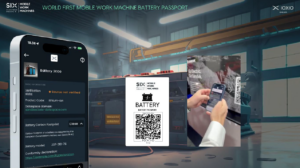
Battery passport test model (Sandvik and Ioxio) – Test the QR code in the image! Screenshot from Eero Kauko’s webinar presentation on December 4, 2024.

Practical guidance on the way
Join the FINNPASS final seminar

The EU’s Ecodesign Regulation introduces digital product passports across industries, with the battery passport as the first implementation. Initiatives like VTT’s FINNPASS project and the Ministry of Finance’s MiniSuomi.fi platform have been preparing for the rollout.

FINNPASS

“We launched the FINNPASS coordination project because product passports are a significant upcoming requirement. There’s a huge demand for information,” said Jaana Keränen, Researcher at VTT.

The project has organized a workshop related to the battery passport, where data points across battery value chains were gathered.

“During the discussions, it became clear that a lot of data about batteries is already being collected, so we definitely don’t have to start from scratch when compiling information for the battery passport,” said Keränen.

The FINNPASS project will publish a practical Digital Product Passport Playbook in February 2025, tailored to SMEs. It will be launched at the project’s closing seminar.

“I invite everyone to join! Follow the LinkedIn group where the exact date and registration details will be published. (FINNPASS – The Digital Product Passport (DPP) Group for Finland),” suggests Keränen.

Test the MiniSuomi platform

On the MiniSuomi.fi platform, the public sector is testing new technologies, including digital wallets for identity verification alongside the battery passport.

“MiniSuomi is an open co-development platform available at minisuomi.fi,” highlighted Mikael af Hällström, Development Specialist at the Finnish Tax Administration.

The battery passport can remain in use for years after its manufacturer has ceased operations. As a technical solution, the publication of the product passport on a blockchain was tested, making it practically permanent. A blockchain is a database that stores digital information on servers operating in a decentralized network. A digital wallet can provide a solution for identifying the creator of digital product passports published on a blockchain.

Battery Regulation webinars continue in 2025

We will continue hosting Battery Regulation webinars next year, including one focusing on due diligence. Follow our website for updates, or subscribe to our newsletter to receive information about upcoming events.

See the questions and answers presented in the webinar.

View presentations from the webinar speakers (in Finnish):

Kati Suomalainen (Ympäristöministeriö): EU:n akkuasetuksen vaatimukset akkupassille
Jaana Keränen (VTT): FINNPASS -hankkeen ja akkupassityöpajan tulosten esittely
Mikael af Hällström (Verohallinto): Minisuomi.fi – kokeiluympäristö
Eero Kauko (Sandvik): Kilpailukykyä digitaalisilla tuotepasseilla

Read our previous articles:

#BatteryRegulation: Review Product and Labeling Requirements Effective August 18, 2024 – Paristokierrätys

#BatteryRegulation: The Battery Passport is Coming – Are You Ready? – Paristokierrätys

New EU Battery Regulation Changes the Market – Eucobat Makes Finnish Producers’ Voice Heard in Brussels – Paristokierrätys

#BatteryRegulation: Distributors of batteries, are you aware of your new responsibilities? – Paristokierrätys

#BatteryRegulation: Webinar answers – How does the battery regulation change the obligations of manufacturers and importers?

#Aalto University: BATCircle2.0 continued Finland-based battery metals and recycling research – Paristokierrätys

#BatteryRegulation: The webinar gave additional information about the requirements of the Battery Regulation (paristokierratys.fi)

#BatteryRegulation: The updated guide regarding battery passports has been released – Paristokierrätys (paristokierratys.fi)

#BatteryRegulation: The application of the EU Battery Regulation begins on 18 February 2024 – preparations in Finland (paristokierratys.fi)

This article is a part of the joint communications of the battery producer organisations Recser Oy and Akkukierrätys Pb Oy concerning the EU Batteries Regulation. You can also subscribe to our newsletter to receive the latest news on the subject.

Review Product and Labeling Requirements Effective August 18, 2024

Review Product and Labeling Requirements Effective August 18, 2024

The EU Battery Regulation came into force on February 18, 2024, introducing new rules for the supply chain/lifecycle of batteries. The regulation includes 97 articles and multiple transitional periods for different requirements. Significant changes took effect on August 18, 2024, with the application of Article 17 and Chapter VI of the regulation. The next major set of requirements will come into effect in August next year, focusing on waste management and producer responsibility as outlined in Chapter VIII.

This article highlights the key obligations that came into force in August for manufacturers, importers, and distributors.

Are You a Manufacturer, Importer, or Distributor?

Each actor in the battery supply chain has its own responsibilities. Article 3 of the Battery Regulation defines the roles of manufacturers, importers, and distributors as follows:

  • ‘Manufacturer’: Any natural or legal person who manufactures batteries, or has them designed or manufactured, and markets them under their own name or trademark or uses them for their own purposes.
  • ‘Importer’: Any natural or legal person established in the Union who places on the market a battery from a third country.
  • ‘Distributor’: Any natural or legal person in the supply chain, other than the manufacturer or importer, who makes a battery available on the market.

Manufacturers Must Add New Labels to Batteries

Manufacturers must ensure the following for batteries:

  • CE Marking: All batteries must now carry a CE marking (Article 38). This requirement has already been mandatory for electrical devices and toys.
  • Identification Details: Batteries must include a model identifier, batch or serial number, or product number, as well as the manufacturer’s name, registered trade name or trademark, a postal address of one contact point, and, if available, website and email addresses (Article 38).
  • Specific Markings: Markings required under national regulations, such as separate collection, heavy metal, and capacity markings.

Importers Must Verify and Add Their Own Information

Importers must ensure that the required markings are present on imported batteries. If the markings do not meet the requirements, the products cannot be placed on the market until they are corrected.

In addition, importers must add their own information to the battery:

  • Importer’s name
  • Registered trade name or trademark
  • A postal address of one contact point
  • Website and email addresses, if available

Distributors (Resellers) Have Inspection Duties

Distributors must check that batteries comply with requirements before placing them on the market. If markings are incomplete, the products cannot be marketed until the deficiencies are rectified. Distributors must also ensure that the storage and transportation conditions of the batteries they handle do not compromise compliance.

You can read more about the responsibilities of manufacturers, importers, and distributors on Tukes’ website (note: the table has not yet been updated to reflect the Battery Regulation): The obligations of economic operators as a table | Finnish Safety and Chemicals Agency (Tukes).

Other Provisions Effective August 2024

Performance and Durability Requirements

Industrial batteries over 2 kWh, batteries for light electric vehicles, and electric vehicle traction batteries must include documentation of their electrochemical performance and durability as of August 18, 2024.

Safety Requirements for Energy Storage

Stationary energy storage systems must meet safety standards during normal use and operation. Annex VIII of the Battery Regulation outlines the conformity assessment procedure for this.

Restriction on Portable Lead-Acid Batteries

Portable batteries containing more than 0.01% lead by weight cannot be marketed. An exception applies to zinc-air button cells, where the restriction will take effect on August 18, 2028. However, lead-acid industrial and vehicle batteries can still be marketed.

[1] Finnish Government Decree on Batteries 520/2014, Section 14: Finnish Government Decree on Batteries 520/2014 – Original Regulations – FINLEX®

Further Reading

This article is a part of the joint communications of the battery producer organisations Recser Oy and Akkukierrätys Pb Oy concerning the EU Batteries Regulation. You can also subscribe to our newsletter to receive the latest news on the subject.