1. Verification obligation
Before placing a battery or rechargeable battery on the market, ensure that the producer is registered in the producer register.
2. Take-back obligation
Accept end-of-life batteries from the categories included in your product range. Collection must be free of charge to the customer and must not be conditional upon the purchase of a new product.
3. Communication obligation
A distributor’s role is not limited to organising collection. Customers must also be clearly informed of how and where end-of-life batteries can be returned.
Distributor’s obligations
Distributors of batteries play an important role in ensuring that producer responsibility is fulfilled.
A distributor’s obligations include, amongst other things, ensuring that producer responsibility for products is fulfilled, organising the collection of end-of-life batteries, and ensuring that customers are provided with information on how to return them. This page summarises the key obligations of distributors and provides guidance on how to fulfil them.
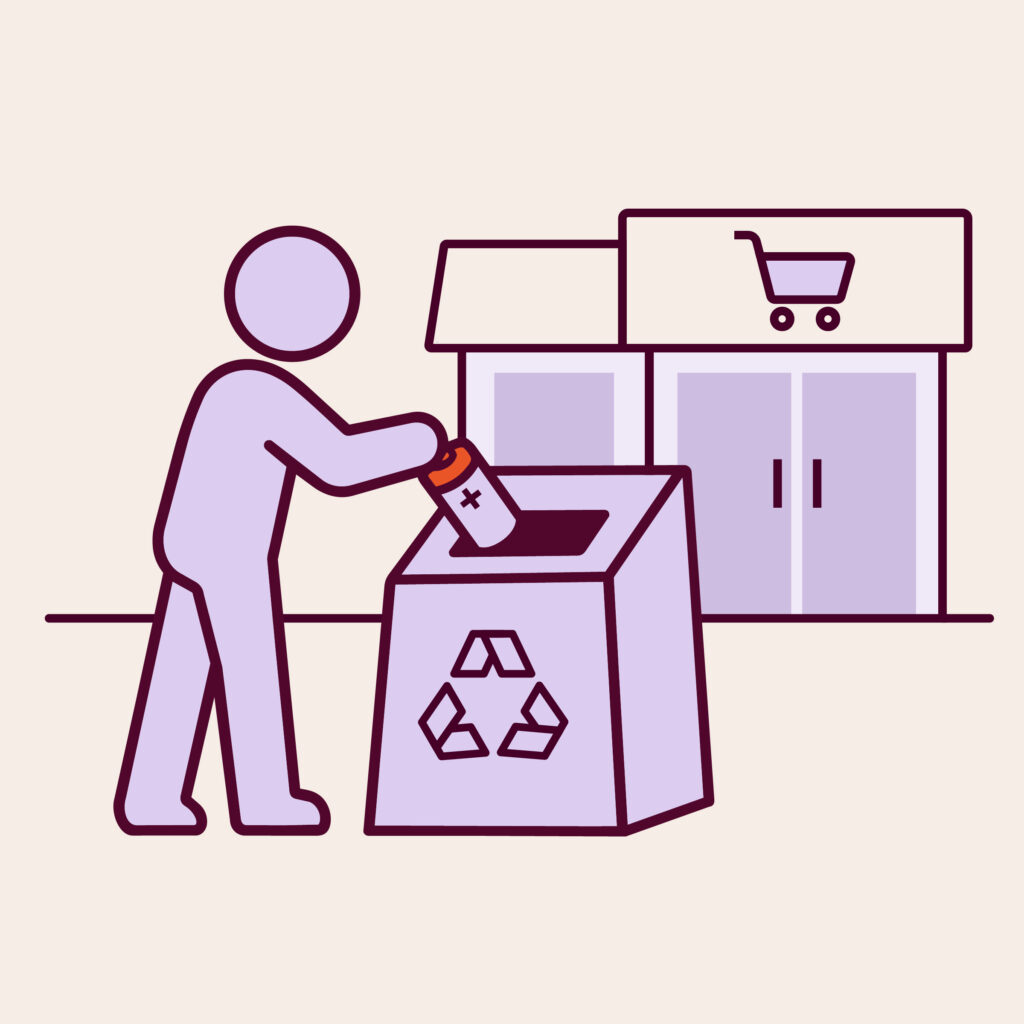
Who is a distributor and what do their obligations entail?
Read more comprehensive overviews of the obligations by topic below.
Who is a distributor?
Distributors are anyone who
- sell products subject to producer responsibility.
- Provide products subject to producer responsibility free of charge, for example as a free gift with a purchase or as a corporate gift.
- Replace products subject to producer responsibility, for example during servicing.
These are counted as distributors and are therefore also obliged to accept returns, meaning they must accept batteries free of charge without requiring the purchase of a new product.
Batteries contained within products are also covered by this obligation.
Obligation to check
Obligation to check under Section 55 of the Waste Act
“A distributor, other undertaking or public procurement entity that procures products referred to in Section 48 must ensure, as far as possible, that the producer of the product supplied to it is listed in the producer register.”
Before making a battery or battery pack available on the market, a distributor must verify that the producer of the product is registered in the producer register.
The purpose of this verification obligation is to ensure that only products for which producer responsibility obligations have been fulfilled reach end-users.
How to check registration
You can check a producer’s registration status for batteries on our website. For all products subject to producer responsibility, you can carry out the check via the Waste Management Compass’s Producer Register information service.
It is recommended that you search primarily using the company’s business ID or VAT number. You can also search for information using, for example, the company name, producer organisation or producer responsibility area.
Note: If a company has producer responsibility for products in several different sectors, such as electrical and electronic equipment, batteries and packaging, producer responsibility must be managed separately for each applicable producer responsibility area.
EU Battery Regulation (EU) 2023/1542, Article 42(2) and Section 55 of the Waste Act
Online marketplaces also have verification obligations
The Battery Regulation also imposes obligations on providers of online platforms through which consumers can conclude distance contracts directly with producers. The online platform provider must obtain information regarding the producer register and the producer’s registration number or numbers.
Article 62(6) of the Battery Regulation
Take-back obligation
A distributor must accept, free of charge, waste batteries from end-users that fall within the categories of batteries included in the distributor’s product range.
The return must not be conditional upon the purchase of a new battery or battery pack. Nor shall the take-back depend on the brand of the battery being returned or on where the product was originally purchased.
Examples:
If a shop sells AA and AAA batteries as well as other portable batteries, the customer does not need to have purchased the batteries being returned from that particular shop in order to return similar products to it.
A shop that sells AA batteries, which fall within the ‘portable batteries’ category, is obliged to accept, for example, a mobile phone battery or a laptop battery. However, a shop is not obliged to accept, for example, a battery from an electric bike if its range does not include batteries falling under the ‘lightweight mobility equipment’ category.
The retailer may, however, if they so wish, also accept batteries from users that fall under a different battery category, provided that the collection point has suitable collection equipment for this purpose.
EU Battery Regulation (EU) 2023/1542, Article 62
Organising the collection of batteries
Agree on collection arrangements with the producer organisation
Distributors must deliver the end-of-life batteries and batteries they have received to the appropriate producer responsibility scheme.
Our website, which provides information on battery classifications, explains in more detail which producer organisation is responsible for recycling under each battery classification.
Through us, you can arrange for the collection of batteries within the following battery categories:
- Portable batteries
- Batteries for light mobility devices
- Starter batteries, i.e. vehicle batteries other than lead-acid batteries
- Industrial batteries and batteries
Where should the collection point be located?
Portable batteries and batteries
Collection is primarily organised at the retailer’s own premises or in the surrounding area.
Under certain conditions, collection may also be organised in the immediate vicinity of the retail outlet, for example at a shared collection point in a shopping centre. Such an arrangement must be agreed with the producer organisation.
Simply directing a customer to a public collection point located elsewhere does not, in principle, fulfil the retail outlet’s collection obligation.
For other battery categories, instructions regarding collection can be found at:
Communication obligation
Make returns easy for customers
Simply organising a collection point is not enough. The distributor must also ensure that the customer receives information on the return of end-of-life batteries.
Inform the customer of at least the following:
- that used batteries and batteries can be returned free of charge
- that returning them does not require the purchase of a new product
- where the collection point is located
- which batteries can be returned to the collection point
- how to return them safely.
It is advisable to place this information where the customer makes their purchase decision or searches for a return point, for example:
- in-store, alongside the products
- next to the collection point
- on the website
- in the online shop’s checkout process, in the case of distance selling.
Ready-to-download materials can be found:
EU Battery Regulation (EU) 2023/1542, Article 74 and, with regard to distance selling, also Article 62
Points to note for online shops
Do you sell batteries or rechargeable batteries online?
Distributors engaged in distance selling also have obligations regarding the collection and provision of information.
If the products are delivered to the customer, the customer must be informed, at the time of ordering, of the return arrangements for used batteries.
In practice, this means that the information should not be found solely on a separate recycling page on the website.
In summary: Make the return instructions visible to the customer as part of the purchasing process. A general recycling guide on a separate page of the website is not a sufficiently clear solution from the customer’s perspective.
Example solution:
“Returning a used battery
You can return a used battery free of charge. Find your nearest collection point and return instructions here.”
Add a link to our collection point search
Battery Regulation (EU) 2023/1542, Article 62(6).
When can a distributor also be a manufacturer?
A distributor’s role may change if, for example, the company sells a battery or battery pack under its own name or trade mark, or modifies the product in a way that may affect its compliance.
In such cases, the company may be subject to the producer’s obligations laid down for manufacturers, either instead of or in addition to the distributor’s obligations.
Distributor’s obligations
You can read more about a distributor’s obligations on the Finnish Supervisory Agency’s website.
Finnish Supervisory AgencyBattery classifications
Find out more about the different battery classifications, which ones you are obliged to accept, and how to prepare for collection.
Receipt in accordance with battery classifications