Dark colours use less energy on the screen than light colours. The theme colour does not affect the colours of videos or other media content. Keeping dark mode enabled helps save energy and may also be more comfortable on the eyes.

Display website images in lighter versions. Smaller image files make the website lighter to load.

Turn off animations and motion effects on the website. This gives you a simpler and calmer browsing experience.

Webinar Provides Answers: Industrial Battery Producer Responsibility in Practice: What BESS Project Stakeholders Need to Know

Webinar Provides Answers: Industrial Battery Producer Responsibility in Practice: What BESS Project Stakeholders Need to Know

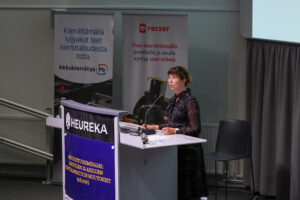
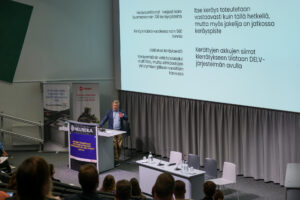
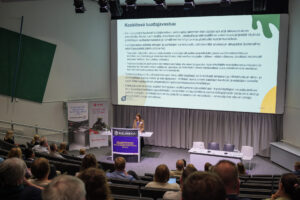
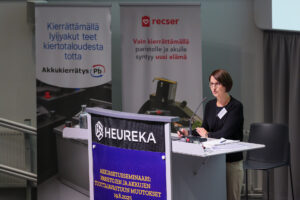
The EU Batteries Regulation has significantly changed producer responsibility obligations for industrial batteries. A Batteries Regulation webinar organised by Recser Oy, Recser Industrial Oy, Akkukierrätys Pb Oy and Renewables Finland (Suomen uusiutuvat ry) focused on identifying who is considered a producer under the new legislation and how these obligations are fulfilled in practice in Finland.

The webinar brought together industrial battery producers, BESS project developers and owners, energy sector stakeholders, and public authorities to discuss the changes introduced by the Batteries Regulation. Particular attention was given to the definition of an industrial battery producer, collective producer responsibility, and practical solutions for battery collection and recycling.

Who Is an Industrial Battery Producer?

Jaana Mäenpää, Senior Officer at the Finnish Supervisory Agency, explained the legal definition of battery producers. Producers are economic operators that first place batteries on the Finnish market. A producer may be, for example, a manufacturer, importer, distance seller or distributor.

Producer responsibility may also arise when batteries are sold together with other products, resold under a private label, or placed on the market following reuse, repurposing or remanufacturing. In addition, the obligation may apply to batteries imported into Finland for a company’s own use.

“Batteries may not be made available on the market in an EU Member State unless the producer responsibility obligations have been fulfilled.”

Mäenpää also reviewed the definitions of industrial batteries and discussed how the Batteries Regulation is interpreted in battery energy storage system projects. As supply chains often involve multiple parties, determining producer responsibility may require case-by-case assessment.

Collective Producer Responsibility Changes the Operating Model

One of the most significant changes introduced by the Batteries Regulation is the transition of producer responsibility for large industrial batteries to a collective model. This means that producers jointly finance and organise the collection and waste management of end-of-life batteries within a battery category, regardless of which producer originally placed the batteries on the market.

Established in spring 2026, Recser Industrial Oy is a wholly owned subsidiary of Recser Oy and has been created to manage the collective producer responsibility obligations for industrial batteries other than lead-based batteries. The aim is to separate the responsibilities, costs and operations related to industrial batteries into their own dedicated system.

In the future, producer responsibility for industrial batteries will be managed through Recser Industrial Oy, while portable batteries, batteries for light means of transport, and vehicle batteries (SLI batteries excluding lead-based batteries) will remain within the scope of Recser Oy. Akkukierrätys Pb Oy, in turn, is responsible for fulfilling producer responsibility obligations for lead-based vehicle and industrial batteries.

Producer obligations include registration, reporting batteries placed on the market, and payment of recycling fees. The producer responsibility organisation is responsible for organising the collection network, logistics, recycling operations and regulatory reporting.

The service model has been designed to be fully digital. Producers register through an online portal, report batteries placed on the market electronically, and pay recycling fees based on their reported volumes. In addition, the producer responsibility organisation provides ongoing guidance, regulatory updates and an annual certificate confirming compliance with producer responsibility obligations.

Recycling Solutions for Growing Battery Volumes

Joni Korkola, Recycling Services Manager at Recser Oy, presented the collection, logistics and recycling chain for industrial batteries. The objective is to establish a nationwide collection network across Finland, complemented by direct collection services from large-scale energy storage sites when needed.

The webinar also examined how battery chemistry affects recycling costs. Particular interest was shown in lithium iron phosphate (LFP) batteries, as their recycling is currently more challenging than that of nickel manganese cobalt (NMC) batteries under existing recycling technologies.

“Recycling solutions for LFP batteries already exist, but the costs remain high because current recycling processes have primarily been
built around NMC and NCA battery chemistries.”

Nevertheless, recycling technologies are expected to develop rapidly as the growing market share of LFP batteries creates strong incentives for new investments and innovation.

A Clear and Cost-Effective System for Producers

The producer perspective was presented by Veli-Erkki Ruotsalainen, Founder and COO of Cactos Oy, who explained how the company is preparing for the new obligations. According to Ruotsalainen, collective producer responsibility simplifies compliance for companies. Once registration, reporting and fee payments have been completed, the producer responsibility organisation manages the remaining obligations.

A key message from the webinar was that every company involved in the industrial battery supply chain should assess its own role and obligations well in advance. Proper compliance with producer responsibility requirements is a prerequisite for placing batteries on the market. Furthermore, responsibility extends throughout the battery life cycle, from market placement to end-of-life management and recycling.

The producer responsibility system will continue to be developed in cooperation with industry stakeholders and other battery producer responsibility organisations. Future development work will focus on enhancing services for industrial battery producers, supporting closed-loop battery material cycles, and exploring alternative financing and fee models that take into account the long service life of industrial batteries.

Watch the full webinar recording in Finnish with English subtitles here.

Battery Producer Responsibility Organisations

Further Information

The Finnish Licensing and Supervision Authority provides additional guidance and official interpretations related to producer responsibility legislation on its website: Legislation and Guidelines on Extended Producer Responsibility – Finnish Supervisory Agency

Renewables Finland

Cactos Oy

Read our previous articles:

Answers from the webinar: what does the EU Battery Regulation require in practice from collection and distributors? – Paristokierrätys

Webinar Provides Answers: Durability, Safety, Labeling, and Information Requirements for Batteries

#BatteryRegulationSeminar: EUCOBAT Stands by Producers as the EU Decides on Battery Regulation Guidelines – Paristokierrätys

#BatteryRegulationSeminar: EU battery regulation tightens requirements, but recycling service providers believe in collaboration: “This is a chain that we all influence” – Paristokierrätys

#BatteryRegulationSeminar: Producer organisations make producer responsibility manageable – even in times of change

#BatteryRegulationSeminar: Battery producer organisations’ seminar strengthened faith in the future and the power of collaboration

#BatteryRegulationSeminar: the EU Battery Regulation imposes obligations on all actors in the value chain – Paristokierrätys

#BatteryRegulation: producer responsibility for industrial batteries changes in August 2025 – what does collective responsibility mean? – Paristokierrätys

#BatteryRegulation: the EU battery regulation demands more efficient recycling – Finland prepares for new targets – Paristokierrätys

#BatteryRegulation: answers from the webinar – proper due diligence in the battery supply chain – Paristokierrätys

#BatteryRegulation: Commission guidelines on the removability and replaceability of portable batteries and light means of transport (LMT) batteries – Paristokierrätys

#BatteryRegulation: An Intense Year of Battery Regulation Behind – and a New One Ahead – Paristokierrätys

#BatteryRegulation: The battery passport is real and full of potential – Test the battery passport using the QR code in the article! – Paristokierrätys

This article is a part of the joint communications of the battery producer organisations Recser Oy and Akkukierrätys Pb Oy concerning the EU Batteries Regulation. You can also subscribe to our newsletter to receive the latest news on the subject.

EUCOBAT Stands by Producers as the EU Decides on Battery Regulation Guidelines

EUCOBAT Stands by Producers as the EU Decides on Battery Regulation Guidelines

Since Member States are at different stages of implementing the Regulation, Eucobat is advocating for transitional periods in the EU Battery Regulation. Eucobat is also concerned that the obligation to take back end-of-life batteries free of charge could bring back batteries placed on the market years ago, shifting costs to producers and distributors and putting pressure on the liquidity of European producer responsibility organisations.

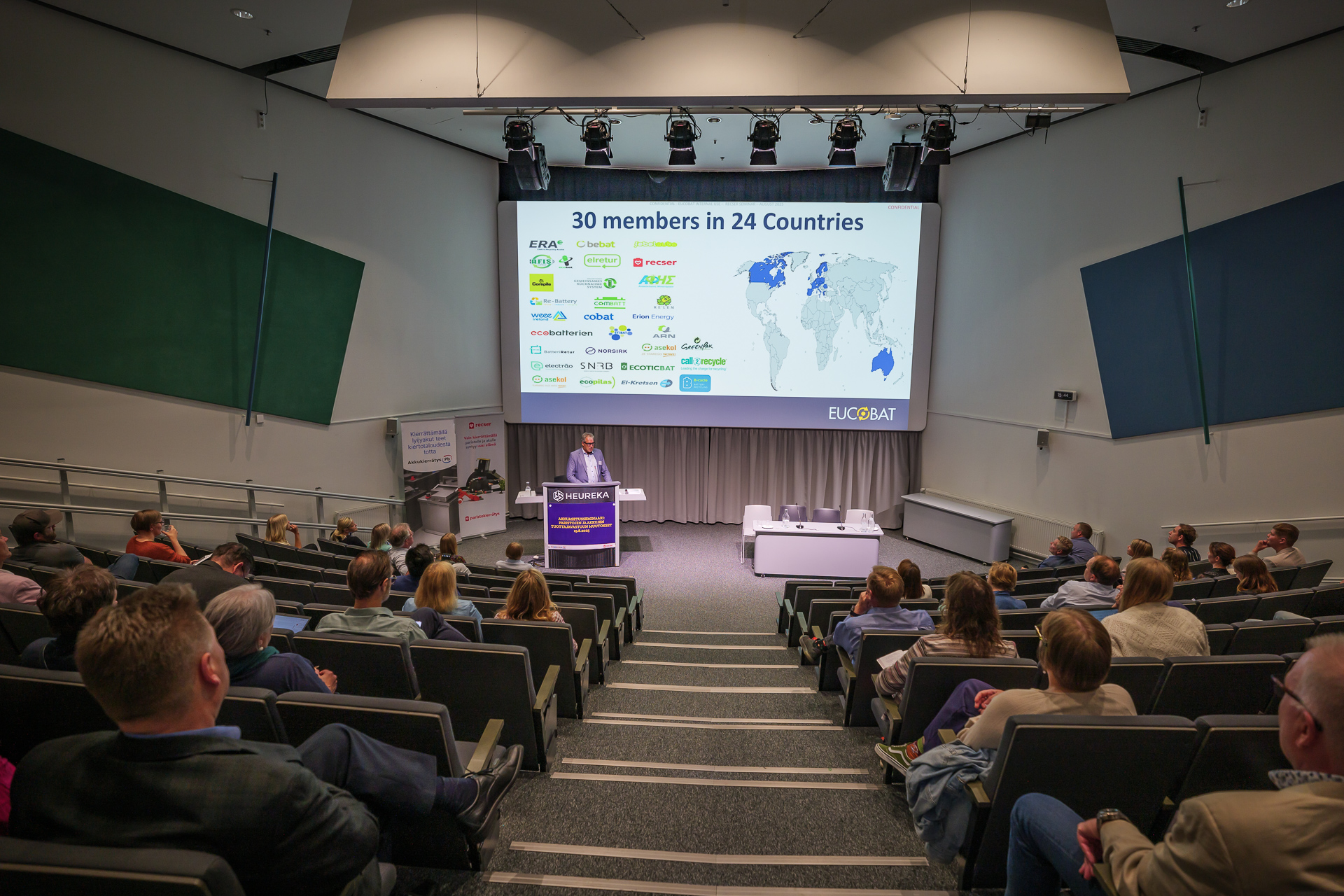
Eucobat, the European association representing national collection schemes for batteries, is based in Brussels and acts as an advocate for producers at EU level. Secretary General Eric Ruyters presented current advocacy priorities at the Battery Regulation Seminar held at Heureka Science Centre in Vantaa in August 2025.

The EU Battery Regulation applies directly in all Member States, and one of its goals is to create a level playing field in the new battery market established by the Regulation.

– We genuinely believe that equal conditions across Member States will benefit us all, says Eucobat Secretary General Eric Ruyters on expectations for EU-level implementation.

Eucobat’s members consist of national producer responsibility organisations running collection schemes in different EU countries. In Finland, Recser Oy is a member of Eucobat.

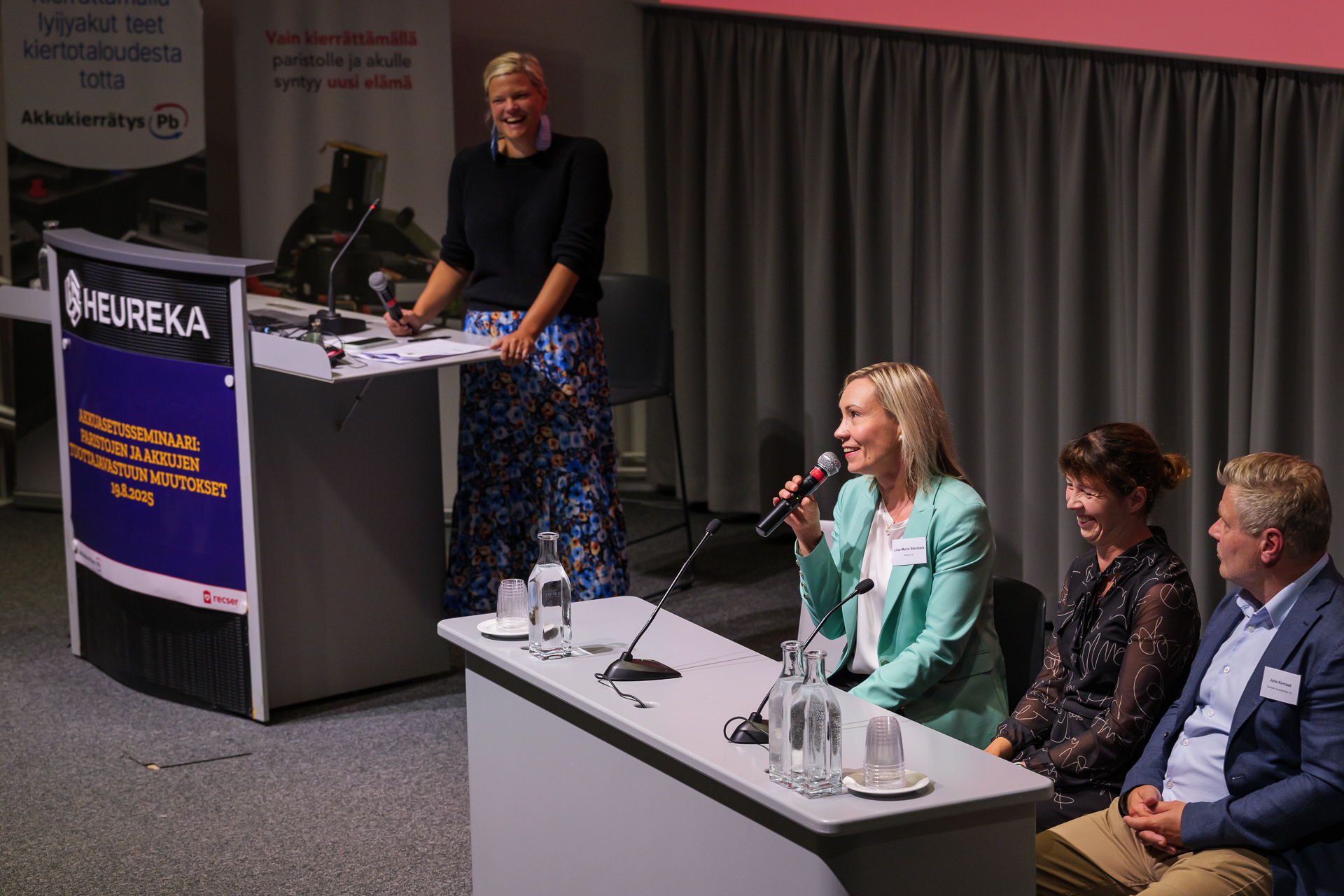
Organizers of the Battery Regulation Seminar (From the left: Terhi Ilonen, Johanna Alakerttula, Liisa-Marie Stenbäck) and Eric Ruyters. Photo: Sus+Com Agency/Antti Partanen

Transitional Period Needed for Implementation

Because the previous Directive mainly set targets, national collection systems have developed into quite different structures and often cover only part of the battery categories defined in the Regulation. For this reason, and because implementation is still ongoing in many Member States, Eucobat is in discussions with the Commission on the need for a clear transition period into early next year.

– Most of our members have had well-organised systems for portable batteries, since they were already subject to clear collection requirements and targets, Ruyters said.

– With the new Regulation, most of our members are expanding the number of battery categories they cover and developing their organisational structures to include all types of batteries – just like in Finland, where producer organisations are now strengthening their cooperation to ensure that all categories are efficiently covered, he continued.

Ruyters also noted that diverging national practices in implementing the Regulation are causing confusion: Member States have different interpretations of definitions and targets as well as varying registration procedures.

– We certainly do not want to stop the process underway in Europe – we simply want a uniform start for all, he said.

Eric Ruyters. Photo: Sus+Com Agency/Antti Partanen

Addressing the Challenge of Historical Waste

A key requirement of the Regulation for the circular economy is the obligation to take back end-of-life batteries. According to Ruyters, Eucobat sees it as problematic if this obligation also applies to industrial and electric vehicle batteries placed on the market before 18 August 2025, when the new producer responsibility rules entered into force.

– Since in many Member States no take back and recycling fees were collected for these so-called historical batteries placed on the market before that date, it would be unreasonable to require producer responsibility organisations to accept them free of charge, Ruyters explained.

Under the Regulation, however, producers must accept all batteries in their category, regardless of chemistry, brand, or origin. Take-back must be free of charge and cannot be tied to a purchase obligation. The same duty applies to distributors.

– This is part of the broader discussion we are having with the Commission. They were surprised to hear what the free take-back obligation could mean in terms of historical waste. Of course, the Regulation must be followed, but it is important that the responsibility applies only to industrial and electric vehicle batteries placed on the market after the Regulation entered into force.

– Producers themselves remain responsible for batteries placed on the market before that date. They can organise collection and recycling individually or agree on it with a producer organisation, provided that it does not distort the collective system, Ruyters said.

In Finland, a collective collection and recycling system has already been established for all small batteries under 25 kilograms as well as for lead batteries. In addition, there is a functioning collection system for EV traction batteries, operated by Suomen Autokierrätys. The change in Finland therefore mainly concerns large industrial batteries.

Producer Registers and Enforcement

The Regulation requires each Member State to have a mandatory producer register. Registration in the national register is a prerequisite for placing batteries on the market in that country.

– There is no single European producer register – instead, producers must register separately in every Member State where they place batteries on the market, Ruyters clarified.

In addition, distance sellers must appoint an authorised representative. Member States must designate a competent authority responsible for maintaining the register and supervising compliance with producer responsibility. From 18 August 2025 onwards, producer organisations can only fulfil the obligations of the Regulation on behalf of those producers with whom they have a contract.

– Free-riding must not be allowed. Authorities must ensure that free riders are obliged to register, join an approved organisation, and pay their share, Ruyters stressed.

When the EU and its Member States succeed in creating equal conditions and eliminating free-riding, we can together ensure that the objectives of the Battery Regulation are achieved – and that Europe takes a genuine leadership role in the circular economy of batteries.

See the speaker’s presentation:

Eric Ruyters, EUCOBAT

Read more:
Eucobat’s recommendations for the Commission and the Member States

Photos: Sus+Com Agency/Antti Partanen

Read our previous articles:

#BatteryRegulationSeminar: EU battery regulation tightens requirements, but recycling service providers believe in collaboration: “This is a chain that we all influence” – Paristokierrätys

#BatteryRegulationSeminar: Producer organisations make producer responsibility manageable – even in times of change

#BatteryRegulationSeminar: Battery producer organisations’ seminar strengthened faith in the future and the power of collaboration

#BatteryRegulationSeminar: the EU Battery Regulation imposes obligations on all actors in the value chain – Paristokierrätys

#BatteryRegulation: producer responsibility for industrial batteries changes in August 2025 – what does collective responsibility mean? – Paristokierrätys

#BatteryRegulation: the EU battery regulation demands more efficient recycling – Finland prepares for new targets – Paristokierrätys

#BatteryRegulation: answers from the webinar – proper due diligence in the battery supply chain – Paristokierrätys

#BatteryRegulation: Commission guidelines on the removability and replaceability of portable batteries and light means of transport (LMT) batteries – Paristokierrätys

#BatteryRegulation: An Intense Year of Battery Regulation Behind – and a New One Ahead – Paristokierrätys

#BatteryRegulation: The battery passport is real and full of potential – Test the battery passport using the QR code in the article! – Paristokierrätys

This article is a part of the joint communications of the battery producer organisations Recser Oy and Akkukierrätys Pb Oy concerning the EU Batteries Regulation. You can also subscribe to our newsletter to receive the latest news on the subject.
EU battery regulation tightens requirements, but recycling service providers believe in collaboration: “This is a chain that we all influence”

EU battery regulation tightens requirements, but recycling service providers believe in collaboration: “This is a chain that we all influence”

Recycling service providers believe the battery regulation will accelerate raw material markets and the development of recycling technologies. Producer responsibility often forms the financial basis for battery recycling, as there has not yet been demand for all the chemical substances they contain. Business opportunities in reuse are also of interest.

At the Battery Regulation Seminar, recycling service providers shared their views on how the regulation will affect their operations. The seminar was held in Heureka, Vantaa, in August 2025.

Panel participants agreed on one of the biggest changes the regulation brings to their operations: the battery regulation will change the markets for recycled battery materials.

– “The increase in collection rates will bring more recyclables, which means more business for us, which is of course positive,” says Tommi Karjalainen, CEO of AkkuSer Oy.

Markets do not yet function fully competitively – for example, virgin materials are often cheaper – so producer responsibility often provides an important financial basis for recycling.

– “Producer responsibility ensures that all material goes to recycling regardless of chemistry; you can’t just pick the raisins out of the cake,” says Joni Korkola, Business Manager at Stena Recycling Oy.

Photo: Sus+Com Agency/Antti Partanen

Challenges for recyclers: efficiency and recovery requirements, new chemistries and fractions

The battery regulation gradually increases recycling efficiency and material recovery requirements until 2031, which also poses challenges for recyclers.

The reporting requirements demand more detailed tracking and identification of different battery and device categories. Calculating the required recovery rates requires recyclers to know the composition of incoming batteries more precisely than before.

This is a challenge that the upcoming battery passport, required by the regulation, is expected to partially solve. The battery-specific passport will be attached to the battery at the beginning of its lifecycle and will include information about the battery’s composition.

– “Without a battery passport, it is extremely challenging for us to identify the chemistry of certain batteries. As the first recycler, it is our duty to report recovery rates. We send the batteries forward for crushing and rely on the information provided by our partners,” says Ben László, Head of ITAD at Kuusakoski Oy. ITAD refers to the company’s reuse business and recycling and disposal of IT equipment.

Panelists also highlighted that not all batteries yet have recycling solutions.

– “Ambitious recycling targets must be met, but for LFP, lithium iron phosphate batteries, we need to find new solutions in Europe,” says Korkola of Stena Recycling Oy.

Lifecycle thinking in the battery regulation benefits recyclers

Panelists pointed out that the regulation’s lifecycle approach is a positive aspect, meaning finding recycling solutions is no longer only the recycler’s responsibility.

– “The battery regulation partly guides manufacturers to consider the raw and binding materials they use and the recyclability already in the design phase. Responsibility for recycling extends to manufacturers as well,” says Teija Käpynen, Environmental Manager at Fortum Battery Recycling Oy.

Considering recyclability also benefits the manufacturer, as the regulation sets minimum recycled material content requirements.

– “If we don’t recover them, they can’t use them in production either. This is an entire chain, and we all as actors influence it,” she continues.

Potential of reuse and remanufacturing sparks interest

The regulation has sparked interest in business opportunities for reuse and remanufacturing.

– “We are very interested in reuse and are actively working on finding various solutions,” says Korkola of Stena Recycling.

However, reuse must be weighed against producer obligations under the battery regulation.

– “There is a lot of potential, but it also comes with significant responsibilities and requirements – the same as for the producer,” says Käpynen of Fortum.

Producer organisations are central to recyclers’ business

Battery producer organisations use responsible recycling service providers for the collection, transport, and treatment of used batteries. For service providers, producer organisations are central to their business.

AkkuSer Oy, founded in 2005, offers recycling services to producer organisations. It owns Finland’s only battery sorting and recycling plant for batteries and small batteries, located in Nivala.

– “Legislation has been central to our story because not everything is market-driven. In 2006 came the Battery Directive, and in 2008 separate collection began. That provided the foundation for our business,” says CEO Tommi Karjalainen.

AkkuSer receives all separately collected batteries from Recser, sorts, crushes, and sends the fractions or sorted batteries to further processors.

Tommi Karjalainen. Photo: Sus+Com Agency/Antti Partanen

Fortum Battery Recycling Oy, founded in 2005, now has a significant commercial EV battery recycling value chain at the European level.

– “We are interested in expanding operations to industrial battery recycling as well,” says Environmental Manager Teija Käpynen.

Central to its operations is its own hydrometallurgical battery material recycling plant in Harjavalta. Additionally, the company has a battery crushing plant in Ikaalinen and a battery pre-processing plant in Kirchardt, Germany, and a crushing plant under development.

– “The black mass from the process is further treated in Harjavalta into nickel-cobalt sulfate solution, which is delivered to battery material manufacturers as raw material,” says Käpynen.

Teija Käpynen. Photo: Sus+Com Agency/Antti Partanen

Kuusakoski Recycling Oy, founded in 1914, is a family company offering a wide range of recycling services, for example for batteries, electrical and electronic equipment, and recyclable plastics.

– “We work with almost all Finnish producer organisations, if not all,” says Head of ITAD Ben László.

In the battery value chain, Kuusakoski acts as the first recycler, sending materials and products forward.

Safety is central to Kuusakoski’s operations, as they handle, store, and export batteries. The company’s new product, a smart battery sensor, warns of battery fire before ignition.

– “Current market technologies detect fire after it has started. The smart sensor detects electrolyte gas leakage before the battery starts burning. It monitors local air and sends an alert to any client software, enabling preventive measures,” says László.

Ben László. Photo: Sus+Com Agency/Antti Partanen

Stena Recycling Oy, founded in 2005, operates recycling services in Finland, Sweden, Norway, Denmark, Germany, Poland, and Italy.

– “We work with practically all Finnish producer organisations in some capacity, from paper to tires,” says Key Account Manager Joni Korkola.

The company has its own battery crushing plant in Sweden, where the black mass is sold at the best market price.

– “Stena’s role sits between Kuusakoski and Fortum: Stena has the crushing plant that Kuusakoski doesn’t have, but no hydrometallurgy, which Fortum has,” Korkola says with a smile.

Joni Korkola. Photo: Sus+Com Agency/Antti Partanen

Photos: Sus+Com Agency/Antti Partanen

See speakers’ presentations (in Finnish):
Tommi Karjalainen, Akkuser Oy
Joni Korkola, Stena Recycling Oy
Ben László, Kuusakoski Oy
Teija Käpynen, Fortum Battery Recycling Oy

Read our previous articles:

#BatteryRegulationSeminar: Producer organisations make producer responsibility manageable – even in times of change

#BatteryRegulationSeminar: Battery producer organisations’ seminar strengthened faith in the future and the power of collaboration

#BatteryRegulationSeminar: the EU Battery Regulation imposes obligations on all actors in the value chain – Paristokierrätys

#BatteryRegulation: producer responsibility for industrial batteries changes in August 2025 – what does collective responsibility mean? – Paristokierrätys

#BatteryRegulation: the EU battery regulation demands more efficient recycling – Finland prepares for new targets – Paristokierrätys

#BatteryRegulation: answers from the webinar – proper due diligence in the battery supply chain – Paristokierrätys

#BatteryRegulation: Commission guidelines on the removability and replaceability of portable batteries and light means of transport (LMT) batteries – Paristokierrätys

#BatteryRegulation: An Intense Year of Battery Regulation Behind – and a New One Ahead – Paristokierrätys

#BatteryRegulation: The battery passport is real and full of potential – Test the battery passport using the QR code in the article! – Paristokierrätys

This article is a part of the joint communications of the battery producer organisations Recser Oy and Akkukierrätys Pb Oy concerning the EU Batteries Regulation. You can also subscribe to our newsletter to receive the latest news on the subject.
Producer organisations make producer responsibility manageable – even in times of change

Producer organisations make producer responsibility manageable – even in times of change

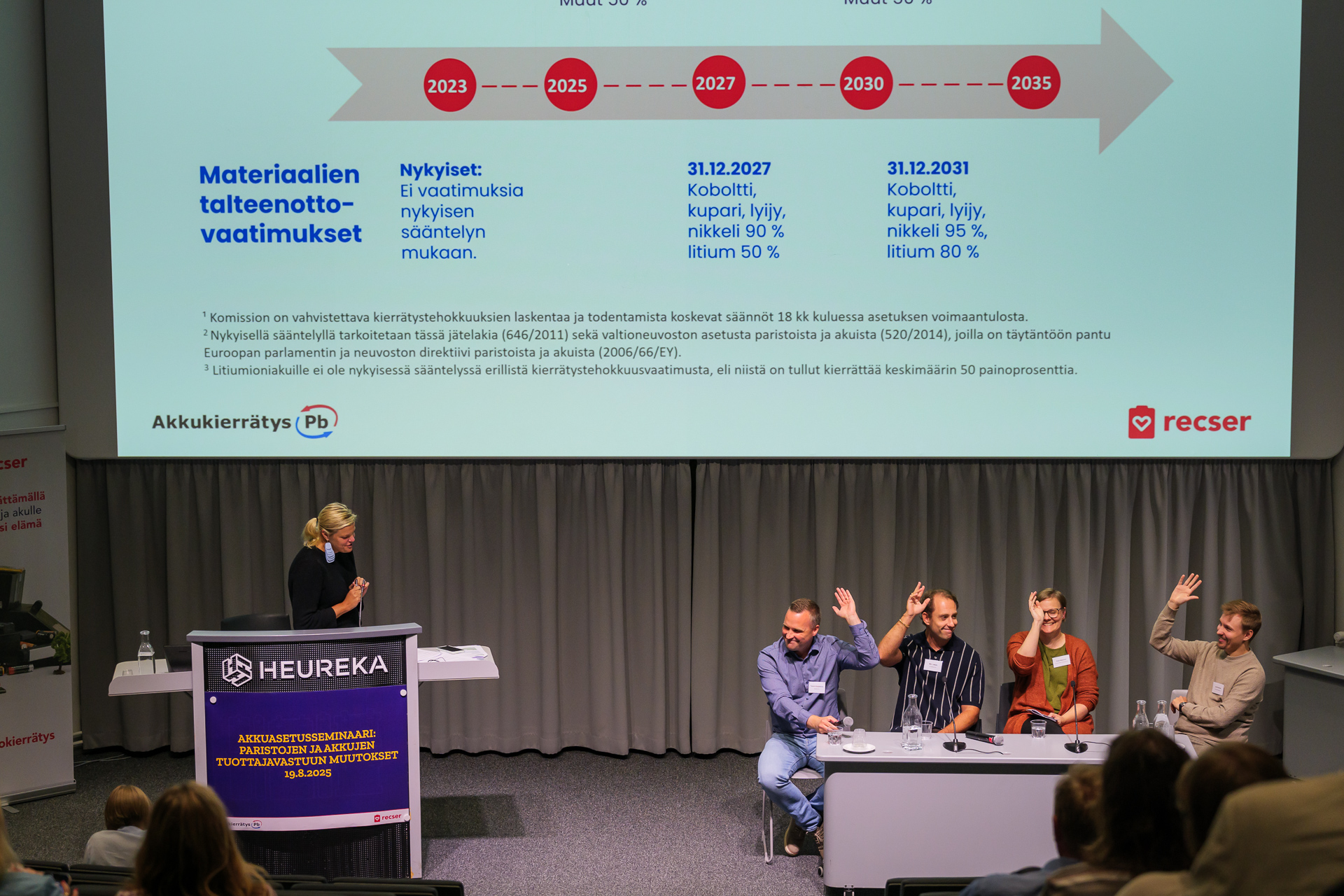
The EU Battery Regulation significantly reforms producer responsibility systems for batteries. At the Battery Regulation Seminar held in August 2025 at Heureka Science Center in Vantaa, participants learned about the regulation’s impacts on the operations of producer organisations: distributors’ obligation to take back batteries as well as stricter efficiency and recovery requirements will change future collection and recycling. Recser Oy is building an entirely new collection system for large industrial batteries in cooperation with Akkukierrätys Pb Oy. Meanwhile, Suomen Autokierrätys Oy is preparing both for these changes and for the growing number of electric vehicles.

“The Battery Regulation changes the way we all work, our objectives, but at the same time, there are many elements that will remain much the same,” says Johanna Alakerttula, Managing Director of Akkukierrätys Pb Oy.

Producer organisations for batteries help their members understand the changes the regulation brings to producer responsibility and fulfill their new, up-to-date obligations.

“A single producer cannot realistically – and frankly should not – handle the obligations alone,” says Liisa-Marie Stenbäck, Managing Director of Recser Oy.

With the Battery Regulation, more and more companies are regarded as producers in the eyes of the law.

“The Battery Regulation has now broadened the definition of a producer to mean anyone who ‘places a product on the market in Finland for the first time.’ Therefore, distributors of products may also be regarded as producers and thus subject to producer responsibility,” Stenbäck explains.

Distributors’ take-back obligation and stricter requirements reform producer organisations

The take-back obligation for distributors is one of the changes introduced by the Battery Regulation, and it affects all three producer organisations.

“In the future, all distributors must take back the types of batteries they sell – which means the collection system will gain a large number of new points,” says Recser’s Stenbäck.

Producer organisations’ collection networks will therefore grow.

“If you sell electric cars, you are also obliged to take them back. Our collection network is already quite broad, and we are now considering what it will look like in a practical sense. We are planning a new system and digitalising it,” says Juha Kenraali, Managing Director of Suomen Autokierrätys Oy.

According to Akkukierrätys Pb’s Alakerttula, many lead battery distributors have in practice already been taking back batteries for a long time. However, the expanded take-back obligation will particularly change practices for smaller companies.

More detailed guidance on the take-back obligation will be provided later by the Ministry of the Environment.

Lithium-ion batteries as Europe’s challenge: stricter recycling efficiency and recovery requirements call for action

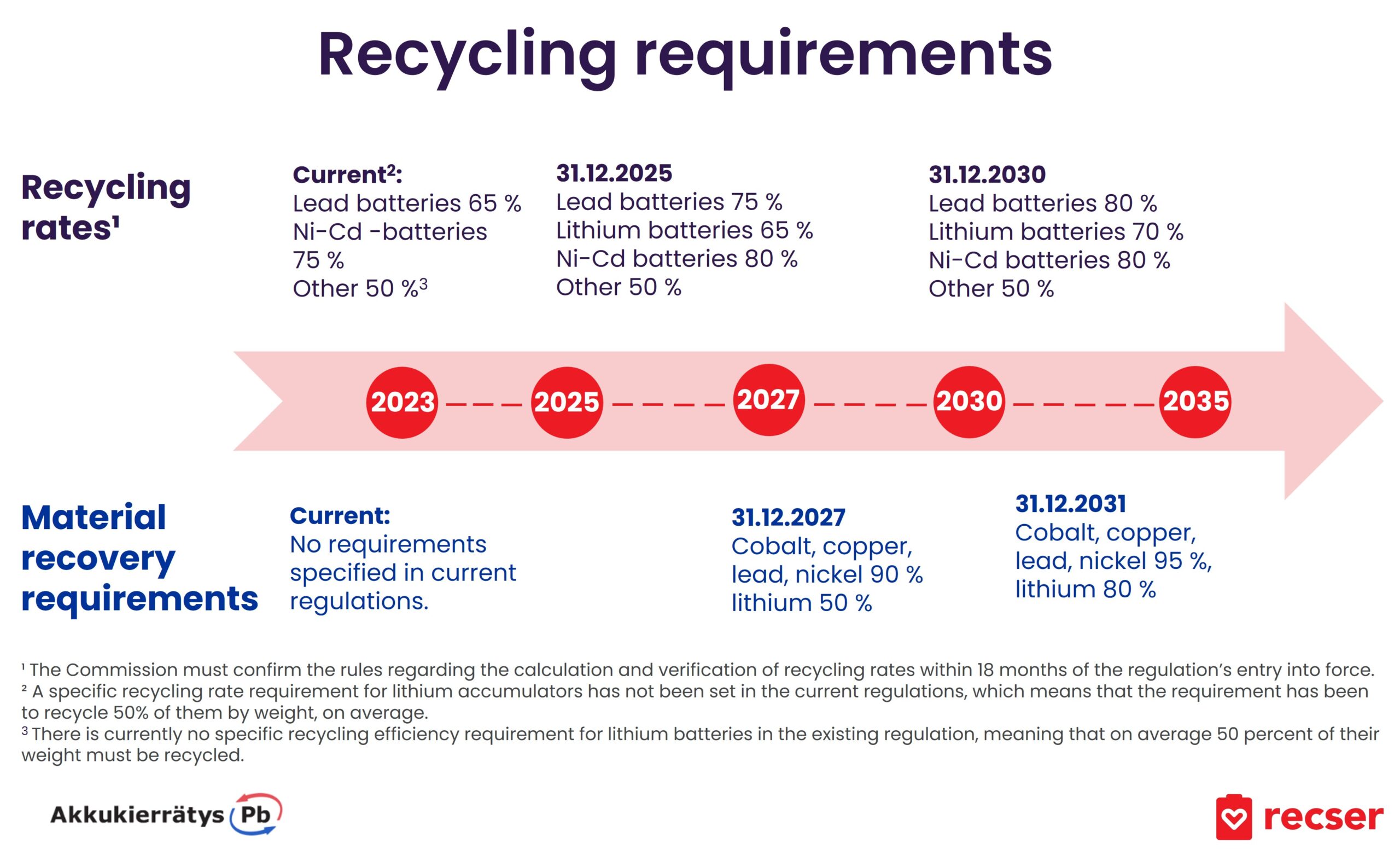
The Battery Regulation strengthens recycling through efficiency requirements and material recovery targets, which will gradually increase until 2031. These changes affect all three producer organisations, albeit in slightly different ways.

“Alkaline batteries and high-cobalt lithium-ion batteries in smart devices are already recycled quite efficiently,” says Stenbäck.

But not all battery types yet have established recycling processes in Europe.

“For light electric vehicle batteries and other low-cobalt lithium-ion batteries, efficient recycling channels have not yet emerged, as waste streams remain small due to long lifetimes. The biggest challenges relate to batteries with varying chemistries and raw material contents that are not evident from their markings,” she continues.

Stricter requirements also apply to lead batteries, though the situation is different in their case.

“A significant share of the lead recovered from batteries in recycling facilities is already used again in lead battery manufacturing,” says Alakerttula.

“Lead battery circular economy is already a reality,” she adds.

Recser Oy: “We make producer responsibility manageable”

Recser Oy, founded in 2008, has operated as a producer organisation for portable batteries and other small batteries under 25 kilograms, excluding lead batteries. It is a producer-founded and producer-owned organisation with more than 1,200 members.

“We expect the number of foreign distance sellers to grow significantly in the coming years, though the majority of registered members are currently domestic importers,” says Managing Director Liisa-Marie Stenbäck.

Liisa-Marie Stenbäck. Photo: Sus+Com Agency/Antti Partanen

Recser’s collection network is extensive relative to population: there are about 7,000 collection points. Last year, around 2,000 tonnes of batteries were collected through the network, about half of which were recycled as secondary raw materials.

“That met the current collection target of 45%, but requirements will tighten significantly in the future,” says Stenbäck.

Battery Regulation changes are already expanding Recser

The most significant change for Recser under the Battery Regulation is the expansion of its operations to also cover large industrial batteries over 25 kilograms.

“The biggest change relates to large industrial batteries. They will be subject to collective responsibility, meaning we must take back all batteries in this category, regardless of who placed them on the market or their chemistry,” Stenbäck explains.

To address this change, Recser and Akkukierrätys Pb will jointly build a new collective system for large industrial batteries. This nationwide network will receive all types of industrial batteries and forward them to recycling.

Akkukierrätys Pb Oy: lead batteries responsibly recycled

Founded in 2008, Akkukierrätys Pb Oy is a producer organisation for automotive and industrial lead batteries. Like other producer organisations, it was established by producers and is owned by four companies that import batteries.

“Lead batteries have been mainstream for a very long time. We have over 400 members, ranging from importers of lead batteries to those importing vehicles and machines containing them,” says Managing Director Johanna Alakerttula.

Johanna Alakerttula. Photo: Sus+Com Agency/Antti Partanen

Akkukierrätys Pb’s nationwide lead battery collection network has more than 400 collection points, including waste facilities and auto service companies. For transport and recycling, Akkukierrätys cooperates with ten different operators.

“About 20,000 tonnes are collected annually. That’s a significant amount and has remained stable year after year,” Alakerttula says.

Suomen Autokierrätys Oy: “Our principle is to handle all producer responsibility obligations on behalf of producers and disturb them as little as possible”

Founded in 2001, Suomen Autokierrätys Oy was established by Autontuojat ry, the Finnish Car Importers’ Association, whose members are importers. Suomen Autokierrätys operates under one umbrella with separate producer organisations for end-of-life vehicles and for traction batteries in electric cars. Its nationwide collection network has about 700 collection points. The batteries recycled from electric cars are primarily lithium-ion batteries.

“There are not yet very many electric cars in traffic, so only a small number are currently reaching recycling. However, this will grow significantly in the future,” says Managing Director Juha Kenraali.

Juha Kenraali. Photo: Sus+Com Agency/Antti Partanen

The annual collection volume is about 500 tonnes.

“In tonnes, that’s already a significant amount, but compared to the potential, it’s still small. That 500 tonnes will increase ten- to twenty-fold in the next 5–10 years,” Kenraali says.

Suomen Autokierrätys is already preparing for the introduction of battery passports under the Battery Regulation. These passports will include information on each recyclable battery, which will facilitate reporting on behalf of producers.

“We have prepared for the battery passport by creating an interface in our new system, which will be able to provide information for possible future passports. The plan is to have the system ready at the beginning of next year,” Kenraali explains.

Producer responsibility for batteries

Producer responsibility refers to a company’s legal obligation to arrange waste management and recycling for its products at the end of their lifecycle. This obligation applies to companies acting as producers – that is, as manufacturers, importers, distributors, or distance sellers.

In Finland, companies meet their producer responsibility obligations by joining a producer organisation for their product group. The producer organisations for batteries in Finland are Akkukierrätys Pb Oy, Recser Oy, Suomen Autokierrätys Oy, and ERP Finland ry.

The producer organisation assumes responsibility for the practical arrangements of collection, transport, and recycling of the products placed on the Finnish market once they become waste.

View presentations from the webinar speakers (in Finnish):

Liisa-Marie Stenbäck, Recser Oy
Johanna Alakerttula, Akkukierrätys Pb Oy
Juha Kenraali, Suomen Autokierrätys Oy

Photos: Sus+Com Agency/Antti Partanen

Read our previous articles:

#BatteryRegulationSeminar: Battery producer organisations’ seminar strengthened faith in the future and the power of collaboration

#BatteryRegulationSeminar: the EU Battery Regulation imposes obligations on all actors in the value chain – Paristokierrätys

#BatteryRegulation: producer responsibility for industrial batteries changes in August 2025 – what does collective responsibility mean? – Paristokierrätys

#BatteryRegulation: the EU battery regulation demands more efficient recycling – Finland prepares for new targets – Paristokierrätys

#BatteryRegulation: answers from the webinar – proper due diligence in the battery supply chain – Paristokierrätys

#BatteryRegulation: Commission guidelines on the removability and replaceability of portable batteries and light means of transport (LMT) batteries – Paristokierrätys

#BatteryRegulation: An Intense Year of Battery Regulation Behind – and a New One Ahead – Paristokierrätys

#BatteryRegulation: The battery passport is real and full of potential – Test the battery passport using the QR code in the article! – Paristokierrätys

This article is a part of the joint communications of the battery producer organisations Recser Oy and Akkukierrätys Pb Oy concerning the EU Batteries Regulation. You can also subscribe to our newsletter to receive the latest news on the subject.
Battery producer organisations’ seminar strengthened faith in the future and the power of collaboration

Battery producer organisations’ seminar strengthened faith in the future and the power of collaboration

The battery regulation seminar, which addressed changes in battery producer responsibility, brought together the entire battery ecosystem. The topic was extremely timely, as the changes concerning waste management and producer responsibility under the EU Battery Regulation had just entered into force the previous day. The event at Heureka Science Centre in Vantaa gathered 240 participants from the battery sector, both on-site and online.

“Producer responsibility is not just an obligation – it is a strategic choice,” said Liisa-Marie Stenbäck, Managing Director of Recser Oy, in her opening speech.

“It is strategic above all because producer responsibility is corporate responsibility. It covers the entire life cycle of a product. In EU legislation, the producer responsibility obligations at the end of a product’s life cycle are referred to as extended producer responsibility, and the most effective way to fulfil them is usually by joining a producer responsibility organisation,” Stenbäck continued.

The seminar was organised by two battery producer responsibility organisations, Recser Oy and Akkukierrätys Pb Oy. Held on 19 August 2025 at Heureka in Vantaa, it brought together 240 stakeholders – producers, waste management operators, PRO representatives, authorities, and other representatives from both the public and private sectors.

“It was great to see that the seminar included representatives from the entire battery ecosystem. PROs are at the centre of this producer responsibility ecosystem, but the Battery Regulation requires all actors to take environmental impacts and circular economy conditions into account. Everyone is needed to make producer responsibility a reality,” said Johanna Alakerttula, Managing Director of Akkukierrätys Pb.

The seminar was part of a series of events jointly organised by Recser Oy and Akkukierrätys Pb Oy, exploring the changes the EU Battery Regulation brings for companies. Two years ago, the same stakeholders gathered at Heureka – then to address a new and emerging topic. Since then, more detailed aspects of the regulation have been covered through webinars.

The Battery Regulation seminar highlighted the legislative changes that had just come into force the previous day. Chapter VIII of the Regulation focuses on extended producer responsibility, which is central to achieving the overall objectives of the Regulation. Key changes include the new producer responsibility obligation for large industrial batteries and distributors’ take-back obligations.

The seminar addressed four themes: legislative requirements, renewal of producer responsibility systems, recyclers’ preparedness for change, and experiences from the EU level.

The Battery Regulation changes sparked discussion: “It will be a bit of a rumba, bigger for some, smaller for others”

The changes introduced by the Battery Regulation sparked much discussion at the seminar, both during Q&A sessions and over coffee breaks.

During a coffee break, Janne Peltola, Category Manager at MEKO Finland Oy, reflected on the Regulation from the perspective of corporate responsibility. He noted that the biggest change is in mindset.

“This strongly highlights corporate responsibility. Every company, regardless of size, must now and in the future operate responsibly and do their part. There is no room for free riders,” Peltola explained.

MEKO Finland Oy (formerly Koivunen Oy) is a Swedish listed company operating in Northern Europe. The company is an importer and wholesaler of automotive spare parts and also operates two of Finland’s largest repair shop chains, Fixus and Mekonomen.

Janne Peltola, MEKO Finland Oy. Photo: Sus+Com Agency/Antti Partanen

Corporate responsibility was also emphasised when seminar participants answered, via the Mentimeter tool, why producer responsibility is important. Some of the responses were more colourful, but all of them highlighted producer responsibility as essential for the circular economy, saving the planet, and sharing collective responsibility.

More than 60 responses were received from participants.

According to Marko Salminen, Sales Manager at Enersys Europe Oy, the biggest change brought by the Regulation for their company concerns producers’ take-back obligations. Enersys Europe, primarily a manufacturer of lead batteries, is one of the world’s largest producers of industrial batteries.

“It will be a bit of a rumba, bigger for some, smaller for others. We want to ensure that we move batteries forward as quickly as possible to operators working with PROs, so that they don’t end up in the wrong channels from our collection points,” Salminen said.

He found the seminar valuable, as he is not personally involved with the Battery Regulation on a daily basis.

Marko Salminen, Enersys Europe Oy. Photo: Sus+Com Agency/Antti Partanen

Helena Castrén, Chair of the Board at Recser Oy, has closely followed the changes introduced by the Regulation. During a coffee break, she reflected on the importance of hearing these topics explained by experts.

“When you hear these topics from the right people, it’s different from just reading about them yourself, as I too have done many times.”

She particularly appreciated the contributions of Johanna Routio (Ministry of the Environment), Jaana Mäenpää (Pirkanmaa ELY Centre), and Sinikka Koikkalainen (Häme ELY Centre).

Helena Castrén, Chair of the Board at Recser Oy. Photo: Sus+Com Agency/Antti Partanen

“From the presentations of the legislative and supervisory authorities, you could sense their expertise. They really know where we are heading, and we have excellent dialogue partners. These three were honestly pretty amazing!” Castrén said.

Photos: Sus+Com Agency/Antti Partanen

Read our previous articles:

#BatteryRegulationSeminar: the EU Battery Regulation imposes obligations on all actors in the value chain – Paristokierrätys

#BatteryRegulation: producer responsibility for industrial batteries changes in August 2025 – what does collective responsibility mean? – Paristokierrätys

#BatteryRegulation: the EU battery regulation demands more efficient recycling – Finland prepares for new targets – Paristokierrätys

#BatteryRegulation: answers from the webinar – proper due diligence in the battery supply chain – Paristokierrätys

#BatteryRegulation: Commission guidelines on the removability and replaceability of portable batteries and light means of transport (LMT) batteries – Paristokierrätys

#BatteryRegulation: An Intense Year of Battery Regulation Behind – and a New One Ahead – Paristokierrätys

#BatteryRegulation: The battery passport is real and full of potential – Test the battery passport using the QR code in the article! – Paristokierrätys

This article is a part of the joint communications of the battery producer organisations Recser Oy and Akkukierrätys Pb Oy concerning the EU Batteries Regulation. You can also subscribe to our newsletter to receive the latest news on the subject.

the EU Battery Regulation imposes obligations on all actors in the value chain

the EU Battery Regulation imposes obligations on all actors in the value chain

The changes in waste management and extended producer responsibility under the EU Battery Regulation entered into force on 18 August 2025. Batteries may no longer be placed on the market without fulfilling producer responsibility obligations and meeting the requirements of the Regulation. In Finland, these obligations are fulfilled by joining a producer responsibility organisation (PRO). The Battery Regulation applies directly in all EU countries, and its requirements must be followed even if national implementation is delayed.

Authorities responsible for legislative preparation and enforcement, the Ministry of the Environment and the ELY Centres, presented the changes at the Battery Regulation Seminar held at Heureka Science Centre in Vantaa in August 2025.

Johanna Routio, Government Secretary at the Ministry of the Environment, explained the nature of the Battery Regulation through a life-cycle approach covering batteries. Jaana Mäenpää, Senior Officer at the Pirkanmaa ELY Centre, emphasised that the Battery Regulation is built around producer responsibility.

In addition, Sinikka Koikkalainen, Head of Supervision at the Häme ELY Centre, outlined the impacts of changes in the European Waste Catalogue on waste reporting and the possible need to amend environmental permits.

The goal is a circular economy: Regulation covers the entire life cycle

According to Government Secretary Johanna Routio, the purpose of the Regulation is to promote the circular economy by covering the entire life cycle of batteries. A key objective is to increase the recovery and reuse of valuable materials contained in batteries.

The background to the Regulation is the rapidly growing demand for batteries, which is expected to increase fourteenfold by 2030.

“The term ‘life-cycle regulation’ may not fully describe it – it is really a ‘circular life regulation,’” Routio said.

Manufacturers, for example, must consider the reusability of products already at the design stage.

“There are obligations for all actors in the value chain, and everyone must do their part,” Routio emphasised.

The chapter of the Battery Regulation concerning producer responsibility entered into force on 18 August 2025. National implementation in Finland has been delayed (as of August 2025), with the goal of bringing the remaining regulatory changes into force by 1 January 2026.

“The current regulatory amendments mainly concern the chapter on producer responsibility and waste management. Preparation of the complementary national legislation is slightly behind schedule. Ideally, national legislation would have entered into force simultaneously with the Regulation’s chapter,” Routio noted.

Guidance is currently being prepared for reporting obligations and distributors’ take-back obligations by battery category. Instructions are also being drafted for producers’ collection network requirements, which will vary depending on the type of industrial battery.

Despite delays at national level, the Regulation must still be complied with. Most of its provisions are directly applicable in all Member States, and their content may not be repeated or interpreted in national legislation.

Johanna Routio, Ministry of the Environment. Photo: Sus+Com Agency/Antti Partanen

Producer responsibility is at the core of the Battery Regulation

With the entry into force of the changes regarding waste management and producer responsibility, batteries can no longer be placed on the market without fulfilling producer obligations. Producer responsibility refers to the obligation of producers to organise the sustainable and safe recycling and other waste management of their products at their own expense.

“In Finland, producer responsibility is primarily managed by joining a producer responsibility organisation,” explained Jaana Mäenpää of the Pirkanmaa ELY Centre.

The Regulation has expanded producer responsibility obligations, making it extremely challenging for individual companies to meet them alone. Producers must, for example, receive waste batteries of their own category free of charge through a nationwide collection network. This is a significant change, particularly for industrial battery producers, who will need to transition from individual contractual models to a common collective system.

Producer responsibility organisations are non-profit organisations founded by producers themselves, to which producers outsource the collection, transport, treatment, and recycling of their end-of-life products. PROs also handle tasks such as regulatory reporting and communications on behalf of producers.

Broader definition of “producer”

“In the case of batteries, the producer is the economic operator who places the product on the Finnish market for the first time. This includes importers, manufacturers, distributors established in Finland, and foreign distance sellers,” Mäenpää clarified.

Importers, in this context, are those bringing products into Finland from within the EU or from outside the EU.

“Producers also include those selling batteries under their own brand or embedded in other products,” Mäenpää continued.

According to the definitions in the Battery Regulation, more actors now fall under the scope of producer responsibility.

“Newly included are economic operators who, through treatment activities such as preparation for reuse or repurposing, place waste batteries back on the market as products,” Mäenpää said.

Distance sellers, in turn, must appoint an authorised representative in Finland to take responsibility for their producer obligations if they sell batteries directly to end-users.

Number of battery categories rises from three to five – PROs support producers in meeting the new requirements

The Regulation increased the number of battery categories from three to five. Portable batteries and automotive batteries remain as their own categories.

“In addition, propulsion batteries for electric and hybrid vehicles and batteries for light means of transport have been separated from industrial batteries into their own categories. Different categories and chemistries are subject to different obligations and targets,” Mäenpää explained.

The classification is important because, for example, new collection requirements under the Regulation are determined based on it. Furthermore, distributors’ take-back obligations specifically apply to the categories of batteries that they sell.

Battery Regulation and changes in the waste catalogue affect waste reporting and environmental permits

In addition to the Battery Regulation, waste operators must prepare for changes in the European Waste Catalogue, which will affect the classification of battery fractions in waste reporting and environmental permits. Batteries, their manufacturing waste, and intermediate fractions from treatment will generally be classified as hazardous waste in the future.

“The change to the Waste Catalogue will apply from 9 November 2026, according to the Commission’s decision. In Finland, the plan is that the current waste codes will still be used for 2026 reporting. Companies should prepare by ensuring that, in their bookkeeping for 2027, wastes are classified under the new codes, with reporting based on them the following year,” said Sinikka Koikkalainen, Head of Supervision at the Häme ELY Centre.

“Operators should already contact their supervisory authority to assess whether their permits will need to be amended before the Waste Catalogue changes take effect,” Koikkalainen added.

Sinikka Koikkalainen, ELY Centre for Häme. Photo: Sus+Com Agency/Antti Partanen

View presentations from the webinar speakers (in Finnish):

Johanna Routio, ympäristöministeriö
Jaana Mäenpää, Pirkanmaan ELY-keskus
Sinikka Koikkalainen, Hämeen ELY-keskus

Read our previous articles:

#BatteryRegulation: producer responsibility for industrial batteries changes in August 2025 – what does collective responsibility mean? – Paristokierrätys

#BatteryRegulation: the EU battery regulation demands more efficient recycling – Finland prepares for new targets – Paristokierrätys

#BatteryRegulation: answers from the webinar – proper due diligence in the battery supply chain – Paristokierrätys

#BatteryRegulation: Commission guidelines on the removability and replaceability of portable batteries and light means of transport (LMT) batteries – Paristokierrätys

#BatteryRegulation: An Intense Year of Battery Regulation Behind – and a New One Ahead – Paristokierrätys

#BatteryRegulation: The battery passport is real and full of potential – Test the battery passport using the QR code in the article! – Paristokierrätys

This article is a part of the joint communications of the battery producer organisations Recser Oy and Akkukierrätys Pb Oy concerning the EU Batteries Regulation. You can also subscribe to our newsletter to receive the latest news on the subject.