Producer responsibility in legislation
Producer responsibility in legislation
Producer responsibility is a key part of the circular economy for batteries. The EU Battery Regulation considers batteries throughout their entire life cycle and links the responsibilities of the various actors in the value chain.
The EU Battery Regulation covers the entire life cycle
The EU Battery Regulation (EU) 2023/1542 applies to all batteries and sets out requirements for the various stages of their life cycle. The regulation extends from raw materials and manufacturing to placing on the market and use, as well as post-use stages such as reuse, collection and recycling.
The aim is to reduce the environmental impact of batteries, promote the circular economy and keep valuable materials in circulation.
Extended producer responsibility is one of the key means by which the circular economy is put into practice.
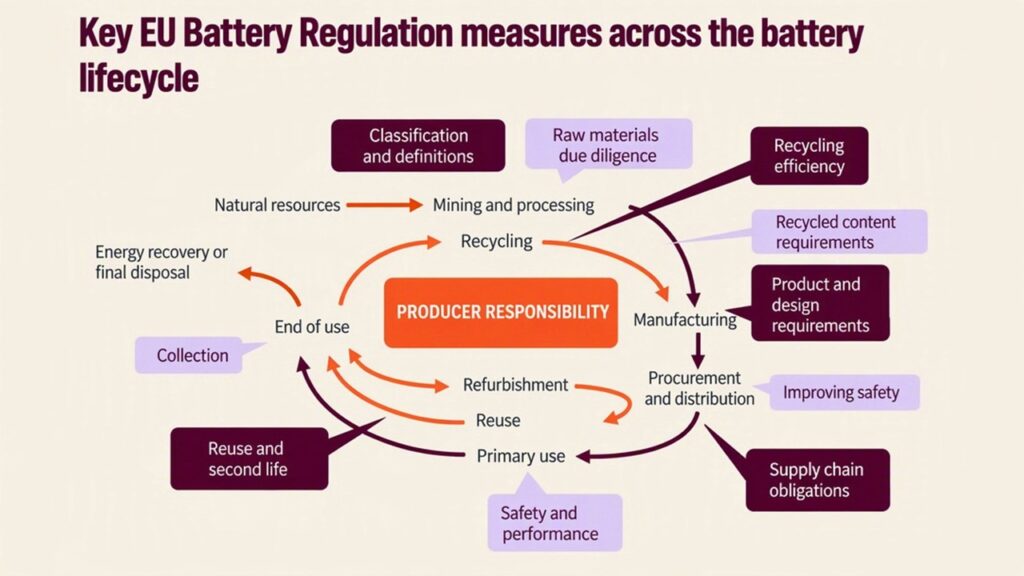
Source: European Commission, adapted.
Responsibilities are interlinked throughout the value chain
The Battery Regulation imposes obligations on the various actors in the value chain in accordance with their respective roles. Each actor must fulfil their own obligations and, in certain situations specified in the Regulation, must also verify that the preceding actor has fulfilled their obligation.
For example, before making a battery available on the market, a distributor must check, amongst other things, that the producer is registered in the producer register.
At the same time, the actions of the various operators in the value chain and the information they provide create the conditions for the next stage to be carried out in accordance with the requirements.
The circular economy only works when the entire chain functions properly.
Legislation governing producer responsibility
Producer responsibility for batteries in Finland is governed in particular by:
The provisions of Chapter VIII of the EU Battery Regulation concerning producer responsibility and the waste management of waste batteries have been applied since 18 August 2025.